Angelic Form-Builders
What are angelic form-builders? Compare Hodson’s account of crystals and plants with Challoner’s Builder of Form, a deva who responds to thought.
In this article
What is a form-builder?
Angelic form-builders are beings believed to guide a pattern as it takes physical shape. In Geoffrey Hodson’s Theosophy, creative intelligences direct the design and nature spirits work closer to the material. [1][2][3]
Hodson uses a germinating seed to illustrate how the work changes. One group acts as the shoot develops. Others arrive as the flower takes shape. [4][5]
The Kingdom of the Gods by Geoffrey Hodson
In The Kingdom of the Gods, Geoffrey Hodson asks how minerals acquire recurring geometrical shapes. He proposes that archangels apprehend a design and strengthen the formative influence he calls the creative Word. At the level closest to matter, nature spirits follow the resulting lines of force. [1][2][3]
In the account of plant growth, a germinating seed gives out a subtle signal, and the builders suited to particular stages respond. Hodson reports that flower fairies arrive as a bulb starts to bloom and stay while buds and petals develop. [4][5][6]
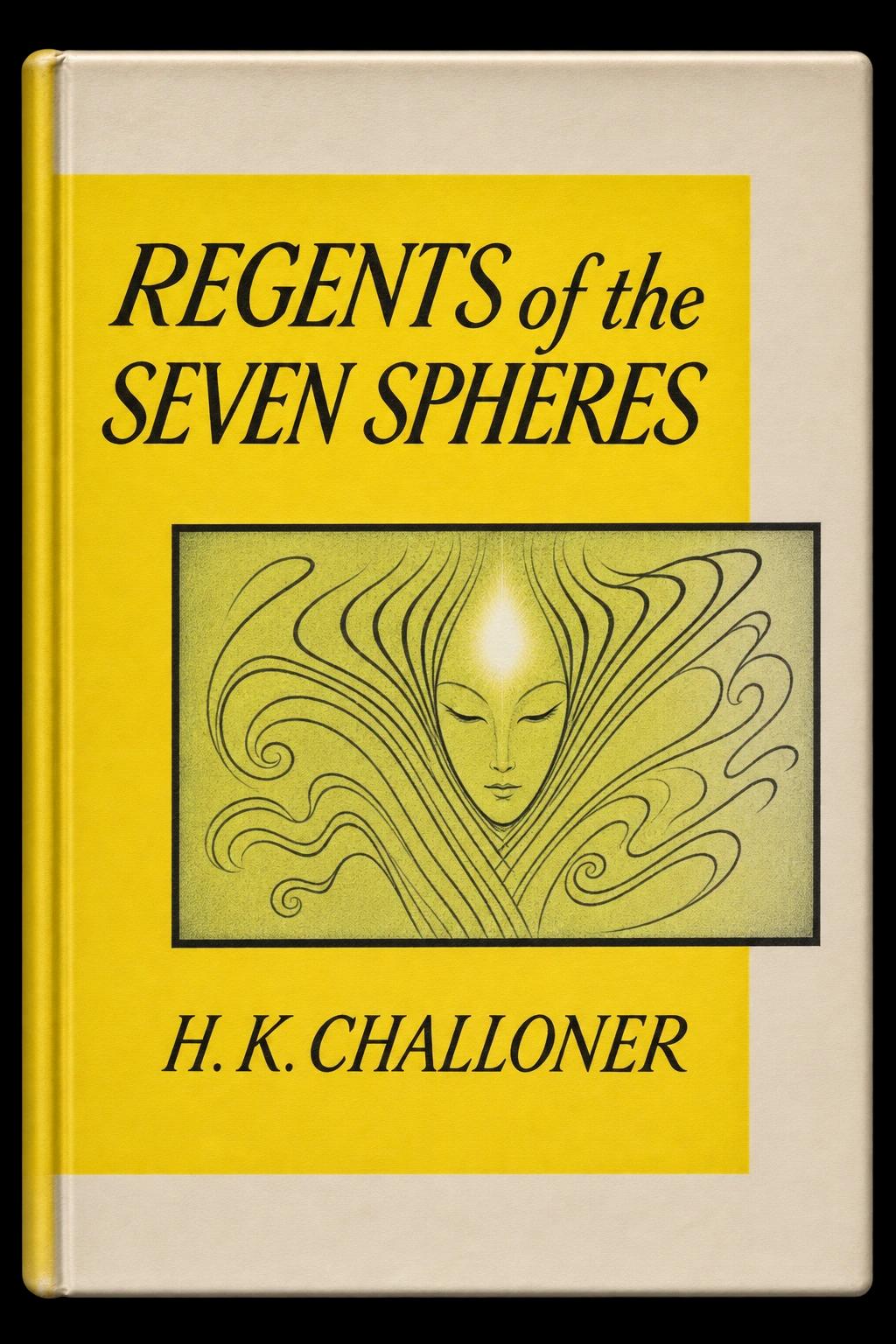
Watchers of the Seven Spheres by H. K. Challoner
In The Builder of Form, a poem in H. K. Challoner’s Watchers of the Seven Spheres, a deva responds to a call. It serves as a matrix that holds a creator’s imagined pattern while other lives and forces gather. The speaker gives that work a fixed allowance of force under karmic law. [11][12]
The things formed can be a child, a song or an empire. The Note of Form gives the builder a way to answer the impulse. The poem links the eventual form to the purpose that called it into being. [12][13][14][15]
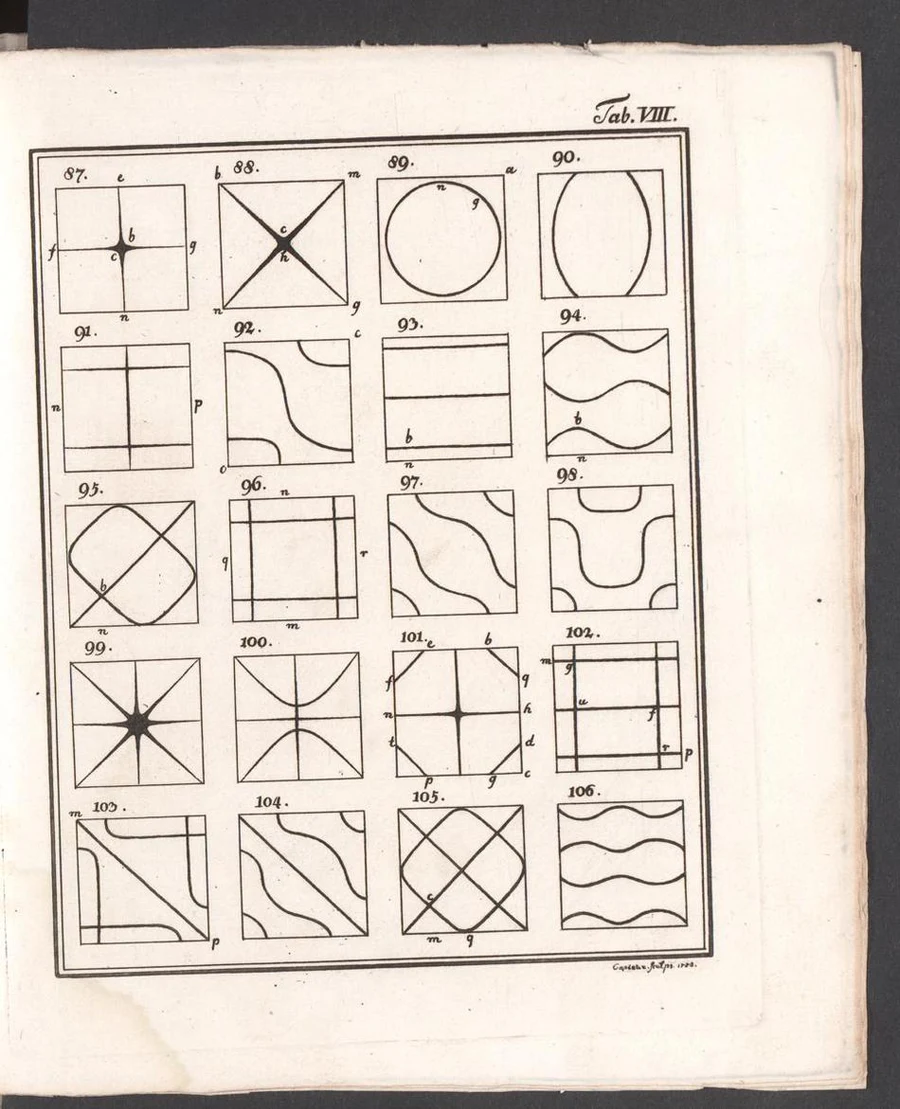
Chladni’s engraved patterns record what can happen to sand on a vibrating plate. Challoner’s Note of Form belongs to a different account of how an imagined shape begins to take form.
ETH-Bibliothek Zürich, Rar 5284. DOI 10.3931/e-rara-4235. Public Domain Mark. · Image source ↗ · Public Domain
Thought-Forms by Annie Besant and C. W. Leadbeater
In Thought-Forms, Annie Besant and C. W. Leadbeater depict forms said to arise above a church during music by Mendelssohn, Gounod and Wagner. The church provides a scale against which to read the shapes attributed to each piece. [7][8][9]
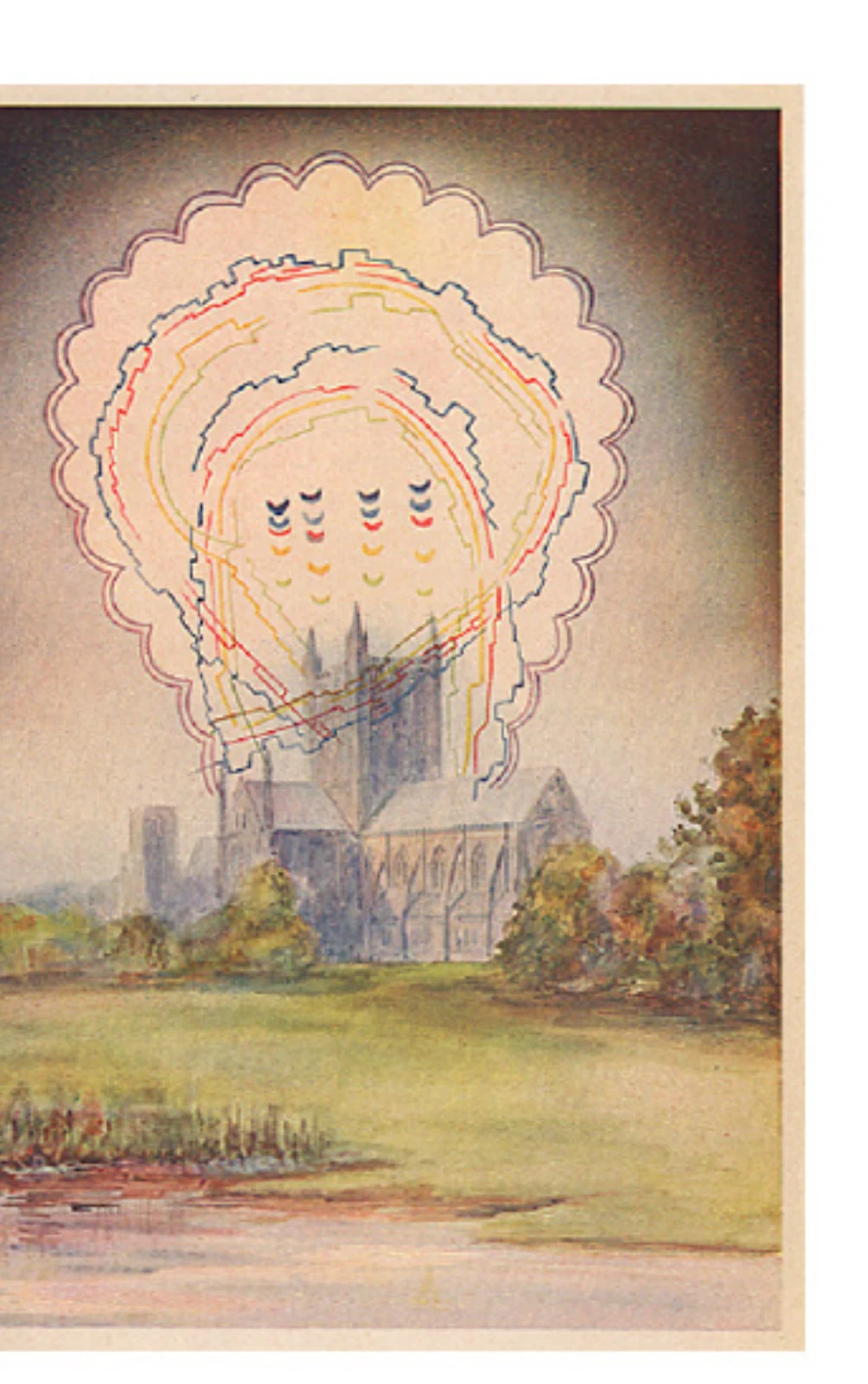
In the Mendelssohn plate from Thought-Forms, coloured bands rise above a church. The same building provides a scale across all three music plates.
Annie Besant and C. W. Leadbeater, Thought-Forms (1901). Historical public-domain plate retained from the Library edition. The artists’ interpretation is part of the book’s account. · Image source ↗ · Public Domain
How the accounts compare
Hodson assigns distinct tasks to intelligences shaping minerals and plants. Challoner gives the builder a voice and extends the idea to music and collective human activity. Her examples put more weight on the responsibility of whoever sets the process in motion. [11][12][13][15][1][2][3][4][5]
Besant and Leadbeater give each musical performance a different visible form. Hodson connects vibration to a mineral or plant’s development and assigns specific work to the beings he proposes. The shared imagery supports different accounts of what produces the shape. [7][8][9][2][4][5]
See references (12)
- The Kingdom of the Gods, Reader page 30
- The Kingdom of the Gods, Reader page 31
- The Kingdom of the Gods, Reader page 33
- The Kingdom of the Gods, Reader page 40
- The Kingdom of the Gods, Reader page 41
- Thought-Forms, Reader page 61
- Thought-Forms, Reader page 63
- Thought-Forms, Reader page 65
- Watchers of the Seven Spheres, Reader page 37
- Watchers of the Seven Spheres, Reader page 38
- Watchers of the Seven Spheres, printed p. 41, Reader page 39
- Watchers of the Seven Spheres, printed p. 43, Reader page 41
In the library
The Kingdom of the Gods
Reading note
The separately titled account draws on exact passages in the consulted Library edition.
Thought-Forms
Reading note
Separately attributed comparison with exact previously researched Library passages.
Watchers of the Seven Spheres
Reading note
The separately titled account draws on exact passages in the consulted Library edition.
Sources
See references (15)
- The Kingdom of the Gods, Reader page 30Geoffrey Hodson, The Kingdom of the Gods, Theosophical Publishing House, first published 1952, thirteenth reprint 2007. Lumitheca Library edition IMJ-0606-E001.Read this page in The Kingdom of the Gods ↗
- The Kingdom of the Gods, Reader page 31Geoffrey Hodson, The Kingdom of the Gods, Theosophical Publishing House, first published 1952, thirteenth reprint 2007. Lumitheca Library edition IMJ-0606-E001.Read this page in The Kingdom of the Gods ↗
- The Kingdom of the Gods, Reader page 33Geoffrey Hodson, The Kingdom of the Gods, Theosophical Publishing House, first published 1952, thirteenth reprint 2007. Lumitheca Library edition IMJ-0606-E001.Read this page in The Kingdom of the Gods ↗
- The Kingdom of the Gods, Reader page 40Geoffrey Hodson, The Kingdom of the Gods, Theosophical Publishing House, first published 1952, thirteenth reprint 2007. Lumitheca Library edition IMJ-0606-E001.Read this page in The Kingdom of the Gods ↗
- The Kingdom of the Gods, Reader page 41Geoffrey Hodson, The Kingdom of the Gods, Theosophical Publishing House, first published 1952, thirteenth reprint 2007. Lumitheca Library edition IMJ-0606-E001.Read this page in The Kingdom of the Gods ↗
- The Kingdom of the Gods, Reader page 42Geoffrey Hodson, The Kingdom of the Gods, Theosophical Publishing House, first published 1952, thirteenth reprint 2007. Lumitheca Library edition IMJ-0606-E001.Read this page in The Kingdom of the Gods ↗
- Thought-Forms, Reader page 61Exact source retained from the earlier attributed Thought-forms account.Read this page in Thought-Forms ↗
- Thought-Forms, Reader page 63Exact source retained from the earlier attributed Thought-forms account.Read this page in Thought-Forms ↗
- Thought-Forms, Reader page 65Exact source retained from the earlier attributed Thought-forms account.Read this page in Thought-Forms ↗
- Ernst Chladni, Entdeckungen über die Theorie des Klanges, plate VIII (1787) ↗ETH-Bibliothek Zürich, Rar 5284. DOI 10.3931/e-rara-4235. Public Domain Mark.
- Watchers of the Seven Spheres, Reader page 37H. K. Challoner, Watchers of the Seven Spheres, London, George Routledge & Sons, 1933. Lumitheca Library edition IMJ-0604-E001.Read this page in Watchers of the Seven Spheres ↗
- Watchers of the Seven Spheres, Reader page 38H. K. Challoner, Watchers of the Seven Spheres, London, George Routledge & Sons, 1933. Lumitheca Library edition IMJ-0604-E001.Read this page in Watchers of the Seven Spheres ↗
- Watchers of the Seven Spheres, printed p. 41, Reader page 39H. K. Challoner, Watchers of the Seven Spheres, London, George Routledge & Sons, 1933. Lumitheca Library edition IMJ-0604-E001.Read this page in Watchers of the Seven Spheres ↗
- Watchers of the Seven Spheres, printed p. 42, Reader page 40H. K. Challoner, Watchers of the Seven Spheres, London, George Routledge & Sons, 1933. Lumitheca Library edition IMJ-0604-E001.Read this page in Watchers of the Seven Spheres ↗
- Watchers of the Seven Spheres, printed p. 43, Reader page 41H. K. Challoner, Watchers of the Seven Spheres, London, George Routledge & Sons, 1933. Lumitheca Library edition IMJ-0604-E001.Read this page in Watchers of the Seven Spheres ↗