Ahaṃkāra
Ahaṃkāra is the function that makes experience feel like mine. Explore how Avalon distinguishes it from attention and judgment.
In this article
The “I-maker”
Ahaṃkāra is the “I-maker” in Indian accounts of mind. It is the faculty by which a perception concerns me or an action becomes something I do. Arthur Avalon describes it as one part of the mental process through which experience acquires a personal point of view. [2][3][4]
The Serpent Power in Arthur Avalon’s translation
In The Serpent Power, Arthur Avalon distinguishes three functions. Manas attends to what the senses present. Ahaṃkāra makes the matter personally relevant. Buddhi determines what it is or decides what to do. His example separates noticing something, recognising one’s involvement and deciding to act. [5][2][3][4]
Avalon also discusses citta in the sense of recollection. Remembering an earlier experience is a different function from referring a present impression to oneself. The distinction helps explain how several faculties work together. [2][6][4]
The verse on Ājñā places manas at the brow lotus. Avalon’s introduction describes the inner instrument there in a broader sense, including ahaṃkāra. [7][8]
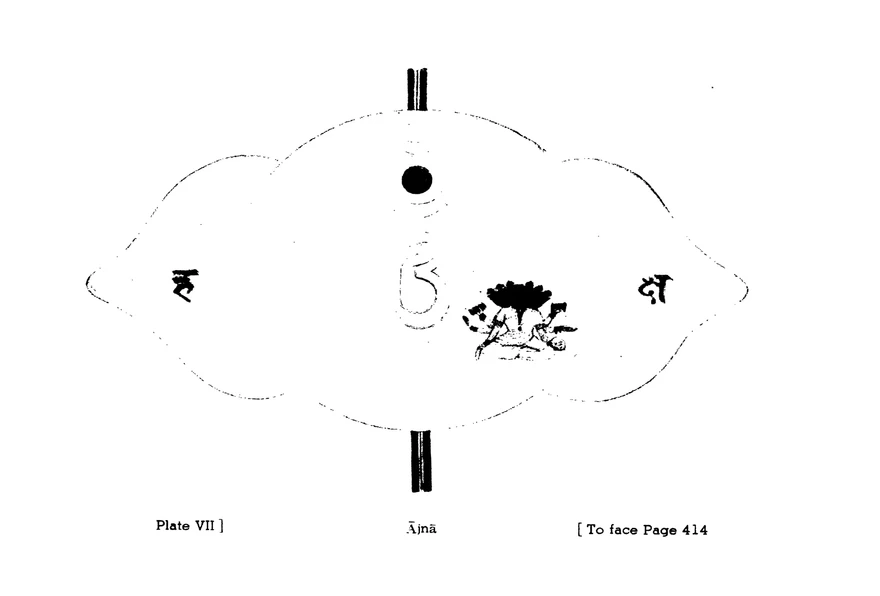
Plate VII shows Ājñā, the brow lotus. Pūrṇānanda’s verse places manas there, and Avalon’s introduction discusses the wider group of mental faculties.
Illustrator unrecorded. The Serpent Power, Plate VII. Library facsimile, compared with the 1924 second edition. · Image source ↗ · Public Domain
See references (7)
- The Serpent Power, printed p. 62, Reader page 78
- The Serpent Power, printed p. 63, Reader page 79
- The Serpent Power, printed p. 65, Reader page 81
- The Serpent Power, printed p. 61, Reader page 77
- The Serpent Power, printed p. 64, Reader page 80
- The Serpent Power, Reader page 141
- The Serpent Power, printed p. 398, Reader page 416
Ahaṃkāra and the individual self
Jīvātman names the individual self as embodied consciousness. Ahaṃkāra gives a particular impression a personal reference. One term names the one who experiences, and the other helps explain why an experience feels like mine. [9][10][2][4]
In the library
The Serpent Power
Reading note
Separately attributed primary Library account, cited on exact verified Reader leaves.
Sources
See references (10)
- The Serpent Power, Plate VII, Reader page 433Illustrator unrecorded. The Serpent Power, Plate VII. Library facsimile, compared with the 1924 second edition.Read this page in The Serpent Power ↗
- The Serpent Power, printed p. 62, Reader page 78Arthur Avalon (Sir John Woodroffe), The Serpent Power, fifth enlarged edition, Ganesh & Co., Madras, 1953. Includes Pūrṇānanda’s Ṣaṭ-cakra-nirūpaṇa, Pādukā-pañcaka and Kālīcaraṇa’s commentary. Exact Library edition IMJ-0608-E001.Read this page in The Serpent Power ↗
- The Serpent Power, printed p. 63, Reader page 79Arthur Avalon (Sir John Woodroffe), The Serpent Power, fifth enlarged edition, Ganesh & Co., Madras, 1953. Includes Pūrṇānanda’s Ṣaṭ-cakra-nirūpaṇa, Pādukā-pañcaka and Kālīcaraṇa’s commentary. Exact Library edition IMJ-0608-E001.Read this page in The Serpent Power ↗
- The Serpent Power, printed p. 65, Reader page 81Arthur Avalon (Sir John Woodroffe), The Serpent Power, fifth enlarged edition, Ganesh & Co., Madras, 1953. Includes Pūrṇānanda’s Ṣaṭ-cakra-nirūpaṇa, Pādukā-pañcaka and Kālīcaraṇa’s commentary. Exact Library edition IMJ-0608-E001.Read this page in The Serpent Power ↗
- The Serpent Power, printed p. 61, Reader page 77Arthur Avalon (Sir John Woodroffe), The Serpent Power, fifth enlarged edition, Ganesh & Co., Madras, 1953. Includes Pūrṇānanda’s Ṣaṭ-cakra-nirūpaṇa, Pādukā-pañcaka and Kālīcaraṇa’s commentary. Exact Library edition IMJ-0608-E001.Read this page in The Serpent Power ↗
- The Serpent Power, printed p. 64, Reader page 80Arthur Avalon (Sir John Woodroffe), The Serpent Power, fifth enlarged edition, Ganesh & Co., Madras, 1953. Includes Pūrṇānanda’s Ṣaṭ-cakra-nirūpaṇa, Pādukā-pañcaka and Kālīcaraṇa’s commentary. Exact Library edition IMJ-0608-E001.Read this page in The Serpent Power ↗
- The Serpent Power, Reader page 141Arthur Avalon (Sir John Woodroffe), The Serpent Power, fifth enlarged edition, Ganesh & Co., Madras, 1953. Includes Pūrṇānanda’s Ṣaṭ-cakra-nirūpaṇa, Pādukā-pañcaka and Kālīcaraṇa’s commentary. Exact Library edition IMJ-0608-E001.Read this page in The Serpent Power ↗
- The Serpent Power, printed p. 398, Reader page 416Arthur Avalon (Sir John Woodroffe), The Serpent Power, fifth enlarged edition, Ganesh & Co., Madras, 1953. Includes Pūrṇānanda’s Ṣaṭ-cakra-nirūpaṇa, Pādukā-pañcaka and Kālīcaraṇa’s commentary. Exact Library edition IMJ-0608-E001.Read this page in The Serpent Power ↗
- The Serpent Power, Reader page 65Arthur Avalon (Sir John Woodroffe), The Serpent Power, fifth enlarged edition, Ganesh & Co., Madras, 1953. Includes Pūrṇānanda’s Ṣaṭ-cakra-nirūpaṇa, Pādukā-pañcaka and Kālīcaraṇa’s commentary. Exact Library edition IMJ-0608-E001.Read this page in The Serpent Power ↗
- The Serpent Power, Reader page 67Arthur Avalon (Sir John Woodroffe), The Serpent Power, fifth enlarged edition, Ganesh & Co., Madras, 1953. Includes Pūrṇānanda’s Ṣaṭ-cakra-nirūpaṇa, Pādukā-pañcaka and Kālīcaraṇa’s commentary. Exact Library edition IMJ-0608-E001.Read this page in The Serpent Power ↗