Agni
Agni is the Vedic god of fire and priest of sacrifice. Explore the opening hymn of the Rigveda, Agni’s birth stories and the sculpture of his goat mount.
In this article
Who is Agni?
Agni is the Vedic god of fire. In the opening hymn of the Rigveda, he acts as a divine priest, bringing the gods to the place of sacrifice and carrying an offering to them. Stories about his birth also find him in the hearth, in lightning and in the act of making fire. [1][3][4][2]
Agni in Rigveda 1.1
Rigveda 1.1 opens by praising Agni as priest and minister of sacrifice. In Ralph T. H. Griffith’s translation, earlier seers and present worshippers both invoke him. Their offering reaches the gods through his care. [1]
The worshippers approach daily with reverence. In the final verse they ask Agni to be as easy to approach as a father is to his son. [1]
Indian Myth and Legend by Donald A. Mackenzie
Donald A. Mackenzie’s Indian Myth and Legend introduces Agni as the divine priest alongside Indra the warrior. Some of the birth stories he collects make fire-making into kinship: the newborn consumes its wooden parents, and Mackenzie interprets the ten mothers as the fingers that bring fire to life. [3][4]
Mackenzie quotes a worshipper imagining what they would give Agni if they could exchange places. He sets it beside the Scottish verse about Martin Elginbrodde, another prayer that asks a god for the generosity the speaker imagines offering in return. [5][6]
He also compares Agni with Heimdal and Scyld. His parallels come from features such as unusual births, a shining appearance and associations with water. [4][7][8]
Agni in historical art
The Cleveland Museum of Art’s sandstone Agni dates to about 1000. Flames rise behind the god, and his mount, a goat, is visible below him. Figures in the upper registers perform a fire sacrifice and teach. The museum identifies the god and his mount with the southeast. [2]
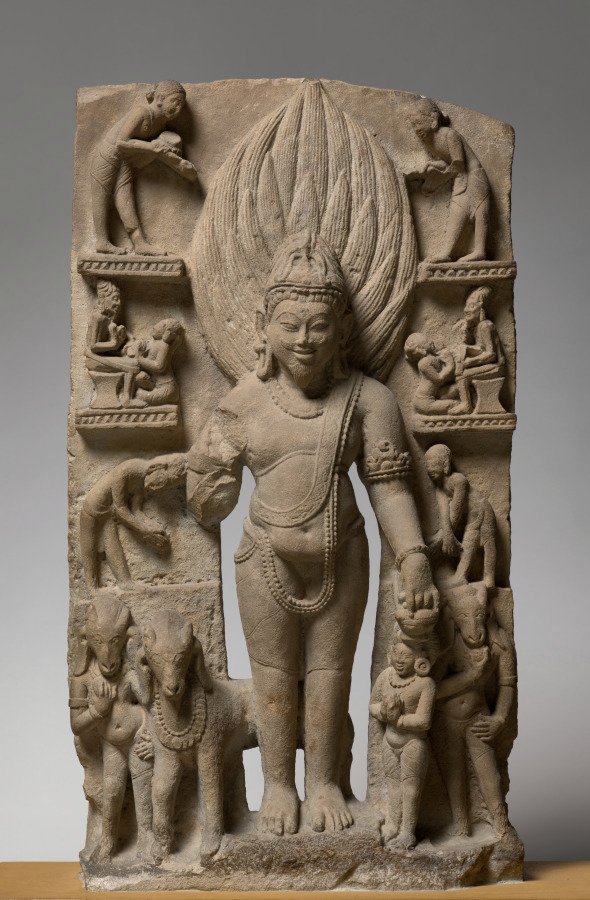
Agni with flames and his goat mount, carved in Uttar Pradesh around 1000. Smaller figures perform rites around him.
The Cleveland Museum of Art, Edward L. Whittemore Fund, 1955.51. CC0; resized and converted to JPEG. · Image source ↗ · CC0
Fire as a god and a ritual act
The hymn praises the fire that carries the worshippers’ offering. The birth stories give a family to the fire someone makes by hand. In the sculpture, the god stands among the people whose acts give the sacrificial fire its place. [4][5][1][2]
Read further in the library
Indian Myth and Legend
Reading note
The separately titled account draws on exact passages in the consulted Library edition.
Sources
See references (8)
- Rigveda 1.1, verses 1–9, translated by Ralph T. H. Griffith ↗Primary hymn, complete nine verses and displayed notes directly read. Griffith’s historical English translation is distinguished from the Sanskrit text and from Mackenzie’s composite quotations. Cached locally as primary-rv-1-1.html.Return to text ↑
- Agni, God of Fire, c. 1000 ↗The Cleveland Museum of Art, Edward L. Whittemore Fund, 1955.51. CC0; resized and converted to JPEG.Return to text ↑
- Indian Myth and Legend, Reader page 78Donald A. Mackenzie, Indian Myth and Legend, Gresham Publishing Company Limited, London, undated consulted impression. Library edition IMJ-0649-E001. Persistent PageIDs and current Reader positions verified against the supplied PDF and cached Reader manifest. Embedded translations are Mackenzie’s presentation unless a separately consulted primary text is named.Read this page in Indian Myth and Legend ↗Return to text ↑
- Indian Myth and Legend, Reader page 79Donald A. Mackenzie, Indian Myth and Legend, Gresham Publishing Company Limited, London, undated consulted impression. Library edition IMJ-0649-E001. Persistent PageIDs and current Reader positions verified against the supplied PDF and cached Reader manifest. Embedded translations are Mackenzie’s presentation unless a separately consulted primary text is named.Read this page in Indian Myth and Legend ↗Return to text ↑
- Indian Myth and Legend, Reader page 83Donald A. Mackenzie, Indian Myth and Legend, Gresham Publishing Company Limited, London, undated consulted impression. Library edition IMJ-0649-E001. Persistent PageIDs and current Reader positions verified against the supplied PDF and cached Reader manifest. Embedded translations are Mackenzie’s presentation unless a separately consulted primary text is named.Read this page in Indian Myth and Legend ↗Return to text ↑
- Indian Myth and Legend, Reader page 84Donald A. Mackenzie, Indian Myth and Legend, Gresham Publishing Company Limited, London, undated consulted impression. Library edition IMJ-0649-E001. Persistent PageIDs and current Reader positions verified against the supplied PDF and cached Reader manifest. Embedded translations are Mackenzie’s presentation unless a separately consulted primary text is named.Read this page in Indian Myth and Legend ↗Return to text ↑
- Indian Myth and Legend, Reader page 81Donald A. Mackenzie, Indian Myth and Legend, Gresham Publishing Company Limited, London, undated consulted impression. Library edition IMJ-0649-E001. Persistent PageIDs and current Reader positions verified against the supplied PDF and cached Reader manifest. Embedded translations are Mackenzie’s presentation unless a separately consulted primary text is named.Read this page in Indian Myth and Legend ↗Return to text ↑
- Indian Myth and Legend, Reader page 82Donald A. Mackenzie, Indian Myth and Legend, Gresham Publishing Company Limited, London, undated consulted impression. Library edition IMJ-0649-E001. Persistent PageIDs and current Reader positions verified against the supplied PDF and cached Reader manifest. Embedded translations are Mackenzie’s presentation unless a separately consulted primary text is named.Read this page in Indian Myth and Legend ↗Return to text ↑