Active Imagination in Jung’s Analytical Psychology
Active imagination is Jung’s method for engaging with images or scenes that arise spontaneously. He describes giving an image time and form, then considering how the conscious personality will respond to it.
In this article
What is active imagination?
Active imagination is a method in C. G. Jung’s analytical psychology for engaging with an image or scene that arises spontaneously. A person might give it form through writing or drawing and then consider what it expresses. The active part includes how the person responds to the point of view that takes shape. [1][2][5]
Making room for images in Jung’s Golden Flower commentary
In his commentary on The Secret of the Golden Flower, Jung describes how easily a person can dismiss a passing image before it develops. His examples include people who write, draw or model forms they did not expect to produce. The image needs time to take shape before it can be considered. [1][2]
Jung makes the value of letting things happen depend on the person’s circumstances. He distinguishes someone already overwhelmed by events from someone who finds it hard to relinquish control. In his account, a symbol can express a changing relationship between conscious experience and unconscious material. [3][4]
Responding to the image in The Transcendent Function
In The Transcendent Function, Jung asks what happens once an image has been given form. The conscious person weighs what it expresses against their own position. He calls the process through which the two positions can give rise to a new standpoint the transcendent function. [5][2]
Giving an inherited image a visual form
William Blake gives the red dragon and the woman from Revelation a particular form in watercolour. The painting shows how much shape and emphasis an artist can give an image. Jung’s examples concern a different use of drawing, making a spontaneous fantasy visible enough to respond to it. [6][2]
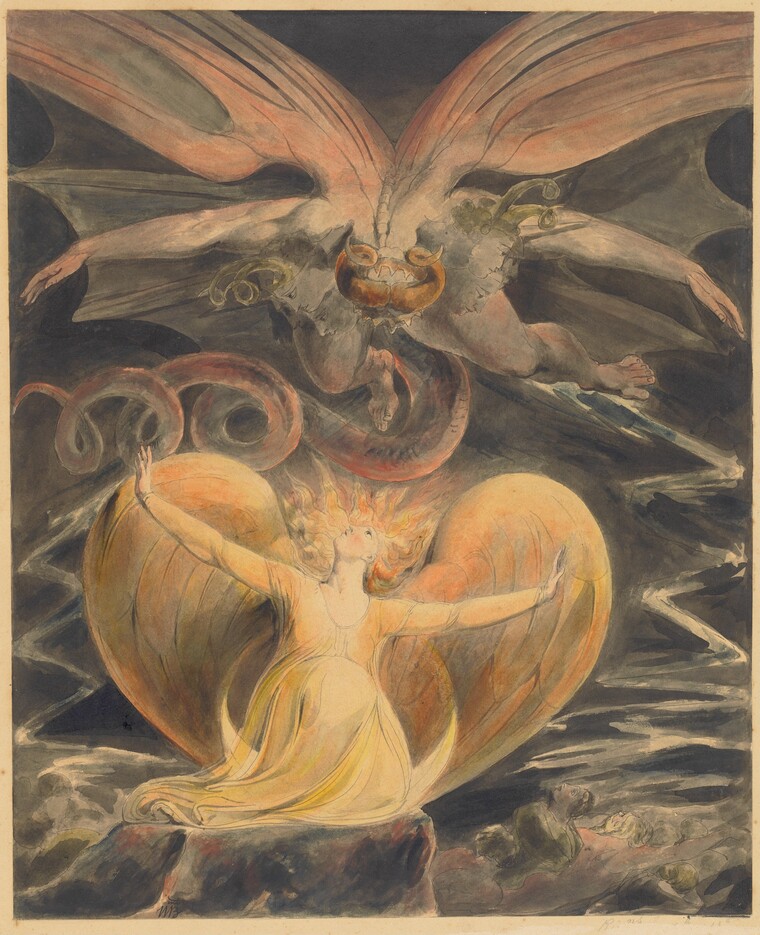
William Blake, The Great Red Dragon and the Woman Clothed with the Sun, c. 1805. Blake gives visual form to a biblical scene through watercolor and ink.
National Gallery of Art, Rosenwald Collection, 1943.3.8999. Public domain. · Image source ↗ · CC0
In the library
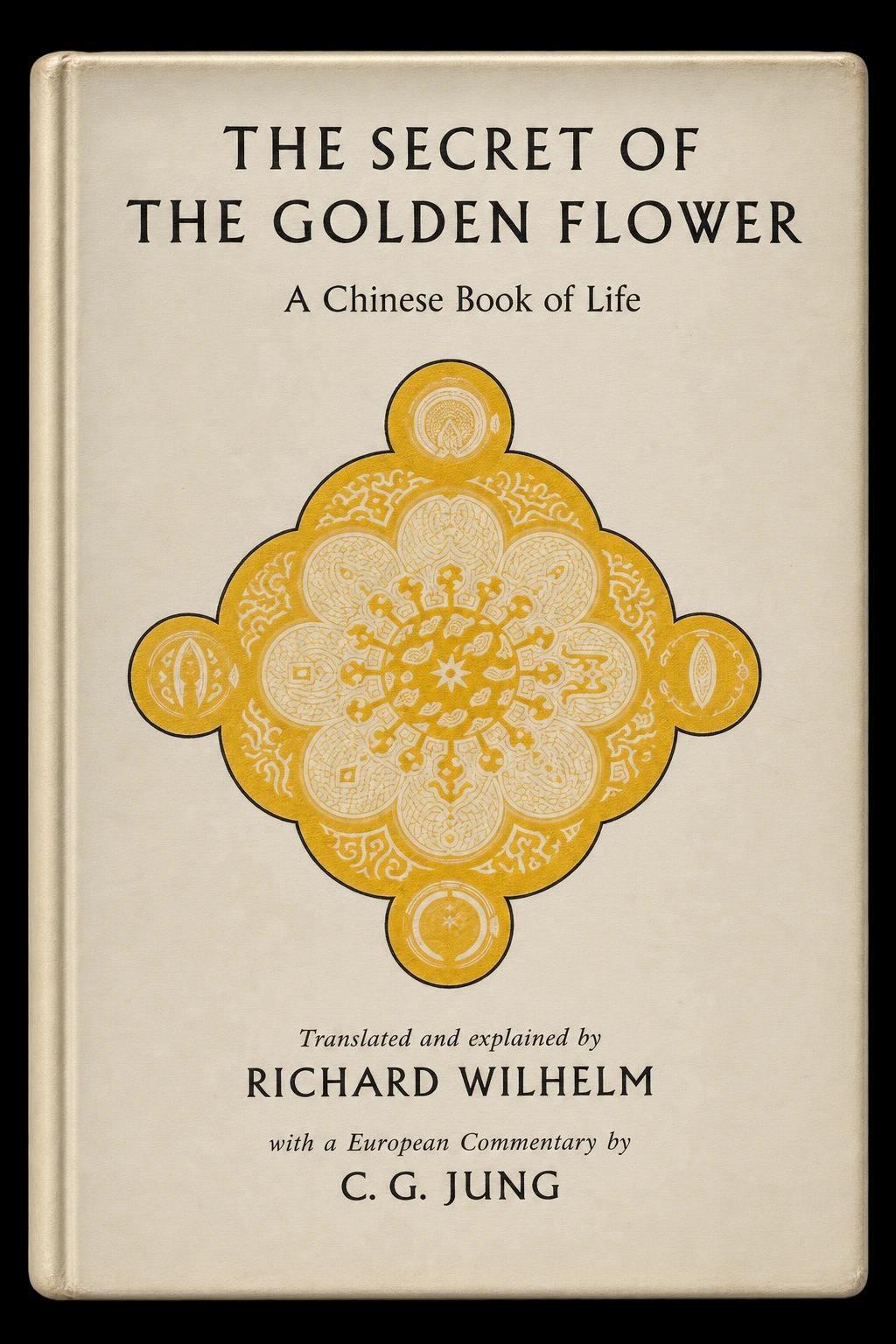
The Secret of the Golden Flower
Reading note
Read the account of Active Imagination in Jung’s commentary in the Wilhelm and Baynes edition.
Sources
See references (6)
- The Secret of the Golden Flower, printed p. 90, Reader page 89The Secret of the Golden Flower: A Chinese Book of Life. Chinese text translated and explained by Richard Wilhelm, English translation by Cary F. Baynes, with separate commentary by C. G. Jung. London, Kegan Paul, Trench, Trubner & Co. Lumitheca Library edition IMJ-0596-E001.Read this page in The Secret of the Golden Flower ↗
- The Secret of the Golden Flower, printed p. 91, Reader page 90The Secret of the Golden Flower: A Chinese Book of Life. Chinese text translated and explained by Richard Wilhelm, English translation by Cary F. Baynes, with separate commentary by C. G. Jung. London, Kegan Paul, Trench, Trubner & Co. Lumitheca Library edition IMJ-0596-E001.Read this page in The Secret of the Golden Flower ↗
- The Secret of the Golden Flower, printed p. 92, Reader page 91The Secret of the Golden Flower: A Chinese Book of Life. Chinese text translated and explained by Richard Wilhelm, English translation by Cary F. Baynes, with separate commentary by C. G. Jung. London, Kegan Paul, Trench, Trubner & Co. Lumitheca Library edition IMJ-0596-E001.Read this page in The Secret of the Golden Flower ↗
- The Secret of the Golden Flower, printed p. 106, Reader page 104The Secret of the Golden Flower: A Chinese Book of Life. Chinese text translated and explained by Richard Wilhelm, English translation by Cary F. Baynes, with separate commentary by C. G. Jung. London, Kegan Paul, Trench, Trubner & Co. Lumitheca Library edition IMJ-0596-E001.Read this page in The Secret of the Golden Flower ↗
- The Transcendent Function, §§ 181–182 ↗C. G. Jung, translated by R. F. C. Hull, Collected Works 8, Princeton University Press.
- The Great Red Dragon and the Woman Clothed with the Sun ↗National Gallery of Art, Rosenwald Collection, 1943.3.8999. Public domain.