The Collective Unconscious in Jung’s Analytical Psychology
The collective unconscious is C. G. Jung’s theory that people inherit tendencies to form certain kinds of images and responses. He called the underlying patterns archetypes and distinguished them from forgotten or repressed personal experience.
In this article
What is the collective unconscious?
The collective unconscious is C. G. Jung’s theory that people share inherited dispositions that shape imagination. He calls the underlying patterns archetypes. The same pattern can take different forms in a dream, a myth or a drawing. In his model, memories and impressions particular to one life belong to the personal unconscious. [1][2][7]
The collective unconscious in Jung’s Golden Flower commentary
In his commentary on The Secret of the Golden Flower, Jung compares its images with material he encountered through patients unfamiliar with Chinese philosophy. He takes the resemblance as a reason to propose a shared basis for some patterns of thought and feeling. He also asks what happens when conscious life loses contact with those patterns. [1][2][3]
Jung discusses a warning from the Hui Ming Jing, a separate Daoist source, against becoming absorbed in colours and figures. He interprets it as a way to reduce the hold of disturbing images. He treats their psychological effects as a question he can address without settling what the images are beyond the psyche. [5][6]
See references (5)
- The Secret of the Golden Flower, printed p. 83, Reader page 82
- The Secret of the Golden Flower, printed p. 84, Reader page 83
- The Secret of the Golden Flower, printed p. 85, Reader page 84
- The Secret of the Golden Flower, Jung’s section on the disintegration of consciousness, Reader page 105
- The Secret of the Golden Flower, printed p. 107, Reader page 106
How Jung defined it in his 1936 lecture
In his 1936 lecture, Jung separates forgotten or repressed experiences from the archetypal patterns he considers inherited. He proposes an inherited capacity to form certain kinds of image. The stories and pictures that result can vary with the person and their culture. [7][1][2]
An example of a repeated visual form
In this English psalter fragment, Christ sits at the centre and the emblems of the four evangelists occupy the corners. Jung used this kind of arrangement in his comparisons with other centred images. The manuscript gives the arrangement a specific Christian subject. [8][4]
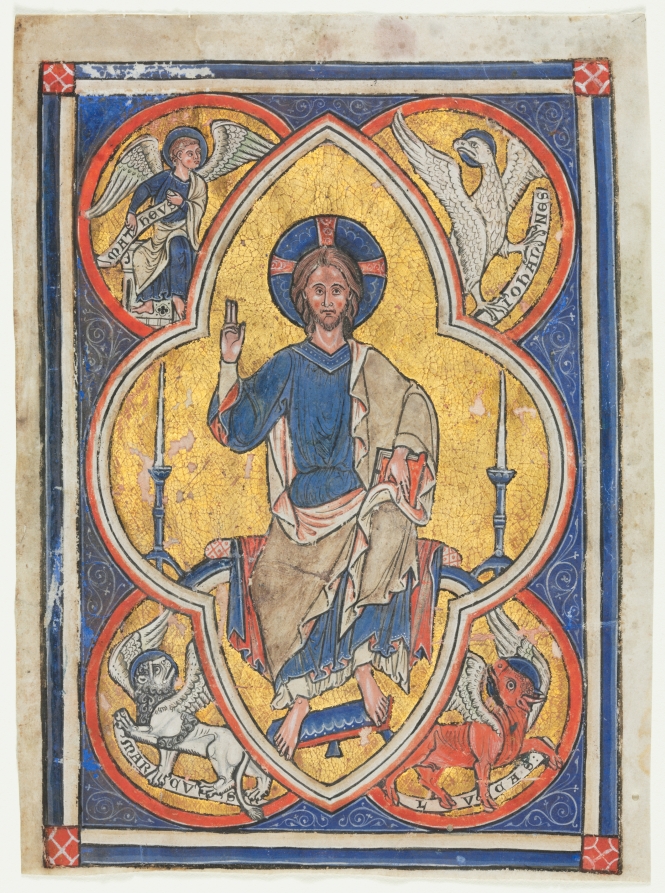
Christ in Majesty with Symbols of the Four Evangelists, Peterborough, England, c. 1235. A historical example of the kind of centred Christian image Jung discusses, from a separate work.
Cleveland Museum of Art, open access image, accession 1945.132. CC0. · Image source ↗ · CC0
In the library
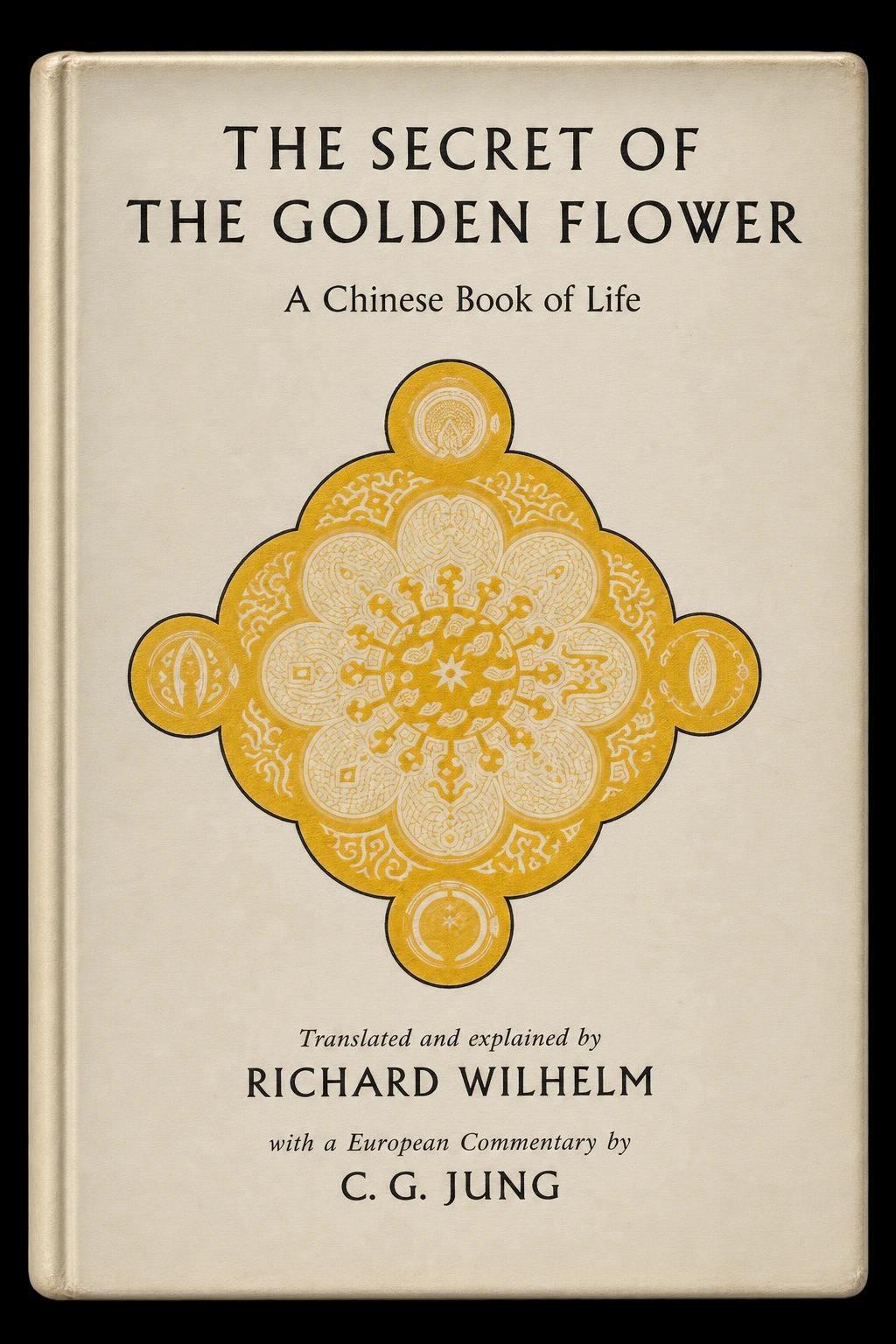
The Secret of the Golden Flower
Reading note
Read the account of Collective Unconscious in Jung’s commentary in the Wilhelm and Baynes edition.
Sources
See references (8)
- The Secret of the Golden Flower, printed p. 83, Reader page 82The Secret of the Golden Flower: A Chinese Book of Life. Chinese text translated and explained by Richard Wilhelm, English translation by Cary F. Baynes, with separate commentary by C. G. Jung. London, Kegan Paul, Trench, Trubner & Co. Lumitheca Library edition IMJ-0596-E001.Read this page in The Secret of the Golden Flower ↗
- The Secret of the Golden Flower, printed p. 84, Reader page 83The Secret of the Golden Flower: A Chinese Book of Life. Chinese text translated and explained by Richard Wilhelm, English translation by Cary F. Baynes, with separate commentary by C. G. Jung. London, Kegan Paul, Trench, Trubner & Co. Lumitheca Library edition IMJ-0596-E001.Read this page in The Secret of the Golden Flower ↗
- The Secret of the Golden Flower, printed p. 85, Reader page 84The Secret of the Golden Flower: A Chinese Book of Life. Chinese text translated and explained by Richard Wilhelm, English translation by Cary F. Baynes, with separate commentary by C. G. Jung. London, Kegan Paul, Trench, Trubner & Co. Lumitheca Library edition IMJ-0596-E001.Read this page in The Secret of the Golden Flower ↗
- The Secret of the Golden Flower, printed p. 97, Reader page 96The Secret of the Golden Flower: A Chinese Book of Life. Chinese text translated and explained by Richard Wilhelm, English translation by Cary F. Baynes, with separate commentary by C. G. Jung. London, Kegan Paul, Trench, Trubner & Co. Lumitheca Library edition IMJ-0596-E001.Read this page in The Secret of the Golden Flower ↗
- The Secret of the Golden Flower, Jung’s section on the disintegration of consciousness, Reader page 105The Secret of the Golden Flower: A Chinese Book of Life. Chinese text translated and explained by Richard Wilhelm, English translation by Cary F. Baynes, with separate commentary by C. G. Jung. London, Kegan Paul, Trench, Trubner & Co. Lumitheca Library edition IMJ-0596-E001.Read this page in The Secret of the Golden Flower ↗
- The Secret of the Golden Flower, printed p. 107, Reader page 106The Secret of the Golden Flower: A Chinese Book of Life. Chinese text translated and explained by Richard Wilhelm, English translation by Cary F. Baynes, with separate commentary by C. G. Jung. London, Kegan Paul, Trench, Trubner & Co. Lumitheca Library edition IMJ-0596-E001.Read this page in The Secret of the Golden Flower ↗
- The Concept of the Collective Unconscious, paragraphs 88–91 ↗C. G. Jung, lecture delivered in 1936, translated by R. F. C. Hull, Collected Works 9, Part 1.
- Miniature Excised from a Psalter: Christ in Majesty with Symbols of the Four Evangelists ↗Cleveland Museum of Art, open access image, accession 1945.132. CC0.