Yugas
The four yugas are Satya, Treta, Dvapara and Kali. See their traditional durations and how Hindu texts imagine change and renewal across the ages.
In this article
What are the four yugas?
A yuga is an age of the world in Hindu accounts of time. Four ages form a cycle: Satya or Krita, Treta, Dvapara and Kali. Conditions change from one age to the next, including the strength of dharma. In the scheme described here, a kalpa contains a thousand complete four-age cycles, and a manvantara is the period governed by one Manu. [5][6][7][2][8][1]
See references (6)
- Bhagavata Purana 3.11.18, translated and explained by A. C. Bhaktivedanta Swami Prabhupada
- Bhagavata Purana 3.11.19, translated and explained by A. C. Bhaktivedanta Swami Prabhupada
- Indian Myth and Legend, Reader page 175
- Indian Myth and Legend, Reader page 179
- Indian Myth and Legend, Reader page 180
- Indian Myth and Legend, Reader page 176
Age lengths in Bhagavata Purana 3.11.18–20
In the Bhāgavata Purāṇa 3.11.18–19, as translated and explained by A. C. Bhaktivedanta Swami Prabhupada, Satya lasts 1,728,000 human years, Treta 1,296,000, Dvapara 864,000 and Kali 432,000. Together they make 4,320,000 human years, or 12,000 divine years in this calculation. [1][2]
Verse 3.11.20 describes a transition at the beginning and end of each age. The duration of an age can include these margins as well as its central period. [3][2]
Indian Myth and Legend by Donald A. Mackenzie
In Indian Myth and Legend, Donald A. Mackenzie distinguishes the earlier use of yuga for an age or generation from the developed four-age system. His table gives 4,800, 3,600, 2,400 and 1,200 divine years including the transitions. He describes a thousand cycles as a day of Brahmā, with fourteen Manus in that day and another creation after the equally long night. [5][8]
When Bhima asks Hanuman to show him the enormous form with which he crossed the sea, Hanuman says the age has changed and he has changed with it. His account of Krita imagines a society without poverty or compulsory labour. The later ages bring declining virtue and divided knowledge. [6][7]
In another story, Markandeya survives fire and flood and finds a child on a celestial bed in a banyan tree. The child invites him inside his body, where the sage sees an inhabited world. The child identifies himself as Nārāyaṇa. Creation returns after the dissolution. [9][10][11][12]
Two passages in Mackenzie give different colour sequences. Hanuman’s speech assigns red to Treta and yellow to Dvapara. The later divine speech assigns yellow to Treta and red to Dvapara. Both begin with white and end with a dark colour. [7][11]
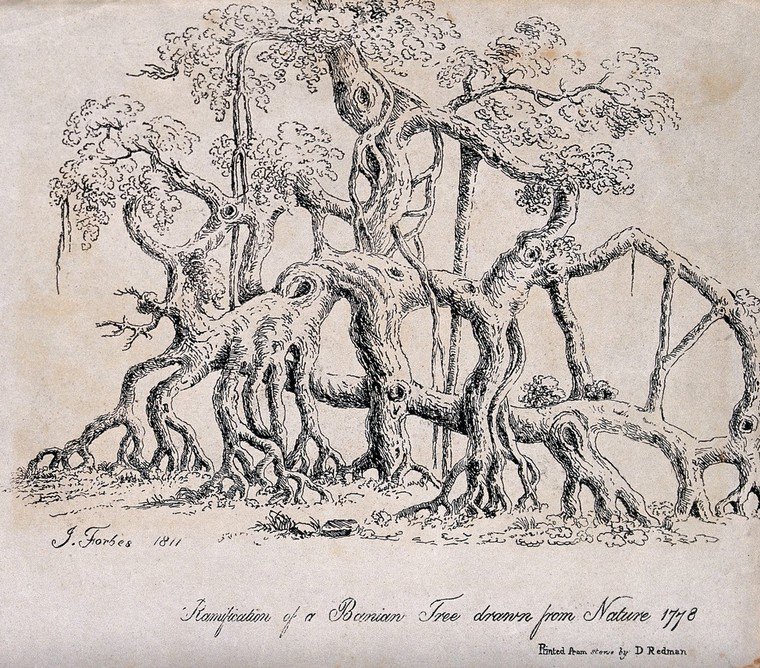
The banyan in an 1811 lithograph after James Forbes. Mackenzie describes Markandeya finding a celestial bed among the branches of a banyan.
Wellcome Collection, 20052i, image V0043038. W. Stoker after James Forbes; printed by D. Redman, 1811. Public Domain Mark; resized and converted to JPEG. · Image source ↗ · Public Domain
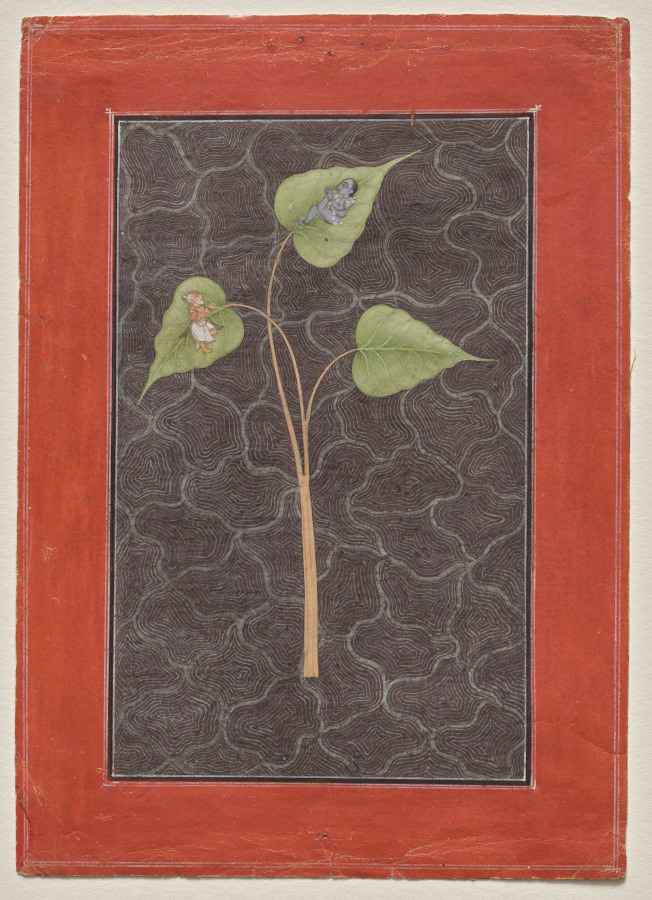
In this painting from around 1680, Markandeya sees the infant Krishna on a leaf above the cosmic ocean. The painting gives the vision a different setting from Mackenzie’s celestial bed.
Cleveland Museum of Art, Gift of Dr. and Mrs. Sherman E. Lee, 1967.241. CC0. · Image source ↗ · CC0
See references (8)
- Indian Myth and Legend, Reader page 175
- Indian Myth and Legend, Reader page 179
- Indian Myth and Legend, Reader page 180
- Indian Myth and Legend, Reader page 176
- Indian Myth and Legend, Reader page 185
- Indian Myth and Legend, Reader page 186
- Indian Myth and Legend, Reader page 187
- Markandeya Viewing Krishna in the Cosmic Ocean, c. 1680, Cleveland Museum of Art 1967.241
How an age changes, and how a world begins again
The numerical scheme measures the length of the ages and their transitions. Hanuman explains what a new age changes for a living being. Markandeya’s vision takes place between creations and asks where the world is held when its familiar form disappears. [5][2][3][6][9][10][11]
See references (7)
- Bhagavata Purana 3.11.19, translated and explained by A. C. Bhaktivedanta Swami Prabhupada
- Bhagavata Purana 3.11.20, translated by A. C. Bhaktivedanta Swami Prabhupada
- Indian Myth and Legend, Reader page 175
- Indian Myth and Legend, Reader page 179
- Indian Myth and Legend, Reader page 185
- Indian Myth and Legend, Reader page 186
- Indian Myth and Legend, Reader page 187
Read further in the library
Indian Myth and Legend
Reading note
The separately titled account draws on exact passages in the consulted Library edition.
Sources
See references (12)
- Bhagavata Purana 3.11.18, translated and explained by A. C. Bhaktivedanta Swami Prabhupada ↗Translation and purport consulted for the four-age cycle and the conversion between divine and human years.Return to text ↑
- Bhagavata Purana 3.11.19, translated and explained by A. C. Bhaktivedanta Swami Prabhupada ↗Verse and purport directly consulted for the four durations, including their human-year equivalents. These are the chronology of this text, not an empirical age determination.Return to text ↑
- Bhagavata Purana 3.11.20, translated by A. C. Bhaktivedanta Swami Prabhupada ↗Verse consulted for the transitional periods before and after the ages. No claim to have independently read the entire chapter.Return to text ↑
- Banyan tree (Ficus benghalensis L.) with many trunks, 1811, after a drawing of 1778 ↗Wellcome Collection, 20052i, image V0043038. W. Stoker after James Forbes; printed by D. Redman, 1811. Public Domain Mark; resized and converted to JPEG.
- Indian Myth and Legend, Reader page 175Donald A. Mackenzie, Indian Myth and Legend, Gresham Publishing Company Limited, London, undated consulted impression. Library edition IMJ-0649-E001. Persistent PageIDs and current Reader positions verified against the supplied PDF and cached Reader manifest. Embedded translations are Mackenzie’s presentation unless a separately consulted primary text is named.Read this page in Indian Myth and Legend ↗Return to text ↑
- Indian Myth and Legend, Reader page 179Donald A. Mackenzie, Indian Myth and Legend, Gresham Publishing Company Limited, London, undated consulted impression. Library edition IMJ-0649-E001. Persistent PageIDs and current Reader positions verified against the supplied PDF and cached Reader manifest. Embedded translations are Mackenzie’s presentation unless a separately consulted primary text is named.Read this page in Indian Myth and Legend ↗Return to text ↑
- Indian Myth and Legend, Reader page 180Donald A. Mackenzie, Indian Myth and Legend, Gresham Publishing Company Limited, London, undated consulted impression. Library edition IMJ-0649-E001. Persistent PageIDs and current Reader positions verified against the supplied PDF and cached Reader manifest. Embedded translations are Mackenzie’s presentation unless a separately consulted primary text is named.Read this page in Indian Myth and Legend ↗Return to text ↑
- Indian Myth and Legend, Reader page 176Donald A. Mackenzie, Indian Myth and Legend, Gresham Publishing Company Limited, London, undated consulted impression. Library edition IMJ-0649-E001. Persistent PageIDs and current Reader positions verified against the supplied PDF and cached Reader manifest. Embedded translations are Mackenzie’s presentation unless a separately consulted primary text is named.Read this page in Indian Myth and Legend ↗Return to text ↑
- Indian Myth and Legend, Reader page 185Donald A. Mackenzie, Indian Myth and Legend, Gresham Publishing Company Limited, London, undated consulted impression. Library edition IMJ-0649-E001. Persistent PageIDs and current Reader positions verified against the supplied PDF and cached Reader manifest. Embedded translations are Mackenzie’s presentation unless a separately consulted primary text is named.Read this page in Indian Myth and Legend ↗Return to text ↑
- Indian Myth and Legend, Reader page 186Donald A. Mackenzie, Indian Myth and Legend, Gresham Publishing Company Limited, London, undated consulted impression. Library edition IMJ-0649-E001. Persistent PageIDs and current Reader positions verified against the supplied PDF and cached Reader manifest. Embedded translations are Mackenzie’s presentation unless a separately consulted primary text is named.Read this page in Indian Myth and Legend ↗Return to text ↑
- Indian Myth and Legend, Reader page 187Donald A. Mackenzie, Indian Myth and Legend, Gresham Publishing Company Limited, London, undated consulted impression. Library edition IMJ-0649-E001. Persistent PageIDs and current Reader positions verified against the supplied PDF and cached Reader manifest. Embedded translations are Mackenzie’s presentation unless a separately consulted primary text is named.Read this page in Indian Myth and Legend ↗Return to text ↑
- Markandeya Viewing Krishna in the Cosmic Ocean, c. 1680, Cleveland Museum of Art 1967.241 ↗Cleveland Museum of Art, Gift of Dr. and Mrs. Sherman E. Lee, 1967.241. CC0.Return to text ↑