Yoga and Magick in Thelema
Why does Crowley distinguish yoga from magick? Compare his inward and outward methods with Vivekananda’s account of concentration and absorption.
In this article
How does Crowley distinguish yoga from magick?
Aleister Crowley calls yoga an inward inquiry and magick an outward one. The distinction describes two kinds of work he assigns his students. He also thinks the attention developed in each can help with the other. Indian traditions give yoga its own aims and methods. [1][3][4][5][6][7]
Raja-Yoga by Swami Vivekananda, on concentration and absorption
In Raja-Yoga, Swami Vivekananda presents dhāraṇā as fixing attention on an object, dhyāna as sustaining attention there and samādhi as absorption. His translation of Patañjali calls the three together saṃyama. [1]
Magick Without Tears by Aleister Crowley
In Magick Without Tears, Crowley starts with the example of a mind full of competing movements. He compares gathering them into one direction for deliberate action with bringing the remaining movement to rest. He gives the first task to magick and the second to yoga. [3][4][5]
In the closing letters he calls the methods outward and inward. He compares seeking an angel he takes to be independent with changing consciousness through inward work. He explains his own preference while saying that training in either approach can serve the other. [6][7][8][9][10][11][12][13]
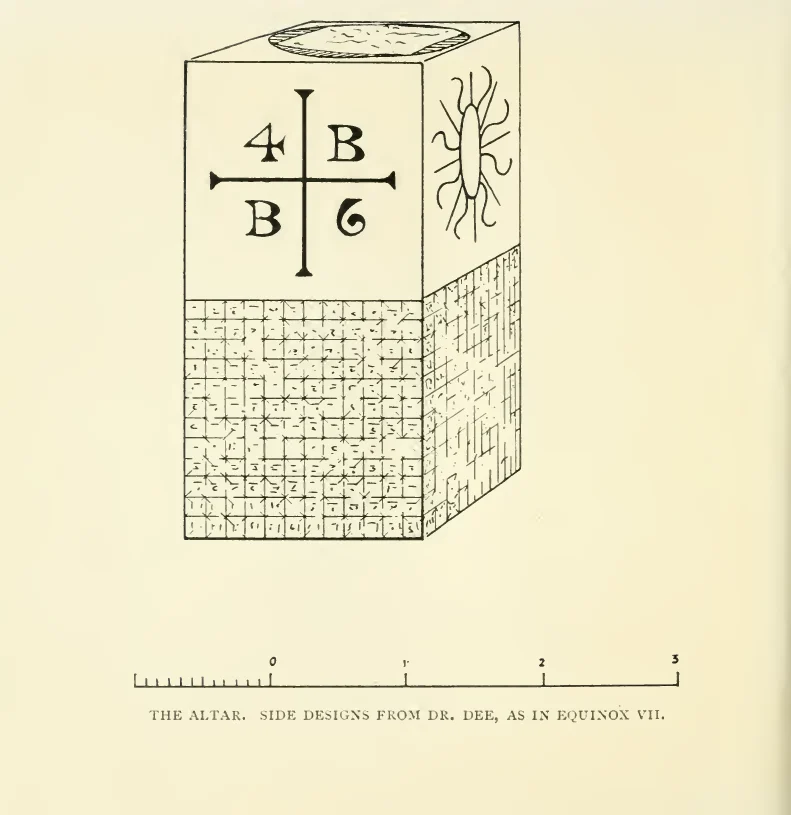
In Book 4, Crowley discusses this double-cube altar in his treatment of ritual objects. He treats the training of attention in a separate part of the book.
Aleister Crowley and Soror Virakam, Book 4, part II (Wieland and Co., ca. 1913), unnumbered plate beside the altar chapter. Digitized copy via Internet Archive. · Image source ↗ · Public Domain
See references (11)
- Magick Without Tears, Reader page 90
- Magick Without Tears, Reader page 91
- Magick Without Tears, Reader page 92
- Magick Without Tears, Reader page 328
- Magick Without Tears, Reader page 329
- Magick Without Tears, Reader page 330
- Magick Without Tears, Reader page 331
- Magick Without Tears, Reader page 332
- Magick Without Tears, Reader page 334
- Magick Without Tears, Reader page 335
- Magick Without Tears, Reader page 336
Attention in yoga and in Crowley’s two methods
Vivekananda distinguishes three modes of attention within yoga. Crowley asks how attention can help in two kinds of work, one inward and the other directed towards what he takes to be a field of experience beyond the practitioner. [1][3][4][6][7][9][10]
See references (7)
- Swami Vivekananda, Raja-Yoga, Patanjali’s Yoga Aphorisms, chapter III, aphorisms 1–4
- Magick Without Tears, Reader page 90
- Magick Without Tears, Reader page 91
- Magick Without Tears, Reader page 328
- Magick Without Tears, Reader page 329
- Magick Without Tears, Reader page 331
- Magick Without Tears, Reader page 332
Read further in the library

Magick Without Tears
Reading note
The separately titled account draws on exact passages in the consulted Library edition.
Sources
See references (13)
- Swami Vivekananda, Raja-Yoga, Patanjali’s Yoga Aphorisms, chapter III, aphorisms 1–4 ↗Swami Vivekananda’s translation and explanation of Patañjali’s Yoga Aphorisms III.1–4. Exact chapter and aphorisms in the Complete Works transcription. This is not Ramacharaka’s similarly named Raja Yoga or Mental Development.Return to text ↑
- The Altar. Side Designs ↗Aleister Crowley and Soror Virakam, Book 4, part II (Wieland and Co., ca. 1913), unnumbered plate beside the altar chapter. Digitized copy via Internet Archive.
- Magick Without Tears, Reader page 90Aleister Crowley, Magick Without Tears, undated digital Library edition IMJ-0641-E001. Links use the current Library Reader sequence.Read this page in Magick Without Tears ↗Return to text ↑
- Magick Without Tears, Reader page 91Aleister Crowley, Magick Without Tears, undated digital Library edition IMJ-0641-E001. Links use the current Library Reader sequence.Read this page in Magick Without Tears ↗Return to text ↑
- Magick Without Tears, Reader page 92Aleister Crowley, Magick Without Tears, undated digital Library edition IMJ-0641-E001. Links use the current Library Reader sequence.Read this page in Magick Without Tears ↗Return to text ↑
- Magick Without Tears, Reader page 328Aleister Crowley, Magick Without Tears, undated digital Library edition IMJ-0641-E001. Links use the current Library Reader sequence.Read this page in Magick Without Tears ↗Return to text ↑
- Magick Without Tears, Reader page 329Aleister Crowley, Magick Without Tears, undated digital Library edition IMJ-0641-E001. Links use the current Library Reader sequence.Read this page in Magick Without Tears ↗Return to text ↑
- Magick Without Tears, Reader page 330Aleister Crowley, Magick Without Tears, undated digital Library edition IMJ-0641-E001. Links use the current Library Reader sequence.Read this page in Magick Without Tears ↗Return to text ↑
- Magick Without Tears, Reader page 331Aleister Crowley, Magick Without Tears, undated digital Library edition IMJ-0641-E001. Links use the current Library Reader sequence.Read this page in Magick Without Tears ↗Return to text ↑
- Magick Without Tears, Reader page 332Aleister Crowley, Magick Without Tears, undated digital Library edition IMJ-0641-E001. Links use the current Library Reader sequence.Read this page in Magick Without Tears ↗Return to text ↑
- Magick Without Tears, Reader page 334Aleister Crowley, Magick Without Tears, undated digital Library edition IMJ-0641-E001. Links use the current Library Reader sequence.Read this page in Magick Without Tears ↗Return to text ↑
- Magick Without Tears, Reader page 335Aleister Crowley, Magick Without Tears, undated digital Library edition IMJ-0641-E001. Links use the current Library Reader sequence.Read this page in Magick Without Tears ↗Return to text ↑
- Magick Without Tears, Reader page 336Aleister Crowley, Magick Without Tears, undated digital Library edition IMJ-0641-E001. Links use the current Library Reader sequence.Read this page in Magick Without Tears ↗Return to text ↑