Xing and Ming in Daoist Alchemy: Nature and Life
Xing and ming are two aspects of human existence in Daoist inner alchemy. Xing concerns one’s nature, while ming can refer to life, vitality or the conditions of existence. Alchemical texts ask how each can be cultivated through the other.
In this article
What are xing and ming?
In Daoist internal alchemy, xing (性) means a person’s original nature. Ming (命) can mean the life one receives, the vitality that sustains it, or the destiny that shapes its course. The two are often cultivated together because the tradition connects insight into one’s nature with work on embodied life. [8]
Nature and life in The Secret of the Golden Flower
In his exposition, Richard Wilhelm uses the older spelling hsing for xing and pairs essence with life. He treats them as expressions of a single principle that differentiate at conception. He connects ming with a command, an allotted span of life and the vitality a person receives. [2][3]
The translated text says essence and life are gathered in the light of Heaven. A later passage connects both with primordial spirit and makes them part of the work of circulating the light. [4][5]
Cary F. Baynes identifies the written and diagrammatic summaries as her additions to the English edition. Her written summary places essence on the yang side and life on the yin side. Jung’s commentary associates essence or consciousness with the intensity of light and life with extension, a distinction he uses when discussing mandalas. [1][6][7]
See references (7)
- The Secret of the Golden Flower, Baynes’s preface, Reader page 9
- The Secret of the Golden Flower, printed p. 13, Reader page 21
- The Secret of the Golden Flower, printed p. 14, Reader page 22
- The Secret of the Golden Flower, printed p. 23, Reader page 30
- The Secret of the Golden Flower, printed p. 26, Reader page 33
- The Secret of the Golden Flower, printed p. 73, Reader page 72
- The Secret of the Golden Flower, printed p. 101, Reader page 100
Why the two are cultivated together
In the Xingming guizhi passage translated by Fabrizio Pregadio, xing and ming share an origin and depend on one another. Pregadio distinguishes approaches that begin with work on ming from approaches that treat the cultivation of xing as encompassing work on ming. The starting point changes how each tradition describes the work. [8]
Spiritual nature and bodily life in a Ming woodcut
The Universal Illumination woodcut places cosmological emblems and named areas of the body around one seated figure. The print belongs to the Xingming guizhi, the work that explains why nature and life are cultivated together. [9][8]
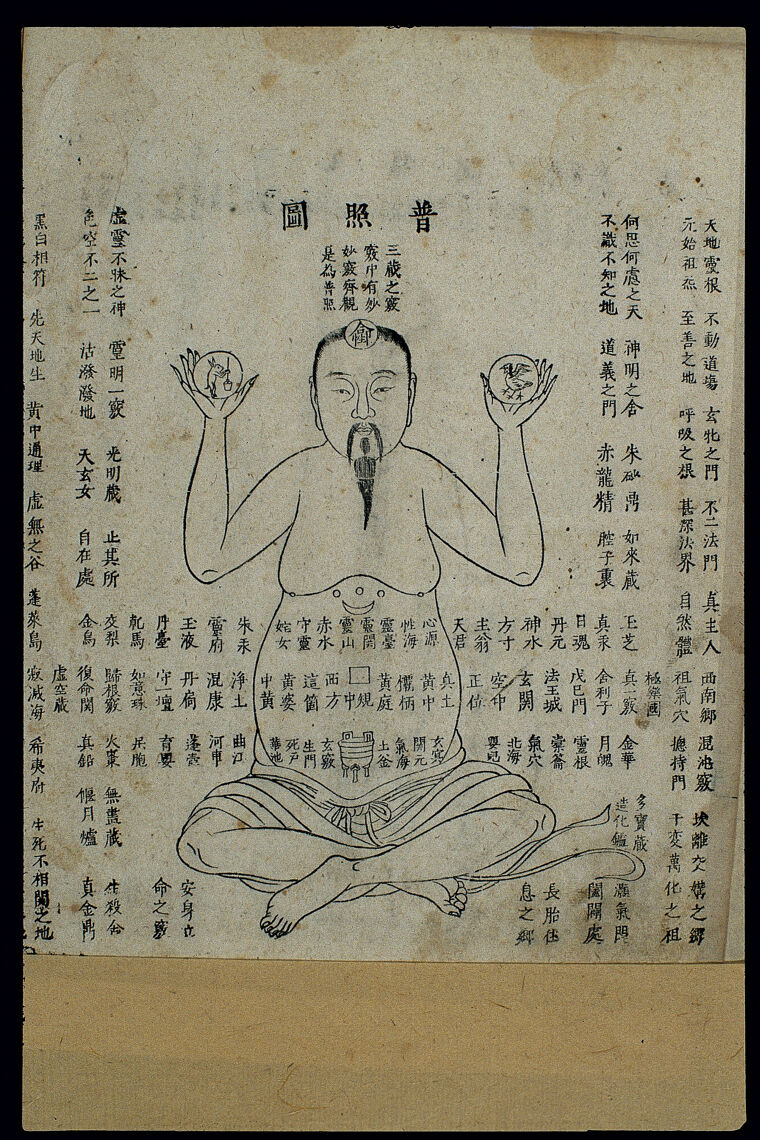
Universal Illumination, a woodcut from Xingming guizhi, published in 1615. The title of the book joins spiritual nature and bodily life.
Wellcome Collection, Chinese woodcut: Daoist internal alchemy (1). Public Domain Mark. · Image source ↗ · Public Domain
In the library
The Secret of the Golden Flower
Reading note
Read the specific account of Xing and Ming in the Wilhelm–Baynes edition.
Sources
See references (9)
- The Secret of the Golden Flower, Baynes’s preface, Reader page 9The Secret of the Golden Flower: A Chinese Book of Life. Chinese text translated and explained by Richard Wilhelm, English translation by Cary F. Baynes, with separate commentary by C. G. Jung. London, Kegan Paul, Trench, Trubner & Co. Lumitheca Library edition IMJ-0596-E001.Read this page in The Secret of the Golden Flower ↗
- The Secret of the Golden Flower, printed p. 13, Reader page 21The Secret of the Golden Flower: A Chinese Book of Life. Chinese text translated and explained by Richard Wilhelm, English translation by Cary F. Baynes, with separate commentary by C. G. Jung. London, Kegan Paul, Trench, Trubner & Co. Lumitheca Library edition IMJ-0596-E001.Read this page in The Secret of the Golden Flower ↗
- The Secret of the Golden Flower, printed p. 14, Reader page 22The Secret of the Golden Flower: A Chinese Book of Life. Chinese text translated and explained by Richard Wilhelm, English translation by Cary F. Baynes, with separate commentary by C. G. Jung. London, Kegan Paul, Trench, Trubner & Co. Lumitheca Library edition IMJ-0596-E001.Read this page in The Secret of the Golden Flower ↗
- The Secret of the Golden Flower, printed p. 23, Reader page 30The Secret of the Golden Flower: A Chinese Book of Life. Chinese text translated and explained by Richard Wilhelm, English translation by Cary F. Baynes, with separate commentary by C. G. Jung. London, Kegan Paul, Trench, Trubner & Co. Lumitheca Library edition IMJ-0596-E001.Read this page in The Secret of the Golden Flower ↗
- The Secret of the Golden Flower, printed p. 26, Reader page 33The Secret of the Golden Flower: A Chinese Book of Life. Chinese text translated and explained by Richard Wilhelm, English translation by Cary F. Baynes, with separate commentary by C. G. Jung. London, Kegan Paul, Trench, Trubner & Co. Lumitheca Library edition IMJ-0596-E001.Read this page in The Secret of the Golden Flower ↗
- The Secret of the Golden Flower, printed p. 73, Reader page 72The Secret of the Golden Flower: A Chinese Book of Life. Chinese text translated and explained by Richard Wilhelm, English translation by Cary F. Baynes, with separate commentary by C. G. Jung. London, Kegan Paul, Trench, Trubner & Co. Lumitheca Library edition IMJ-0596-E001.Read this page in The Secret of the Golden Flower ↗
- The Secret of the Golden Flower, printed p. 101, Reader page 100The Secret of the Golden Flower: A Chinese Book of Life. Chinese text translated and explained by Richard Wilhelm, English translation by Cary F. Baynes, with separate commentary by C. G. Jung. London, Kegan Paul, Trench, Trubner & Co. Lumitheca Library edition IMJ-0596-E001.Read this page in The Secret of the Golden Flower ↗
- Destiny, Vital Force, or Existence? On the Meanings of Ming in Daoist Internal Alchemy and Its Relation to Xing or Human Nature, pp. 173–174 and 186–187 ↗Fabrizio Pregadio, Daoism: Religion, History and Society 6 (2014).
- Universal Illumination ↗Wellcome Collection, Chinese woodcut: Daoist internal alchemy (1). Public Domain Mark.