Wu Wei: Non-Action in Daoist Thought
Wu wei is often translated as non-action. In Daoist thought it can mean acting without forcing an outcome. The Secret of the Golden Flower describes how deliberate attention can give way to a movement that occurs by itself.
In this article
What is wu wei?
Wu wei (無為), often translated as non-action, describes allowing something to unfold without forcing it. A person can prepare the conditions for change and then let the change take its course. Daoist texts apply the idea to governing, cultivation and ordinary action. [3][6]
Action and non-action in The Secret of the Golden Flower
In Richard Wilhelm’s translation, rendered into English by Cary F. Baynes, deliberate reflection helps begin the circulation of the light. In the same work, the account of inward hearing calls for a light touch. The practitioner can pay attention without trying to direct everything that follows. [1][2]
The Far Journey chapter pairs non-action with action. Non-action keeps attention from becoming caught in forms and images. Action keeps stillness from becoming numbness. The chapter describes a stage at which movement can arise by itself after attention has been gathered. [3][4]
The chapter’s closing explanation distinguishes a movement that follows an external stimulus from one that arises when the heart is quiet. The difference lies in where the movement begins. [5]
See references (5)
- The Secret of the Golden Flower, printed p. 26, Reader page 33
- The Secret of the Golden Flower, printed p. 48, Reader page 51
- The Secret of the Golden Flower, printed p. 59, Reader page 60
- The Secret of the Golden Flower, printed p. 60, Reader page 61
- The Secret of the Golden Flower, Far Journey chapter, Reader page 64
Non-action in the Daodejing
Chapter 37 of the Daodejing describes the Dao’s non-action and asks how rulers might follow it so that things can change of themselves. The Golden Flower takes a similar question into meditation, asking what happens after the practitioner has prepared the conditions for change. [6][3]
Lü Dongbin in a Ming album leaf
The Met identifies the small figure above the landscape as Lü Dongbin. The painting draws on the lore of the immortal under whose name the Far Journey chapter teaches. The scale of the figure makes him easy to miss above the pavilion and hills. [7][3]
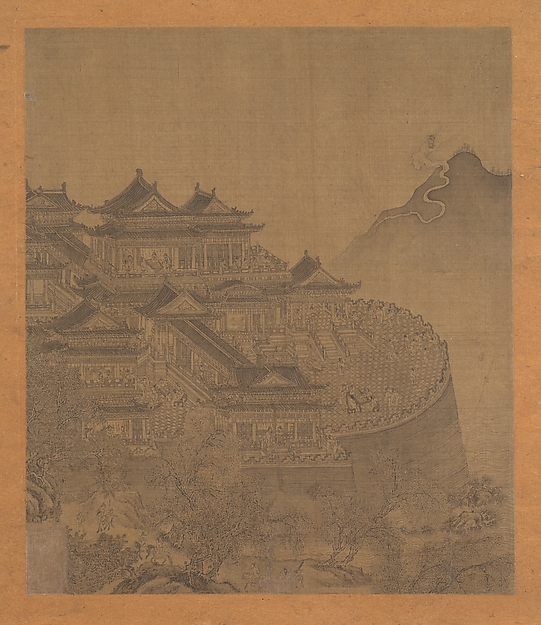
The Immortal Lü Dongbin Appearing over the Yueyang Pavilion, 15th to 16th century. The Golden Flower presents the teaching on non-action in the voice of Master Lü.
The Metropolitan Museum of Art, From the Collection of A. W. Bahr, Purchase, Fletcher Fund, 1947. Public domain. · Image source ↗ · CC0
In the library
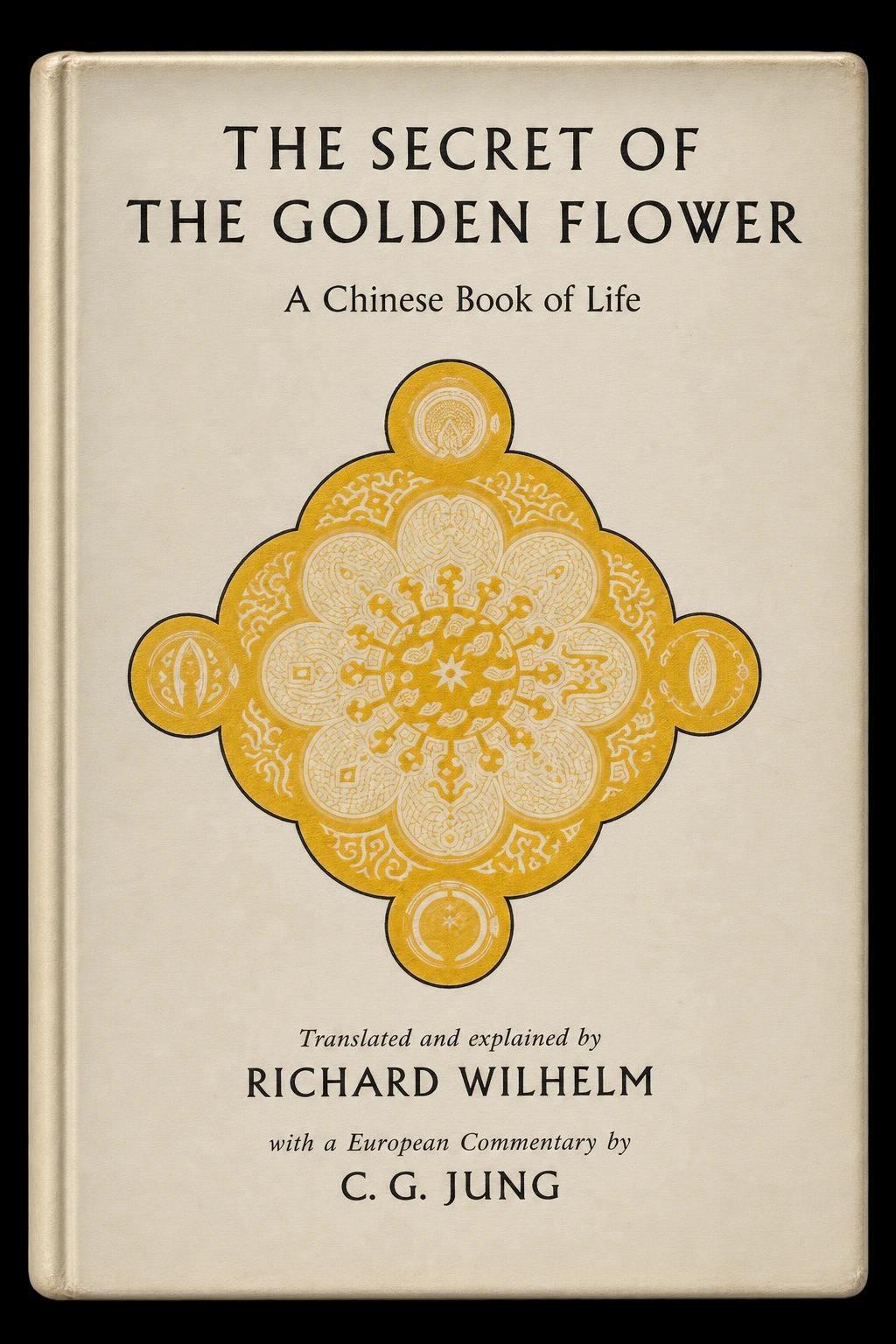
The Secret of the Golden Flower
Reading note
Read the specific account of Wu Wei in the Wilhelm–Baynes edition.
Sources
See references (7)
- The Secret of the Golden Flower, printed p. 26, Reader page 33The Secret of the Golden Flower: A Chinese Book of Life. Chinese text translated and explained by Richard Wilhelm, English translation by Cary F. Baynes, with separate commentary by C. G. Jung. London, Kegan Paul, Trench, Trubner & Co. Lumitheca Library edition IMJ-0596-E001.Read this page in The Secret of the Golden Flower ↗
- The Secret of the Golden Flower, printed p. 48, Reader page 51The Secret of the Golden Flower: A Chinese Book of Life. Chinese text translated and explained by Richard Wilhelm, English translation by Cary F. Baynes, with separate commentary by C. G. Jung. London, Kegan Paul, Trench, Trubner & Co. Lumitheca Library edition IMJ-0596-E001.Read this page in The Secret of the Golden Flower ↗
- The Secret of the Golden Flower, printed p. 59, Reader page 60The Secret of the Golden Flower: A Chinese Book of Life. Chinese text translated and explained by Richard Wilhelm, English translation by Cary F. Baynes, with separate commentary by C. G. Jung. London, Kegan Paul, Trench, Trubner & Co. Lumitheca Library edition IMJ-0596-E001.Read this page in The Secret of the Golden Flower ↗
- The Secret of the Golden Flower, printed p. 60, Reader page 61The Secret of the Golden Flower: A Chinese Book of Life. Chinese text translated and explained by Richard Wilhelm, English translation by Cary F. Baynes, with separate commentary by C. G. Jung. London, Kegan Paul, Trench, Trubner & Co. Lumitheca Library edition IMJ-0596-E001.Read this page in The Secret of the Golden Flower ↗
- The Secret of the Golden Flower, Far Journey chapter, Reader page 64The Secret of the Golden Flower: A Chinese Book of Life. Chinese text translated and explained by Richard Wilhelm, English translation by Cary F. Baynes, with separate commentary by C. G. Jung. London, Kegan Paul, Trench, Trubner & Co. Lumitheca Library edition IMJ-0596-E001.Read this page in The Secret of the Golden Flower ↗
- Daodejing, chapter 37 ↗Attributed to Laozi, translated by James Legge (1891).
- The Immortal Lü Dongbin Appearing over the Yueyang Pavilion ↗The Metropolitan Museum of Art, From the Collection of A. W. Bahr, Purchase, Fletcher Fund, 1947. Public domain.