World Tree
What does a world tree connect? Compare Yggdrasil and the Bhagavad Gita’s inverted tree with Hall’s symbolic interpretation of the spine.
In this article
A tree that connects worlds
A world tree gives the cosmos a form that can be pictured and traversed. In the Norse poems, Yggdrasil’s roots reach toward different realms. In the Bhagavad Gītā, the roots of the sacred fig face upward and its branches downward. [3][2][4][5]
Poetic Edda, Grímnismál and Hávamál
Grímnismál describes the gods riding to judgment at Yggdrasil and names three directions in which its roots extend. In Hávamál, Odin hangs on a tree for nine nights and takes up the runes. The ordeal is often read alongside the poems about Yggdrasil. [3]
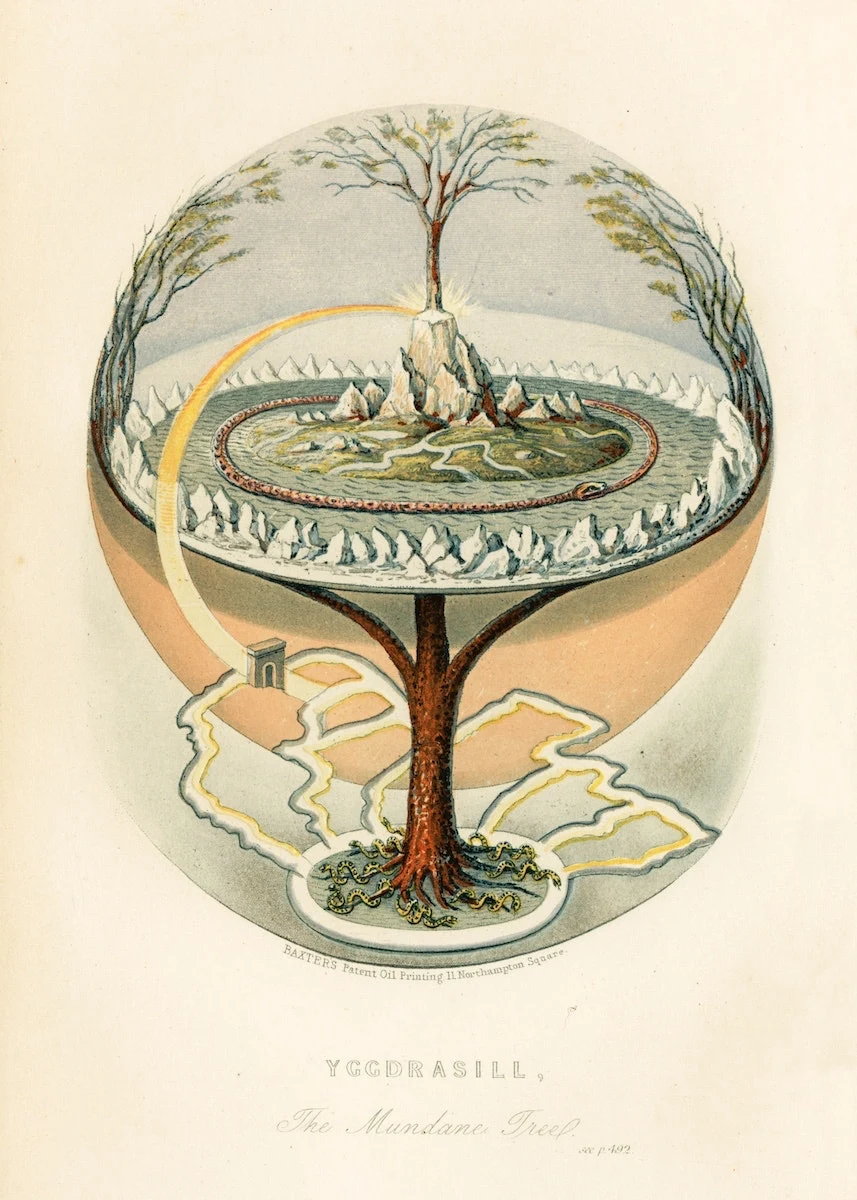
Oluf Olufsen Bagge’s 1847 drawing interprets Yggdrasil as a tree reaching through several levels of the Norse cosmos.
Yggdrasil, The Mundane Tree, attributed to Oluf Olufsen Bagge. Northern Antiquities, 1847. Public Domain Mark, Wikimedia Commons. · Image source ↗ · Public Domain
Bhagavad Gita, 15.1
In Bhagavad Gītā 15.1, Krishna describes an aśvattha, or sacred fig, with roots above and branches below. Its leaves are Vedic hymns. Knowing the tree is linked to knowing the Vedas. [2]
Man the Grand Symbol of the Mysteries by Manly P. Hall
In Man the Grand Symbol of the Mysteries, Manly P. Hall gathers references to the Gītā’s inverted tree, the Iranian Gaokerena and the Norse Yggdrasil in a chapter on the spinal column. [6][4][7][5]
Hall treats the spine as a smaller counterpart to a cosmic axis. He reads the branching pattern as a way to picture how paths extend from a centre in the body. [8][4][9]
See references (6)
- Man the Grand Symbol of the Mysteries, printed p. 280, Reader page 274
- Man the Grand Symbol of the Mysteries, printed p. 282, Reader page 276
- Man the Grand Symbol of the Mysteries, Reader page 271
- Man the Grand Symbol of the Mysteries, printed p. 281, Reader page 275
- Man the Grand Symbol of the Mysteries, Reader page 270
- Man the Grand Symbol of the Mysteries, printed p. 283, Reader page 277
Roots, branches and the spine
The Gītā uses the inverted fig in a teaching about the world and its origin. The Eddic poems give trees a role in cosmic geography and Odin’s ordeal. Hall reads these images through the spine. His account gives the ordeal as nine months, where Hávamál says nine nights. [4][5][9][2][3]
See references (5)
In the library
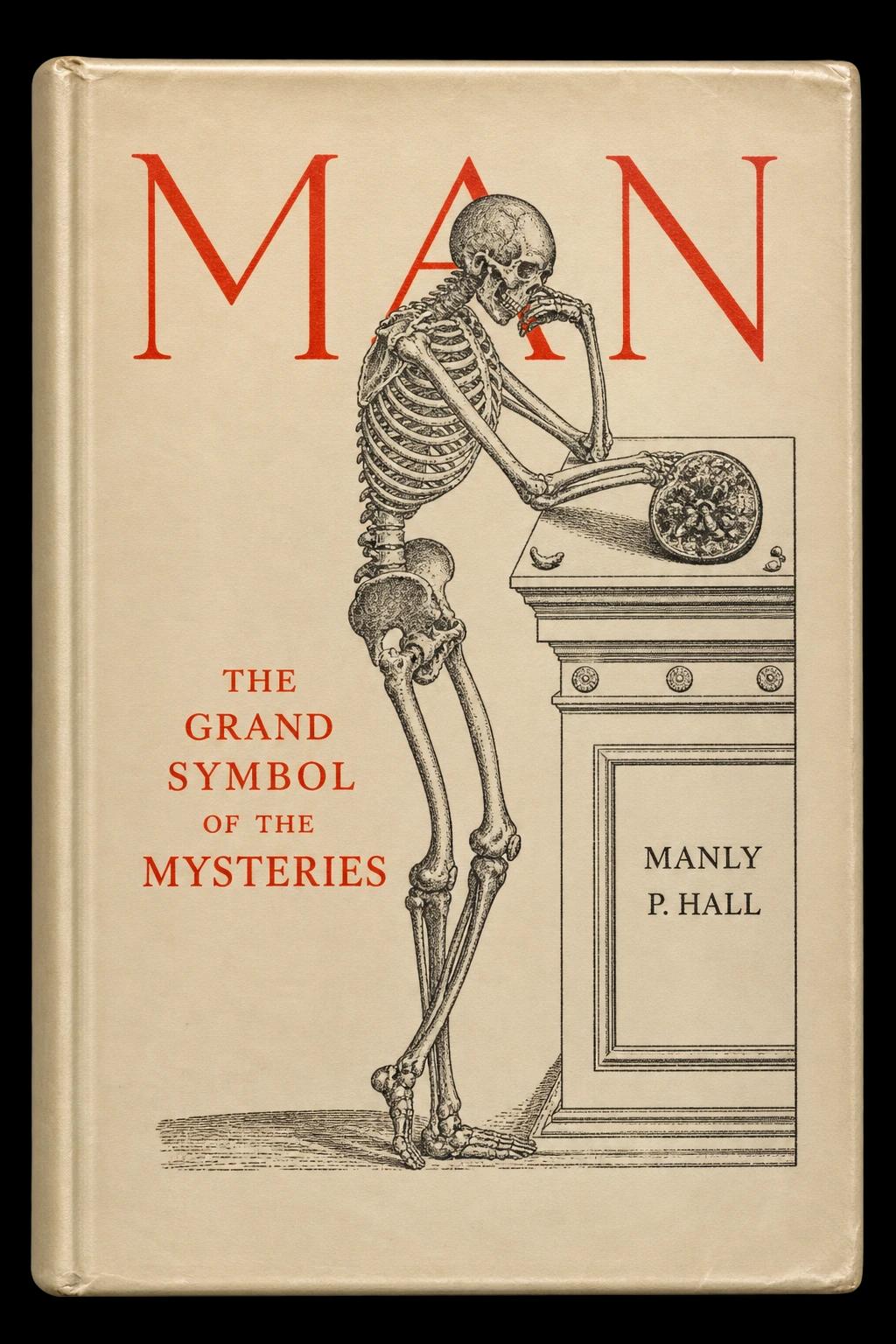
Man the Grand Symbol of the Mysteries
Reading note
The separately titled account draws on exact passages in the consulted Library edition.
Sources
See references (9)
- Yggdrasil, The Mundane Tree ↗Yggdrasil, The Mundane Tree, attributed to Oluf Olufsen Bagge. Northern Antiquities, 1847. Public Domain Mark, Wikimedia Commons.
- Bhagavad Gita 15.1, the inverted tree ↗Bhagavad Gita 15.1, Sanskrit text and collected translations, IIT Kanpur.
- Poetic Edda, Hávamál 139–140 and Grímnismál 29–35 ↗Poetic Edda, translated by Henry Adams Bellows, 1923, Hávamál 139–140 and Grímnismál 29–35.
- Man the Grand Symbol of the Mysteries, printed p. 280, Reader page 274Manly P. Hall, Man the Grand Symbol of the Mysteries, Fourth Edition, The Philosophers Press, Los Angeles, 1937. Lumitheca Library edition IMJ-0603-E001.Read this page in Man the Grand Symbol of the Mysteries ↗
- Man the Grand Symbol of the Mysteries, printed p. 282, Reader page 276Manly P. Hall, Man the Grand Symbol of the Mysteries, Fourth Edition, The Philosophers Press, Los Angeles, 1937. Lumitheca Library edition IMJ-0603-E001.Read this page in Man the Grand Symbol of the Mysteries ↗
- Man the Grand Symbol of the Mysteries, Reader page 271Manly P. Hall, Man the Grand Symbol of the Mysteries, Fourth Edition, The Philosophers Press, Los Angeles, 1937. Lumitheca Library edition IMJ-0603-E001.Read this page in Man the Grand Symbol of the Mysteries ↗
- Man the Grand Symbol of the Mysteries, printed p. 281, Reader page 275Manly P. Hall, Man the Grand Symbol of the Mysteries, Fourth Edition, The Philosophers Press, Los Angeles, 1937. Lumitheca Library edition IMJ-0603-E001.Read this page in Man the Grand Symbol of the Mysteries ↗
- Man the Grand Symbol of the Mysteries, Reader page 270Manly P. Hall, Man the Grand Symbol of the Mysteries, Fourth Edition, The Philosophers Press, Los Angeles, 1937. Lumitheca Library edition IMJ-0603-E001.Read this page in Man the Grand Symbol of the Mysteries ↗
- Man the Grand Symbol of the Mysteries, printed p. 283, Reader page 277Manly P. Hall, Man the Grand Symbol of the Mysteries, Fourth Edition, The Philosophers Press, Los Angeles, 1937. Lumitheca Library edition IMJ-0603-E001.Read this page in Man the Grand Symbol of the Mysteries ↗