Why Do Witches Ride Broomsticks?
Why did witches come to ride broomsticks in art and folklore? Compare early prints of brooms, forks and goats, and the witches who fly up a chimney.
In this article
How did the broomstick become an image of witch flight?
Early modern European prints made a household broom into a vehicle for impossible flight. A woodcut associated with Thomas Erastus shows a rider above the roof while a person at the door peers through a keyhole. The scene makes witch flight something that might be imagined inside an ordinary house. [3][1]
The broom was one of several objects depicted. Grillot de Givry identifies a fork in a work by Hans Baldung and brooms at the hearth in a print by Jaspar Isaac. The broom and chimney became a memorable pair because both belong to the room the rider leaves. [4][3]
Witchcraft Magic & Alchemy by Grillot de Givry
In Witchcraft Magic & Alchemy, Grillot de Givry describes Jaspar Isaac’s figures gathered by the hearth. One has already begun to disappear up the chimney. The Erastus woodcut shows fireplace and roof together, so the reader can trace the whole route. [4][3]
De Givry notes that different prints give the bristles different directions. In a work by Jakob van den Gheyn, a broom rises above a cauldron. In other illustrations a light is fastened to the twigs. Artists changed the details while keeping the rider and broom recognisable. [5]
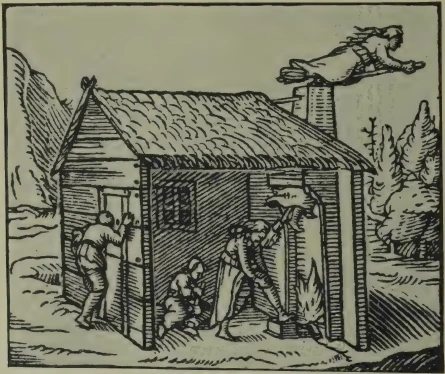
Woodcut associated with the 1579 French edition of Thomas Erastus’s dialogues, reproduced as figure 35 in De Givry. The cutaway joins the hearth and roof in a single view.
Woodcut in Thomas Erastus, Dialogues touchant le pouvoir des sorcières, 1579, as reproduced by De Givry. The Museum of Witchcraft and Magic independently catalogues the motif and edition. · Image source ↗ · Public Domain
How the image travelled between stories
The Erastus woodcut shows someone leaving a house. A print after Pieter Bruegel the Elder uses a similar scene of flight in the story of Saint James and the magician Hermogenes. De Givry notices that the artist brought a familiar image into an older legend. [3][5][1][2]
Read further in the library
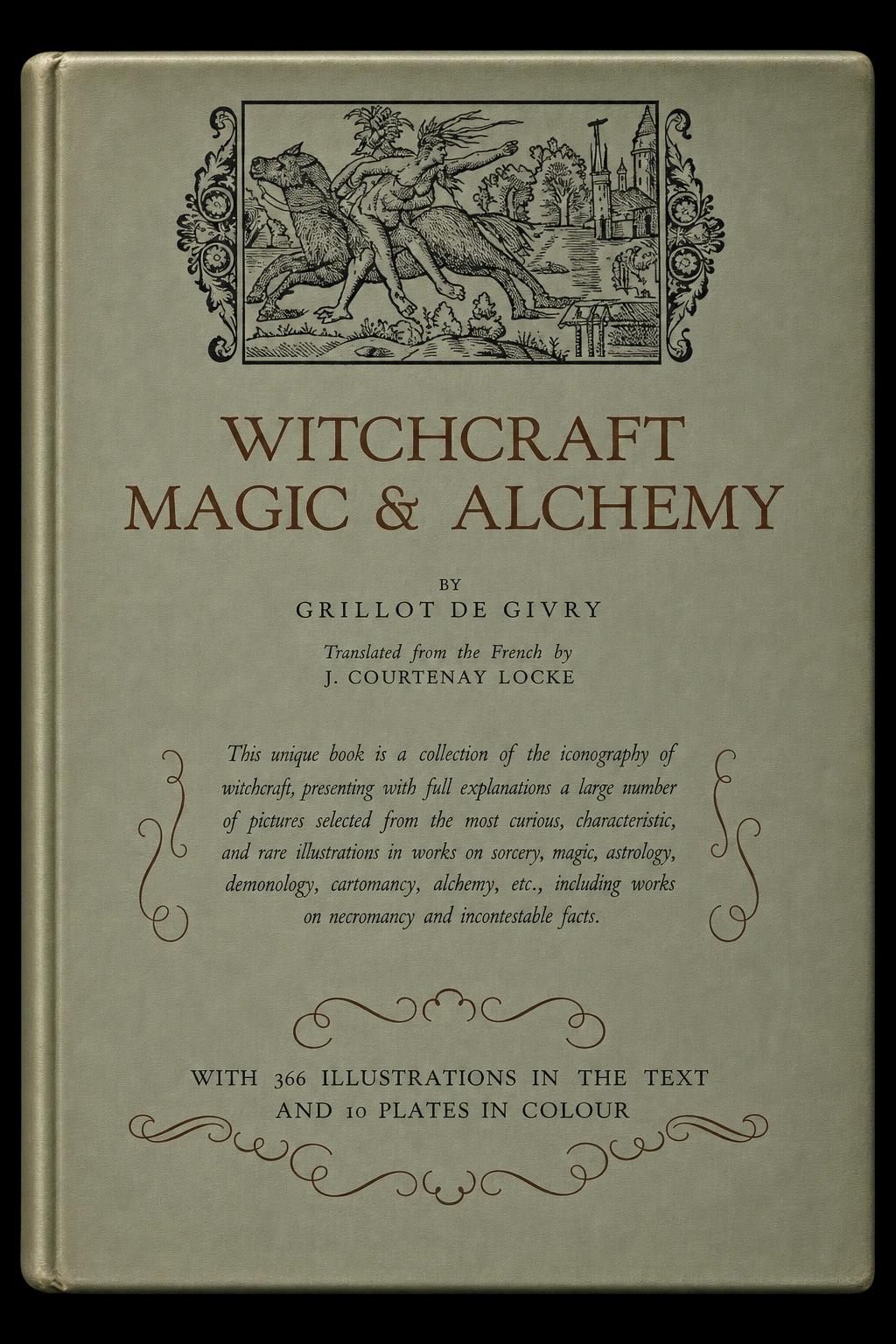
Witchcraft Magic and Alchemy
Reading note
The separately titled account draws on exact passages in the consulted Library edition.
Sources
See references (5)
- Witch woodcut from Dialogues touchant le pouvoir des sorcières ↗Museum of Witchcraft and Magic, object 609. Reproduction of the woodcut associated with the 1579 work by Thomas Erastus.Return to text ↑
- Saint James and the Magician Hermogenes ↗Pieter van der Heyden after Pieter Bruegel the Elder, published by Hieronymus Cock, 1565. National Gallery of Art.Return to text ↑
- Witchcraft Magic & Alchemy, printed p. 64, Reader page 57Grillot de Givry, Witchcraft Magic & Alchemy, translated by J. Courtenay Locke. Boston and New York, Houghton Mifflin Company, 1931.Read this page in Witchcraft Magic and Alchemy ↗Return to text ↑
- Witchcraft Magic & Alchemy, printed p. 60, Reader page 54Grillot de Givry, Witchcraft Magic & Alchemy, translated by J. Courtenay Locke. Boston and New York, Houghton Mifflin Company, 1931.Read this page in Witchcraft Magic and Alchemy ↗Return to text ↑
- Witchcraft Magic & Alchemy, printed p. 65, Reader page 58Grillot de Givry, Witchcraft Magic & Alchemy, translated by J. Courtenay Locke. Boston and New York, Houghton Mifflin Company, 1931.Read this page in Witchcraft Magic and Alchemy ↗Return to text ↑