The Wave in Walter Russell’s Cosmology
What is a wave in Walter Russell’s cosmology? Explore the opposing cones, inertial planes and tonal intervals he uses to explain how forms appear.
In this article
Why Russell draws a wave in three dimensions
For Walter Russell, a wave is a process by which a concept held in inertia takes material form. His diagram gives the entire wave two opposing volumes. A spiral line traces how motion changes within them. [3][4][5]
The Universal One by Walter Russell
In The Universal One, Walter Russell starts a wave with an impact on what he calls an inertial plane. He calls successive stages tones and relates their intervals to changes of pressure and potential. [3][4][6][7]
Russell shapes the opposing volumes as cones. He uses them to describe how form develops from a plane toward a sphere and disperses again. The spiral records changing motion through that sequence. [5][7][8]
See references (6)
- The Universal One, printed p. 225, Reader page 224
- The Universal One, printed p. 226, Reader page 225
- The Universal One, printed p. 228, Reader page 227
- The Universal One, printed p. 227, Reader page 226
- The Universal One, printed p. 229, Reader page 228
- The Universal One, printed p. 231, Reader page 230
A cosmological wave and an electromagnetic wave
NASA describes an electromagnetic wave through electric and magnetic fields that propagate through space. Russell uses a wave to explain the appearance of matter through a proposed progression of concentration and dispersal. [3][5][2]
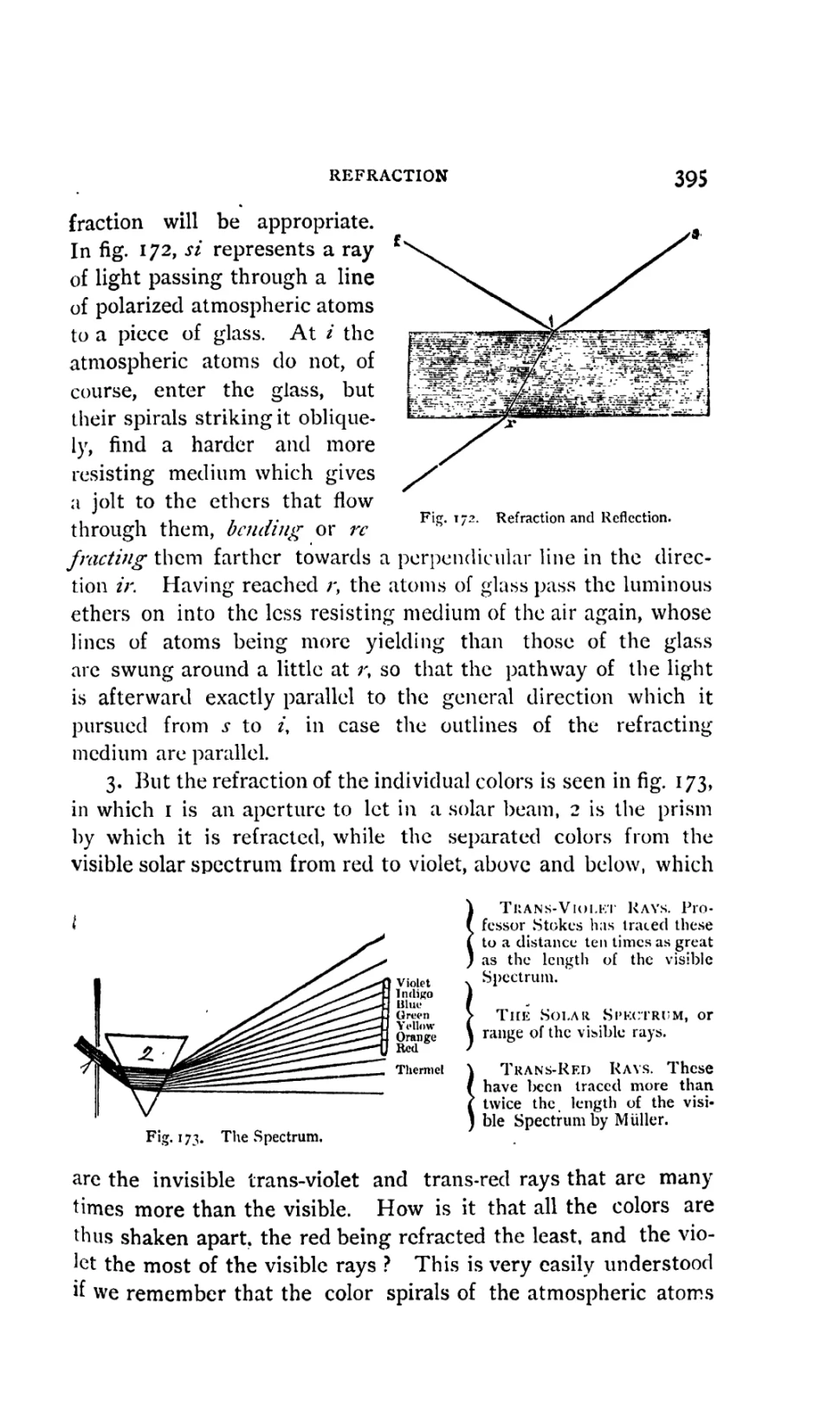
Babbitt’s diagrams show a ray bending in glass and a prism spreading light into a spectrum. Russell’s chapter uses a wave to describe how a form acquires dimensions.
Edwin D. Babbitt, The Principles of Light and Color, second edition, 1896. Lumitheca Library facsimile. · Image source ↗ · Public Domain
In the library
The Principles of Light and Color
Reading note
Separately attributed primary Library account, cited on exact verified Reader leaves.

The Universal One
Reading note
The separately titled account draws on exact passages in the consulted Library edition.
Sources
See references (8)
- Figures 172 and 173, refraction and the spectrum, printed p. 395, Reader page 402Edwin D. Babbitt, The Principles of Light and Color, second edition, 1896. Lumitheca Library facsimile.Read this page in The Principles of Light and Color ↗
- NASA Basics of Space Flight, chapter 6, Electromagnetic Radiation ↗NASA Science, Basics of Space Flight, chapter 6, section 1.
- The Universal One, printed p. 225, Reader page 224Walter Russell, The Universal One, edited by Louise Russell, University of Science and Philosophy, Limited Edition De Luxe. Lumitheca Library edition IMJ-0605-E001.Read this page in The Universal One ↗
- The Universal One, printed p. 226, Reader page 225Walter Russell, The Universal One, edited by Louise Russell, University of Science and Philosophy, Limited Edition De Luxe. Lumitheca Library edition IMJ-0605-E001.Read this page in The Universal One ↗
- The Universal One, printed p. 228, Reader page 227Walter Russell, The Universal One, edited by Louise Russell, University of Science and Philosophy, Limited Edition De Luxe. Lumitheca Library edition IMJ-0605-E001.Read this page in The Universal One ↗
- The Universal One, printed p. 227, Reader page 226Walter Russell, The Universal One, edited by Louise Russell, University of Science and Philosophy, Limited Edition De Luxe. Lumitheca Library edition IMJ-0605-E001.Read this page in The Universal One ↗
- The Universal One, printed p. 229, Reader page 228Walter Russell, The Universal One, edited by Louise Russell, University of Science and Philosophy, Limited Edition De Luxe. Lumitheca Library edition IMJ-0605-E001.Read this page in The Universal One ↗
- The Universal One, printed p. 231, Reader page 230Walter Russell, The Universal One, edited by Louise Russell, University of Science and Philosophy, Limited Edition De Luxe. Lumitheca Library edition IMJ-0605-E001.Read this page in The Universal One ↗