Walter Russell’s Periodic Table
Explore Walter Russell’s radial periodic table, its ten octaves and central line of inert gases, and how it differs from the IUPAC periodic table.
In this article
How to read the circular chart
Walter Russell’s periodic table is a circular chart of the elements as he understands them in his cosmology. Rings and lines divide a cycle of motion into stages. The position of an element represents where he thinks it belongs in that cycle. [3][4][5][6]
The Universal One by Walter Russell
In The Universal One, Walter Russell divides a complete cycle into ten octaves. The first five represent increasing concentration and the last five a return toward balance. Carbon has a place near the turn, and the diagram marks inert gases along an axis. [3][7][6][8][9][10]
The chart includes known elements and proposed ones. Russell calls hydron a master tone and gives it a place in the same system of motion. The proposed names show where he expected the chart to account for substances beyond the known elements. [11][10][12][13]
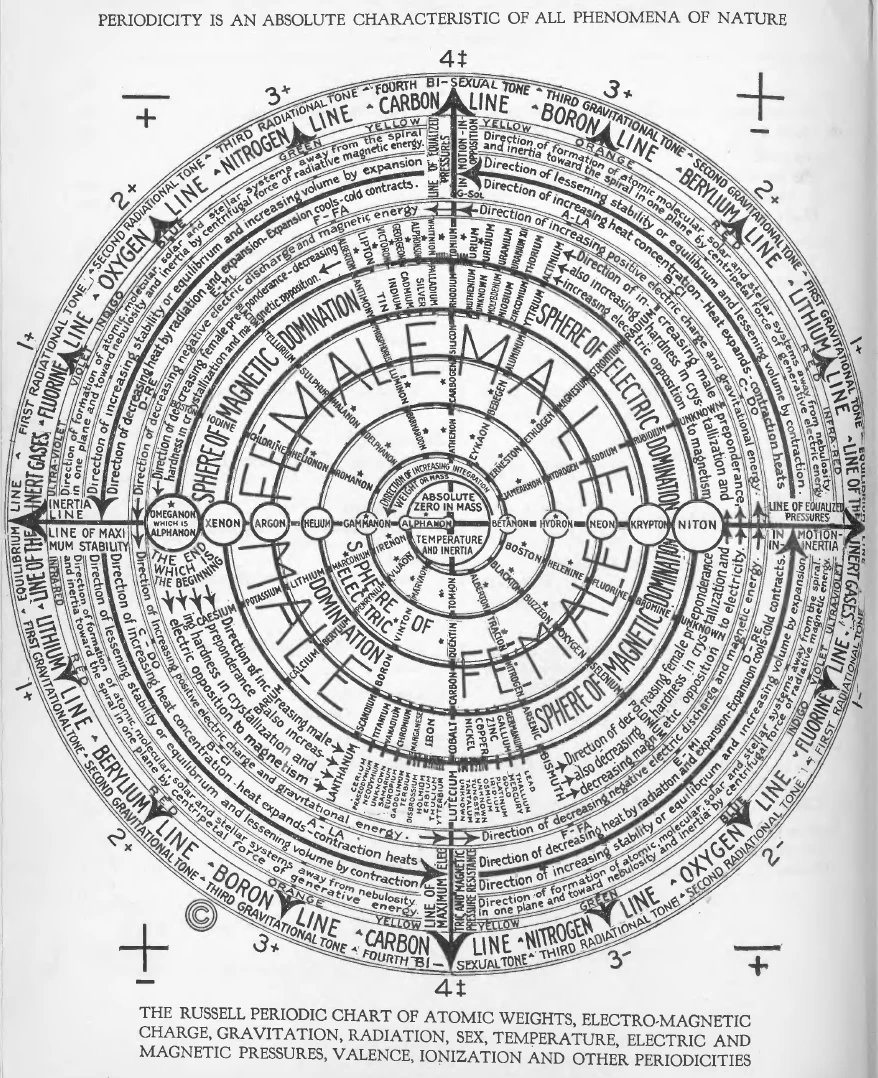
Russell assigns a place to known and proposed elements in the ten octaves of his circular chart. Note the positions along the axis as well as around the rings.
Walter Russell, The Russell Periodic Chart. Brieger Press, New York, copyright 1926, Library of Congress LCCN 27004508. Library of Congress, public domain. · Image source ↗ · Public Domain
See references (9)
- The Universal One, printed p. 17, Reader page 16
- The Universal One, printed p. 125, Reader page 124
- The Universal One, printed p. 106, Reader page 105
- The Universal One, printed p. 126, Reader page 125
- The Universal One, printed p. 127, Reader page 126
- The Universal One, printed p. 129, Reader page 128
- The Universal One, printed p. 128, Reader page 127
- The Universal One, printed p. 132, Reader page 131
- The Universal One, printed p. 137, Reader page 136
Russell’s positions and atomic numbers
IUPAC orders the chemical elements by atomic number and records their symbols and standard atomic weights where applicable. Russell assigns positions through his theory of motion. The familiar element names make the difference in organisation visible. [3][5][6][13][2]
In the library
The Universal One
Reading note
The separately titled account draws on exact passages in the consulted Library edition.
Sources
See references (13)
- The Russell Periodic Chart ↗Walter Russell, The Russell Periodic Chart. Brieger Press, New York, copyright 1926, Library of Congress LCCN 27004508. Library of Congress, public domain.
- IUPAC Periodic Table of Elements ↗International Union of Pure and Applied Chemistry, official periodic table.
- The Universal One, printed p. 17, Reader page 16Walter Russell, The Universal One, edited by Louise Russell, University of Science and Philosophy, Limited Edition De Luxe. Lumitheca Library edition IMJ-0605-E001.Read this page in The Universal One ↗
- The Universal One, printed p. 121, Reader page 120Walter Russell, The Universal One, edited by Louise Russell, University of Science and Philosophy, Limited Edition De Luxe. Lumitheca Library edition IMJ-0605-E001.Read this page in The Universal One ↗
- The Universal One, printed p. 122, Reader page 121Walter Russell, The Universal One, edited by Louise Russell, University of Science and Philosophy, Limited Edition De Luxe. Lumitheca Library edition IMJ-0605-E001.Read this page in The Universal One ↗
- The Universal One, printed p. 125, Reader page 124Walter Russell, The Universal One, edited by Louise Russell, University of Science and Philosophy, Limited Edition De Luxe. Lumitheca Library edition IMJ-0605-E001.Read this page in The Universal One ↗
- The Universal One, printed p. 106, Reader page 105Walter Russell, The Universal One, edited by Louise Russell, University of Science and Philosophy, Limited Edition De Luxe. Lumitheca Library edition IMJ-0605-E001.Read this page in The Universal One ↗
- The Universal One, printed p. 126, Reader page 125Walter Russell, The Universal One, edited by Louise Russell, University of Science and Philosophy, Limited Edition De Luxe. Lumitheca Library edition IMJ-0605-E001.Read this page in The Universal One ↗
- The Universal One, printed p. 127, Reader page 126Walter Russell, The Universal One, edited by Louise Russell, University of Science and Philosophy, Limited Edition De Luxe. Lumitheca Library edition IMJ-0605-E001.Read this page in The Universal One ↗
- The Universal One, printed p. 129, Reader page 128Walter Russell, The Universal One, edited by Louise Russell, University of Science and Philosophy, Limited Edition De Luxe. Lumitheca Library edition IMJ-0605-E001.Read this page in The Universal One ↗
- The Universal One, printed p. 128, Reader page 127Walter Russell, The Universal One, edited by Louise Russell, University of Science and Philosophy, Limited Edition De Luxe. Lumitheca Library edition IMJ-0605-E001.Read this page in The Universal One ↗
- The Universal One, printed p. 132, Reader page 131Walter Russell, The Universal One, edited by Louise Russell, University of Science and Philosophy, Limited Edition De Luxe. Lumitheca Library edition IMJ-0605-E001.Read this page in The Universal One ↗
- The Universal One, printed p. 137, Reader page 136Walter Russell, The Universal One, edited by Louise Russell, University of Science and Philosophy, Limited Edition De Luxe. Lumitheca Library edition IMJ-0605-E001.Read this page in The Universal One ↗