Ventricular Doctrine
How did ventricular doctrine place imagination, judgment and memory in the brain? View Fludd’s diagram and read Hall’s account of the theory.
In this article
Where medieval writers placed thought
Ventricular doctrine was a historical theory that placed mental faculties in the brain’s chambers. A common scheme put the reception of impressions and the making of images toward the front, judgment in the middle, and memory at the back. Writers assigned different faculties to the chambers over time. [4][5][6][7]
De humani corporis fabrica by Andreas Vesalius
In De humani corporis fabrica, Andreas Vesalius illustrates the brain exposed from above. The illustration shows the cavities that dissection can reveal, giving the reader a different kind of evidence from a diagram of mental faculties. [3]
Utriusque cosmi historia by Robert Fludd
In Utriusque cosmi historia, Robert Fludd connects the sensory organs and mental faculties to the sensible, imaginable and intellectual worlds. The circles above the head show relations among these worlds and the faculties that engage with them. [2]
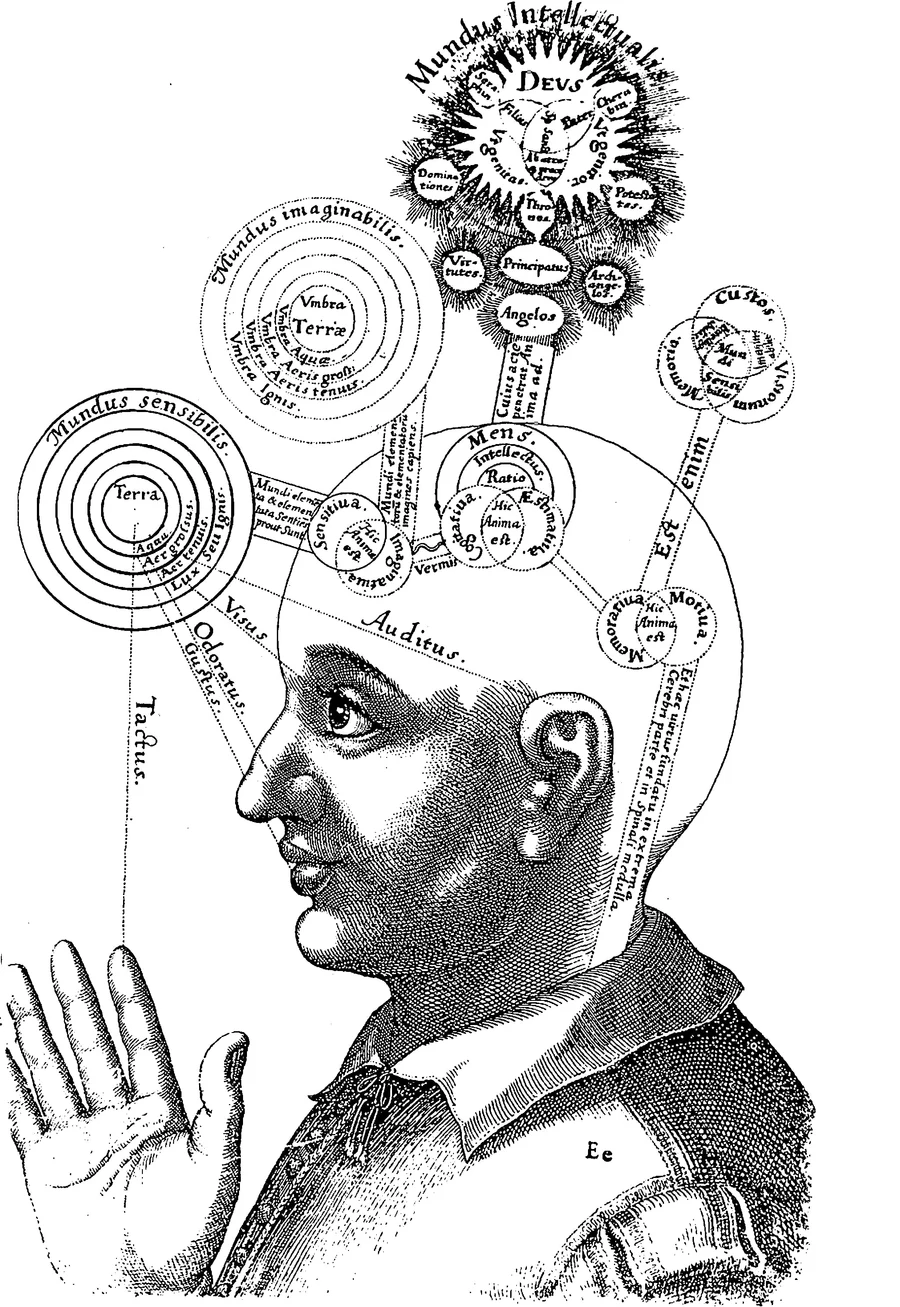
Robert Fludd connects the senses and mental faculties with the sensible, imaginable and intellectual worlds in this engraving.
Robert Fludd, Utriusque cosmi historia, volume II, 1619. Wikimedia Commons, via Source Library. Public Domain Mark. · Image source ↗ · Public Domain
Man the Grand Symbol of the Mysteries by Manly P. Hall
In Man the Grand Symbol of the Mysteries, Manly P. Hall reproduces Robert Fludd’s diagram and surveys older accounts of mental faculties. He follows the way their authors arranged functions such as imagination, judgment and memory in a sequence. [8][4][5][6][9]
Hall also describes chambers through the analogy of a court. Testimony is heard, sifted and judged in successive rooms. The analogy makes the old theory’s passage from a first impression to judgment easier to follow. [10][11][6][7]
See references (8)
- Man the Grand Symbol of the Mysteries, Reader page 205
- Man the Grand Symbol of the Mysteries, printed p. 216, Reader page 212
- Man the Grand Symbol of the Mysteries, printed p. 217, Reader page 213
- Man the Grand Symbol of the Mysteries, printed p. 220, Reader page 216
- Man the Grand Symbol of the Mysteries, printed p. 208, Reader page 204
- Man the Grand Symbol of the Mysteries, printed p. 218, Reader page 214
- Man the Grand Symbol of the Mysteries, printed p. 214, Reader page 210
- Man the Grand Symbol of the Mysteries, printed p. 215, Reader page 211
A map of faculties and a drawing of anatomy
Fludd’s engraving pictures a theory of how sensing and thinking relate. The anatomy of Andreas Vesalius uses sections of the head to show the visible cavities and their neighbours. Hall places examples of both approaches in the same chapter. [8][12][10][6][2][3]
See references (6)
- Utriusque cosmi historia, volume II, part 1, printed p. 217, diagram of faculties and their worlds
- De humani corporis fabrica (1543), book VII, printed p. 610
- Man the Grand Symbol of the Mysteries, printed p. 217, Reader page 213
- Man the Grand Symbol of the Mysteries, printed p. 208, Reader page 204
- Man the Grand Symbol of the Mysteries, printed p. 214, Reader page 210
- Man the Grand Symbol of the Mysteries, printed p. 212, Reader page 208
In the library
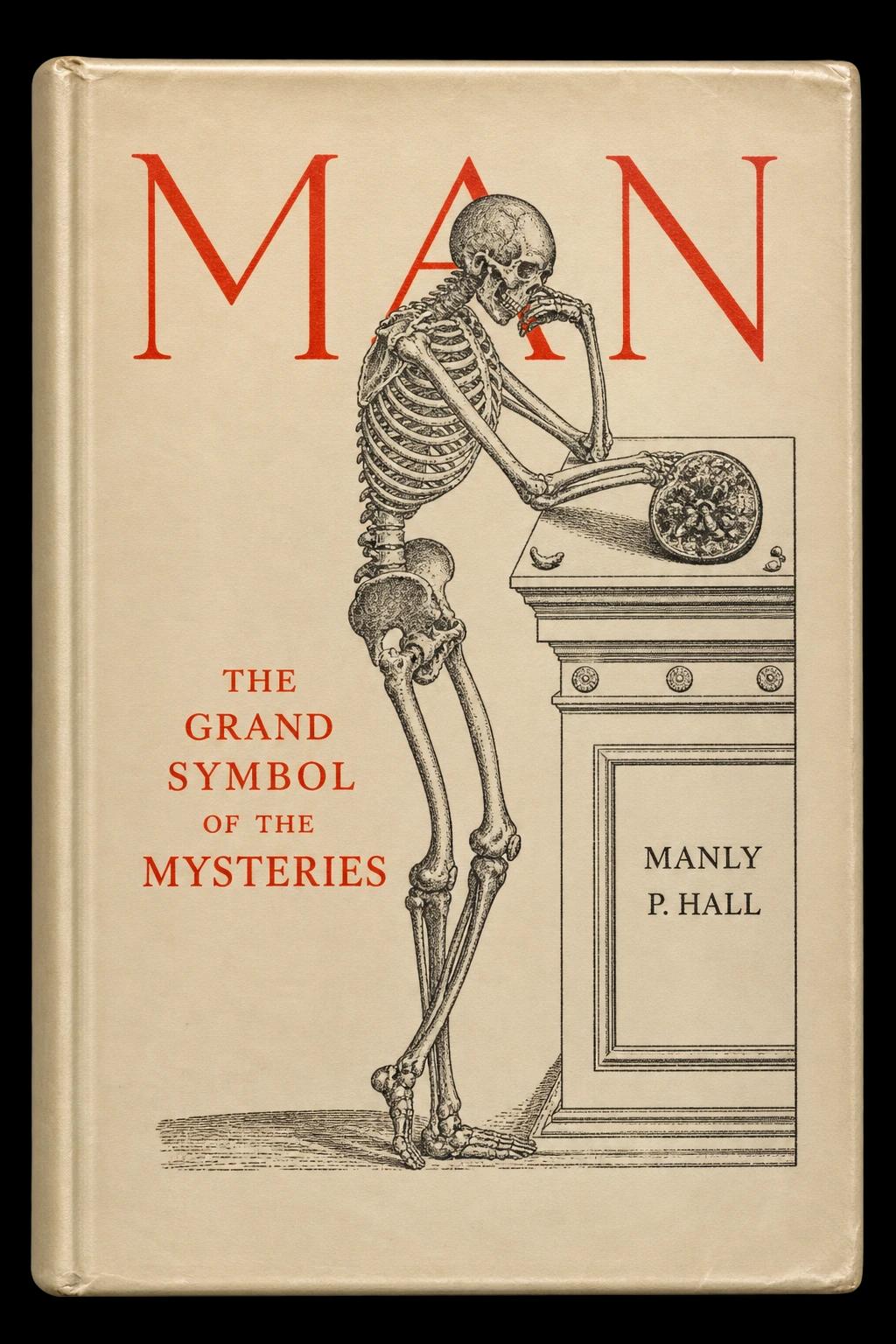
Man the Grand Symbol of the Mysteries
Reading note
The separately titled account draws on exact passages in the consulted Library edition.
Sources
See references (12)
- Fludd’s diagram of the faculties and senses ↗Robert Fludd, Utriusque cosmi historia, volume II, 1619. Wikimedia Commons, via Source Library. Public Domain Mark.
- Utriusque cosmi historia, volume II, part 1, printed p. 217, diagram of faculties and their worlds ↗Robert Fludd, Utriusque cosmi historia, volume II, 1619, De triplici animae in corpore visione.
- De humani corporis fabrica (1543), book VII, printed p. 610 ↗Andreas Vesalius, De humani corporis fabrica, book VII. Digitized edition, e-rara.
- Man the Grand Symbol of the Mysteries, Reader page 205Manly P. Hall, Man the Grand Symbol of the Mysteries, Fourth Edition, The Philosophers Press, Los Angeles, 1937. Lumitheca Library edition IMJ-0603-E001.Read this page in Man the Grand Symbol of the Mysteries ↗
- Man the Grand Symbol of the Mysteries, printed p. 216, Reader page 212Manly P. Hall, Man the Grand Symbol of the Mysteries, Fourth Edition, The Philosophers Press, Los Angeles, 1937. Lumitheca Library edition IMJ-0603-E001.Read this page in Man the Grand Symbol of the Mysteries ↗
- Man the Grand Symbol of the Mysteries, printed p. 217, Reader page 213Manly P. Hall, Man the Grand Symbol of the Mysteries, Fourth Edition, The Philosophers Press, Los Angeles, 1937. Lumitheca Library edition IMJ-0603-E001.Read this page in Man the Grand Symbol of the Mysteries ↗
- Man the Grand Symbol of the Mysteries, printed p. 220, Reader page 216Manly P. Hall, Man the Grand Symbol of the Mysteries, Fourth Edition, The Philosophers Press, Los Angeles, 1937. Lumitheca Library edition IMJ-0603-E001.Read this page in Man the Grand Symbol of the Mysteries ↗
- Man the Grand Symbol of the Mysteries, printed p. 208, Reader page 204Manly P. Hall, Man the Grand Symbol of the Mysteries, Fourth Edition, The Philosophers Press, Los Angeles, 1937. Lumitheca Library edition IMJ-0603-E001.Read this page in Man the Grand Symbol of the Mysteries ↗
- Man the Grand Symbol of the Mysteries, printed p. 218, Reader page 214Manly P. Hall, Man the Grand Symbol of the Mysteries, Fourth Edition, The Philosophers Press, Los Angeles, 1937. Lumitheca Library edition IMJ-0603-E001.Read this page in Man the Grand Symbol of the Mysteries ↗
- Man the Grand Symbol of the Mysteries, printed p. 214, Reader page 210Manly P. Hall, Man the Grand Symbol of the Mysteries, Fourth Edition, The Philosophers Press, Los Angeles, 1937. Lumitheca Library edition IMJ-0603-E001.Read this page in Man the Grand Symbol of the Mysteries ↗
- Man the Grand Symbol of the Mysteries, printed p. 215, Reader page 211Manly P. Hall, Man the Grand Symbol of the Mysteries, Fourth Edition, The Philosophers Press, Los Angeles, 1937. Lumitheca Library edition IMJ-0603-E001.Read this page in Man the Grand Symbol of the Mysteries ↗
- Man the Grand Symbol of the Mysteries, printed p. 212, Reader page 208Manly P. Hall, Man the Grand Symbol of the Mysteries, Fourth Edition, The Philosophers Press, Los Angeles, 1937. Lumitheca Library edition IMJ-0603-E001.Read this page in Man the Grand Symbol of the Mysteries ↗