Vault of the Adepts
The Vault of the Adepts is a seven-sided ritual chamber. Trace its Rosicrucian literary background and the role of the tomb in the Stella Matutina ceremony.
In this article
What is vault of the adepts?
The Vault of the Adepts is a seven-sided chamber used to represent the tomb of Christian Rosenkreutz in Golden Dawn-related initiation. In the Stella Matutina account the altar and a tomb called the pastos give the candidate a setting for mystical burial and rising. The design draws on an older Rosicrucian story. [5][6]
The Fama Fraternitatis
The anonymous Fama Fraternitatis tells how members of the fraternity uncover a sealed door while altering a building. In the version printed by A. E. Waite, a light likened to a sun shines from the ceiling of the seven-sided vault. Beneath the round altar the brothers find their founder’s body and a parchment book. The books and instruments kept in the walls are meant to preserve enough knowledge for the fraternity to be restored. [11]
Light-Bearers of Darkness: Inquire Within
Inquire Within’s Light-Bearers of Darkness describes a chamber whose seven sides carry planetary symbolism. The altar is interpreted through the relation of spirit to the four elements. Below it lies the pastos. The Chief Adept represents Christian Rosenkreutz, and a crook and scourge stand for mercy and severity brought into balance. [5][6]
Inquire Within describes the burial and rising as a loss of independence under occult guardians, part of the book’s antisemitic theory of hidden control. Elsewhere the book recounts reported journeys to a hidden old vault. Those reports have a different setting from the ritual chamber where the candidate takes part. [7][5][6][8][9][10]
See references (6)
Dante’s gate
The Divine Comedy by Dante Alighieri
In Dante Alighieri’s Purgatory IX, Lucia brings the sleeping pilgrim to the approach. He climbs three steps. An angel marks his forehead with seven letters and opens the gate with silver and gold keys. Admission begins the work of purification that continues on the mountain. [1][2][3]
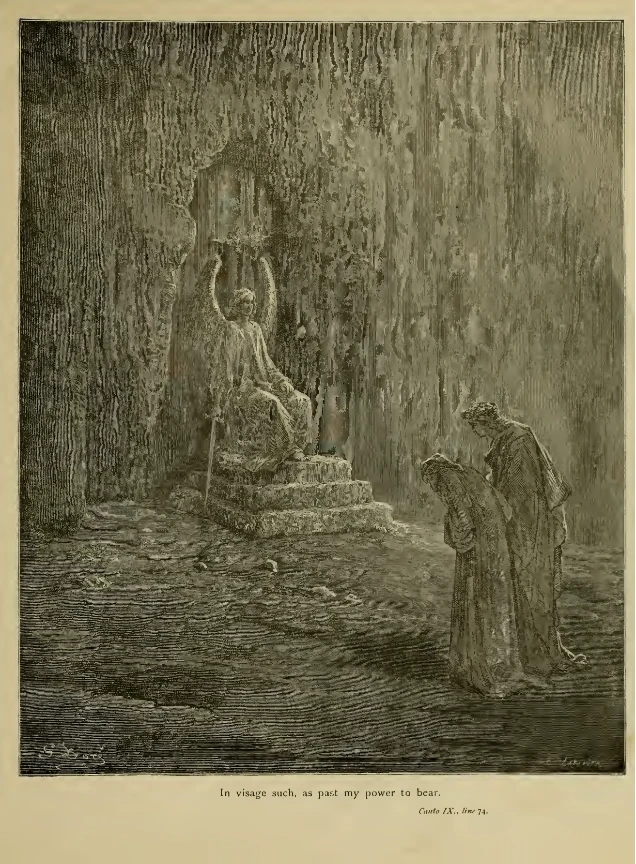
Gustave Doré’s illustration of the gatekeeper in Purgatory IX, from the Library’s 1901 Cary edition.
Purgatory and Paradise, 1901. Dante Alighieri, translated by Henry Francis Cary, designs by Gustave Doré. Thompson & Thomas, Chicago. Historical text and original designs Public Domain. · Image source ↗ · Public Domain
Finding a tomb and passing into a rite
The Rosicrucian story gives the tomb the character of a discovery. The Stella Matutina chamber makes it the setting for a candidate’s change of state. Dante’s angel likewise gives entry a place and a sequence, but the pilgrim goes on to the terraces for the work those marks anticipate. [5][6][1][2][3][11]
See references (6)
- Purgatory and Paradise, Reader page 57
- Purgatory and Paradise, Reader page 58
- Purgatory and Paradise, Reader page 59
- Light-Bearers of Darkness, printed p. 157, Reader page 160
- Light-Bearers of Darkness, printed p. 158, Reader page 161
- Fama Fraternitatis, in A. E. Waite’s The Real History of the Rosicrucians (1887), printed pp. 76–78
Read further in the library
Purgatory and Paradise: The Vision of Dante
Reading note
Separately attributed primary Library account, cited on exact verified Reader leaves.
Light-Bearers of Darkness
Reading note
The separately titled account draws on exact passages in the consulted Library edition.
Sources
See references (11)
- Purgatory and Paradise, Reader page 57Dante Alighieri, The Divine Comedy, translated by Henry Francis Cary, designs by Gustave Doré. Inferno: undated New Edition, Thompson & Thomas, Chicago. Purgatory and Paradise: New Edition, Thompson & Thomas, Chicago, 1901. Canto arguments are editorial matter and are distinguished from the poem.Read this page in Purgatory and Paradise: The Vision of Dante ↗Return to text ↑
- Purgatory and Paradise, Reader page 58Dante Alighieri, The Divine Comedy, translated by Henry Francis Cary, designs by Gustave Doré. Inferno: undated New Edition, Thompson & Thomas, Chicago. Purgatory and Paradise: New Edition, Thompson & Thomas, Chicago, 1901. Canto arguments are editorial matter and are distinguished from the poem.Read this page in Purgatory and Paradise: The Vision of Dante ↗Return to text ↑
- Purgatory and Paradise, Reader page 59Dante Alighieri, The Divine Comedy, translated by Henry Francis Cary, designs by Gustave Doré. Inferno: undated New Edition, Thompson & Thomas, Chicago. Purgatory and Paradise: New Edition, Thompson & Thomas, Chicago, 1901. Canto arguments are editorial matter and are distinguished from the poem.Read this page in Purgatory and Paradise: The Vision of Dante ↗Return to text ↑
- Purgatory and Paradise, Reader page 63Dante Alighieri, The Divine Comedy, translated by Henry Francis Cary, designs by Gustave Doré. Inferno: undated New Edition, Thompson & Thomas, Chicago. Purgatory and Paradise: New Edition, Thompson & Thomas, Chicago, 1901. Canto arguments are editorial matter and are distinguished from the poem.Read this page in Purgatory and Paradise: The Vision of Dante ↗
- Light-Bearers of Darkness, printed p. 157, Reader page 160Inquire Within, Light-Bearers of Darkness (first printed 1930; supplied facsimile reprinted 2001), exact selected Library edition IMJ-0032-E002. Quotations and reported documents are read through this polemical source, unless a separately titled account states otherwise. Original source leaf 206 is absent; original PageIDs and current Reader positions are verified.Read this page in Light-Bearers of Darkness ↗Return to text ↑
- Light-Bearers of Darkness, printed p. 158, Reader page 161Inquire Within, Light-Bearers of Darkness (first printed 1930; supplied facsimile reprinted 2001), exact selected Library edition IMJ-0032-E002. Quotations and reported documents are read through this polemical source, unless a separately titled account states otherwise. Original source leaf 206 is absent; original PageIDs and current Reader positions are verified.Read this page in Light-Bearers of Darkness ↗Return to text ↑
- Light-Bearers of Darkness, printed p. 10, Reader page 13Inquire Within, Light-Bearers of Darkness (first printed 1930; supplied facsimile reprinted 2001), exact selected Library edition IMJ-0032-E002. Quotations and reported documents are read through this polemical source, unless a separately titled account states otherwise. Original source leaf 206 is absent; original PageIDs and current Reader positions are verified.Read this page in Light-Bearers of Darkness ↗Return to text ↑
- Light-Bearers of Darkness, Reader page 94Inquire Within, Light-Bearers of Darkness (first printed 1930; supplied facsimile reprinted 2001), exact selected Library edition IMJ-0032-E002. Quotations and reported documents are read through this polemical source, unless a separately titled account states otherwise. Original source leaf 206 is absent; original PageIDs and current Reader positions are verified.Read this page in Light-Bearers of Darkness ↗Return to text ↑
- Light-Bearers of Darkness, Reader page 95Inquire Within, Light-Bearers of Darkness (first printed 1930; supplied facsimile reprinted 2001), exact selected Library edition IMJ-0032-E002. Quotations and reported documents are read through this polemical source, unless a separately titled account states otherwise. Original source leaf 206 is absent; original PageIDs and current Reader positions are verified.Read this page in Light-Bearers of Darkness ↗Return to text ↑
- Light-Bearers of Darkness, Reader page 96Inquire Within, Light-Bearers of Darkness (first printed 1930; supplied facsimile reprinted 2001), exact selected Library edition IMJ-0032-E002. Quotations and reported documents are read through this polemical source, unless a separately titled account states otherwise. Original source leaf 206 is absent; original PageIDs and current Reader positions are verified.Read this page in Light-Bearers of Darkness ↗Return to text ↑
- Fama Fraternitatis, in A. E. Waite’s The Real History of the Rosicrucians (1887), printed pp. 76–78 ↗Fama Fraternitatis, in A. E. Waite’s The Real History of the Rosicrucians (1887)Return to text ↑