Vastation
Vastation is a stripping away in Swedenborg’s afterlife. It can clear false beliefs before instruction or expose wrongdoing hidden by outward goodness.
In this article
Understanding the concept
Vastation is a stripping away in Emanuel Swedenborg’s account of the afterlife. For some people preparing for heaven, it clears firmly held false beliefs. For others, it removes a show of goodness and exposes what has been governing them. [1][2]
Both uses turn on what a person can take inwardly as their own. A false belief can take such hold that it blocks further learning. Someone else can know the language of goodness without making it the basis of their choices. [3][1][2]
Heaven and Its Wonders and Hell by Emanuel Swedenborg
Emanuel Swedenborg’s Heaven and Its Wonders and Hell describes the second state after death as a disclosure of interiors. Spirits who appeared alike while governed by outward habits become distinguishable as their settled desires emerge. Separation follows the unveiling of character rather than a new social disguise. [3]
In §513, Swedenborg says that some people undergo vastation in the lower earth before receiving instruction. He says the false beliefs they have confirmed can keep them from seeing a truth that would help them. Others reach heaven by routes that do not require this preparation. [1]
In §551, truths and goods that have remained only in memory lose their power to make an evil spirit look upright. Swedenborg calls this being vastated with respect to truths and goods. A person’s earlier ability to speak well could conceal what they actually wanted. [2]
In both passages an outer layer falls away. The first loss clears an obstacle to instruction. The second brings to light a direction of life that outward conduct had hidden. [1][2]
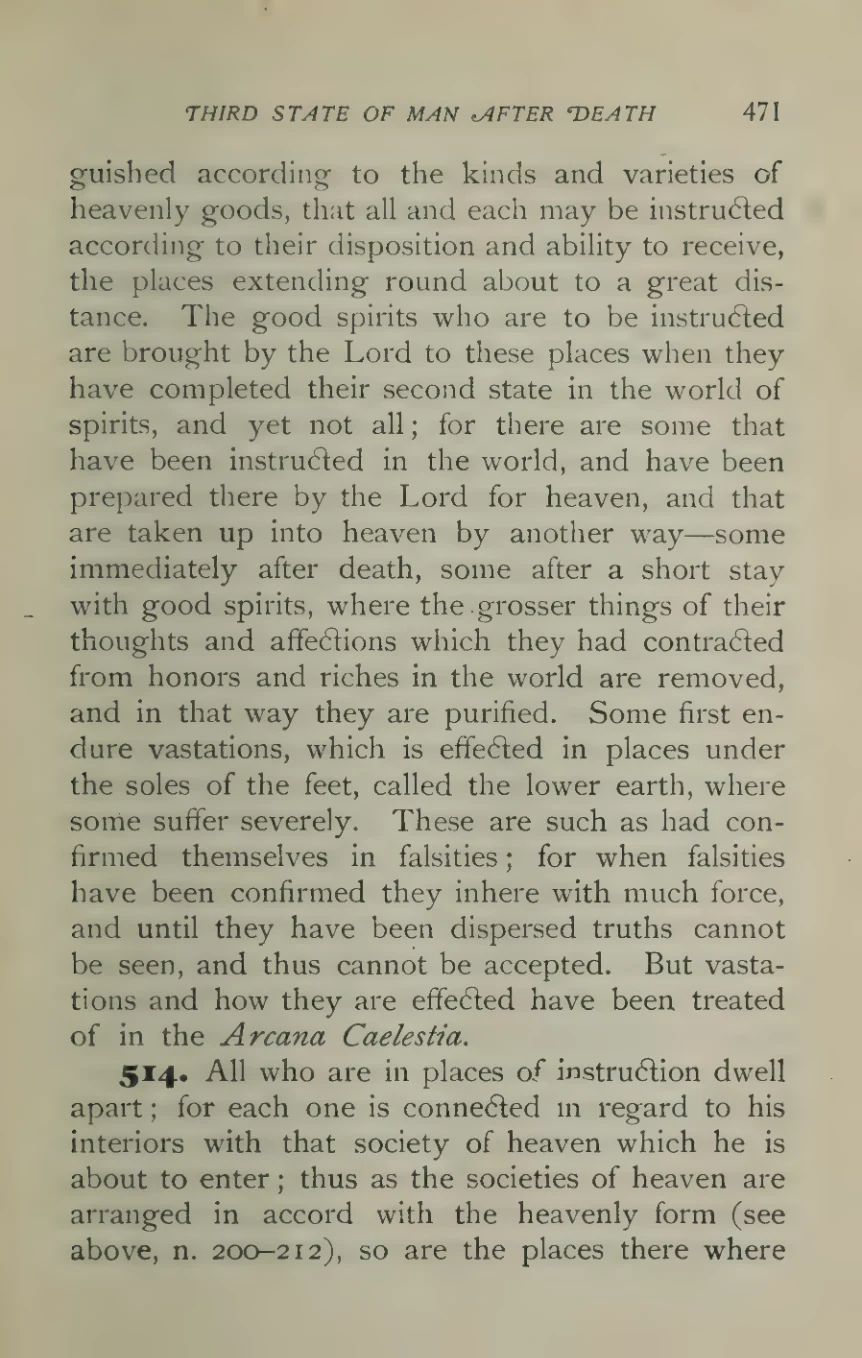
Heaven and Its Wonders and Hell (1916), printed p. 471, Library Reader page 478. Section 513 describes vastation among the routes to instruction.
Emanuel Swedenborg, Heaven and Its Wonders and Hell, J. C. Ager translation, New York, 1916. Public-domain historical page from the checksum-verified Library PDF. · Image source ↗ · Public Domain
The Divine Comedy by Dante Alighieri
Dante Alighieri’s Purgatorio organises correction through the ways love can be misdirected, too weak or attached too strongly to lesser goods. Marks on the pilgrim’s forehead and successive terraces make change visible. Statius explains release through a changed willingness to rise when purification has been fulfilled. [4][5][6][7][8][9]
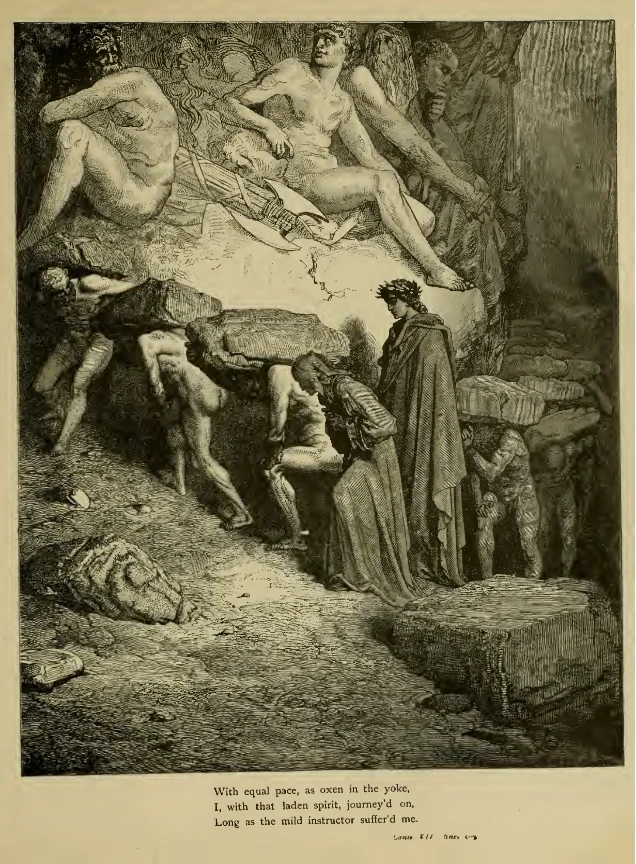
Gustave Doré, Purgatorio XII. Dante walks beside a burdened soul on the terrace of pride.
Purgatory and Paradise, 1901. Dante Alighieri, translated by Henry Francis Cary, designs by Gustave Doré. Thompson & Thomas, Chicago. Historical text and original designs Public Domain. · Image source ↗ · Public Domain
See references (6)
- Purgatory and Paradise, Reader page 58
- Purgatory and Paradise, Reader page 59
- Purgatory and Paradise, Purgatory XVII, Reader page 105
- Purgatory and Paradise, Purgatory XVII, Reader page 106
- Purgatory and Paradise, Purgatory XXI, printed p. 95, Reader page 127
- Purgatory and Paradise, Purgatory XXI, printed p. 96, Reader page 128
Preparation and exposure
The terraces in Dante’s Purgatorio prepare souls to rise. Swedenborg has a comparable use in the removal of false beliefs, but also uses vastation for the disclosure that precedes hell. The difference appears in where the person can go once the condition has been exposed. [3][1][2][4][5][6][7][8][9]
Swedenborg points readers of §513 to Arcana Caelestia for a fuller account. That cross-reference belongs to his discussion of those being prepared to receive instruction. [1]
See references (9)
- Heaven and Its Wonders and Hell, printed p. 471, Reader page 478
- Heaven and Its Wonders and Hell, printed p. 516, Reader page 523
- Heaven and Its Wonders and Hell, printed p. 466, Reader page 473
- Purgatory and Paradise, Reader page 58
- Purgatory and Paradise, Reader page 59
- Purgatory and Paradise, Purgatory XVII, Reader page 105
- Purgatory and Paradise, Purgatory XVII, Reader page 106
- Purgatory and Paradise, Purgatory XXI, printed p. 95, Reader page 127
- Purgatory and Paradise, Purgatory XXI, printed p. 96, Reader page 128
Read further in the library

Heaven and Its Wonders and Hell
Reading note
The separately titled account draws on exact passages in the consulted Library edition.
Purgatory and Paradise: The Vision of Dante
Reading note
Separately attributed comparison with exact previously researched Library passages.
Sources
See references (10)
- Heaven and Its Wonders and Hell, printed p. 471, Reader page 478Emanuel Swedenborg, Heaven and Its Wonders and Hell, From Things Heard and Seen, translated by J. C. Ager. American Swedenborg Printing and Publishing Society, New York, 1916. Latin original first published in 1758. Numbered sections and exact pages refer to this consulted edition. Claims of spiritual experience remain attributed.Read this page in Heaven and Its Wonders and Hell ↗Return to text ↑
- Heaven and Its Wonders and Hell, printed p. 516, Reader page 523Emanuel Swedenborg, Heaven and Its Wonders and Hell, From Things Heard and Seen, translated by J. C. Ager. American Swedenborg Printing and Publishing Society, New York, 1916. Latin original first published in 1758. Numbered sections and exact pages refer to this consulted edition. Claims of spiritual experience remain attributed.Read this page in Heaven and Its Wonders and Hell ↗Return to text ↑
- Heaven and Its Wonders and Hell, printed p. 466, Reader page 473Emanuel Swedenborg, Heaven and Its Wonders and Hell, From Things Heard and Seen, translated by J. C. Ager. American Swedenborg Printing and Publishing Society, New York, 1916. Latin original first published in 1758. Numbered sections and exact pages refer to this consulted edition. Claims of spiritual experience remain attributed.Read this page in Heaven and Its Wonders and Hell ↗Return to text ↑
- Purgatory and Paradise, Reader page 58Dante Alighieri, The Divine Comedy, translated by Henry Francis Cary, designs by Gustave Doré. Inferno: undated New Edition, Thompson & Thomas, Chicago. Purgatory and Paradise: New Edition, Thompson & Thomas, Chicago, 1901. Canto arguments are editorial matter and are distinguished from the poem.Read this page in Purgatory and Paradise: The Vision of Dante ↗Return to text ↑
- Purgatory and Paradise, Reader page 59Dante Alighieri, The Divine Comedy, translated by Henry Francis Cary, designs by Gustave Doré. Inferno: undated New Edition, Thompson & Thomas, Chicago. Purgatory and Paradise: New Edition, Thompson & Thomas, Chicago, 1901. Canto arguments are editorial matter and are distinguished from the poem.Read this page in Purgatory and Paradise: The Vision of Dante ↗Return to text ↑
- Purgatory and Paradise, Purgatory XVII, Reader page 105Dante Alighieri, Purgatory and Paradise, translated by Henry Francis Cary, designs by Gustave Doré, New Edition, Thompson & Thomas, Chicago, 1901. Literary accounts attributed to the poem and its speakers.Read this page in Purgatory and Paradise: The Vision of Dante ↗Return to text ↑
- Purgatory and Paradise, Purgatory XVII, Reader page 106Dante Alighieri, Purgatory and Paradise, translated by Henry Francis Cary, designs by Gustave Doré, New Edition, Thompson & Thomas, Chicago, 1901. Literary accounts attributed to the poem and its speakers.Read this page in Purgatory and Paradise: The Vision of Dante ↗Return to text ↑
- Purgatory and Paradise, Purgatory XXI, printed p. 95, Reader page 127Dante Alighieri, Purgatory and Paradise, translated by Henry Francis Cary, designs by Gustave Doré, New Edition, Thompson & Thomas, Chicago, 1901. Literary accounts attributed to the poem and its speakers.Read this page in Purgatory and Paradise: The Vision of Dante ↗Return to text ↑
- Purgatory and Paradise, Purgatory XXI, printed p. 96, Reader page 128Dante Alighieri, Purgatory and Paradise, translated by Henry Francis Cary, designs by Gustave Doré, New Edition, Thompson & Thomas, Chicago, 1901. Literary accounts attributed to the poem and its speakers.Read this page in Purgatory and Paradise: The Vision of Dante ↗Return to text ↑
- Purgatory and Paradise, Reader page 73Dante Alighieri, The Divine Comedy, translated by Henry Francis Cary, designs by Gustave Doré. Inferno: undated New Edition, Thompson & Thomas, Chicago. Purgatory and Paradise: New Edition, Thompson & Thomas, Chicago, 1901. Canto arguments are editorial matter and are distinguished from the poem.Read this page in Purgatory and Paradise: The Vision of Dante ↗