Vajrasattva in Buddhist Purification and Art
Who is Vajrasattva? Explore his place in Tibetan Buddhist purification and see how Getty and an eighth-century Kashmiri bronze show his vajra and bell.
In this article
Who is Vajrasattva?
Vajrasattva is a figure of purification in Vajrayāna Buddhism. In Tibetan preliminary practices, meditation and recitation centred on him address harmful actions and habits understood to obstruct progress. In art he often holds a vajra at his chest and a bell near his hip. [1][2][4][5]
The Gods of Northern Buddhism by Alice Getty
Alice Getty records accounts that link Vajrasattva with Akṣobhya or identify him with Vajradhara. She also describes systems that give him a primordial role. These accounts place the figure differently within Buddhist cosmology. [1][2]
Getty describes Vajrasattva usually holding the vajra in his right hand near the chest and the bell in his left near the hip. Some Japanese images of Kongōsatta bring the bell to the knee. The variation helps explain why both objects matter when identifying a figure. [2][3]
Purification in Patrul Rinpoche’s guide
In Adam Pearcey’s translation of Patrul Rinpoche’s guide to preliminary practice, the practitioner visualises the teacher in the form of Vajrasattva. The guide links this image and the hundred-syllable mantra with purification. It also describes the vajra at the heart and bell at the hip, the arrangement readers can look for in Getty’s examples. [4][1]
A Kashmiri Vajrasattva
A vajra and bell appear in this Kashmiri sculpture. One foot drops to a lotus, and the Met identifies two nāga figures beneath the seat. The image gives a regional example of the same implements in a different seated posture. [5][2]
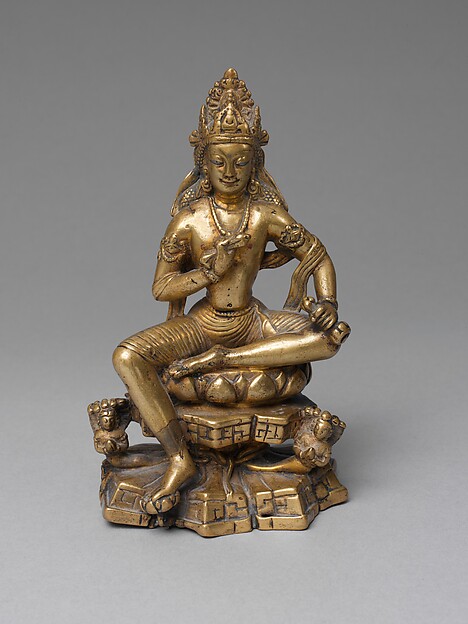
Vajrasattva, Kashmir, eighth century. Two figures emerge below the seat near the lowered foot.
The Metropolitan Museum of Art. Kashmir, eighth century. Gift of Florence and Herbert Irving, 2015. Accession 2015.500.4.6. · Image source ↗ · CC0
In the library
The Gods of Northern Buddhism
Reading note
Read Alice Getty’s illustrated discussion of Vajrasattva.
Sources
See references (5)
- The Gods of Northern Buddhism, printed p. 5, Reader page 57Alice Getty, The Gods of Northern Buddhism, 1928 revised second edition, Munshiram Manoharlal reprint. Lumitheca Library edition IMJ-0597-E001.Read this page in The Gods of Northern Buddhism ↗
- The Gods of Northern Buddhism, printed p. 6, Reader page 58Alice Getty, The Gods of Northern Buddhism, 1928 revised second edition, Munshiram Manoharlal reprint. Lumitheca Library edition IMJ-0597-E001.Read this page in The Gods of Northern Buddhism ↗
- The Gods of Northern Buddhism, printed p. 7, Reader page 59Alice Getty, The Gods of Northern Buddhism, 1928 revised second edition, Munshiram Manoharlal reprint. Lumitheca Library edition IMJ-0597-E001.Read this page in The Gods of Northern Buddhism ↗
- Brief Guide to the Ngöndro Visualization, Vajrasattva Purification section ↗Brief Guide to the Ngöndro Visualization, Vajrasattva Purification section. Translation credit: Patrul Rinpoche, translated by Adam Pearcey and edited by Janine Schulz.
- The Bodhisattva Vajrasattva ↗The Metropolitan Museum of Art. Kashmir, eighth century. Gift of Florence and Herbert Irving, 2015. Accession 2015.500.4.6.