Vajrapāṇi, the Buddhist Bearer of the Vajra
Who is Vajrapāṇi? Compare the Buddha’s vajra-bearing companion in Gandhāran art with the fierce protector described by Alice Getty.
In this article
Who is Vajrapāṇi?
Vajrapāṇi is a Buddhist guardian whose name means bearer of the vajra, an emblem associated with the thunderbolt. In early Gandhāran art he can stand beside the Buddha as an attendant. Fierce forms in other Buddhist traditions give the same emblem to a protector poised to act. [1][2][3][5]
The Gods of Northern Buddhism by Alice Getty
Alice Getty recounts how the Buddha charges Vajrapāṇi with protecting nāgas, or serpent beings, while they listen to his teaching. When their enemies the garuḍas approach, he takes on their wings, head and claws. In a separate Tibetan form Getty describes, a raised vajra and a serpent necklace mark his fierce appearance. [1][3]
Getty also studies Gandhāran attendants with objects she interprets as early vajras. These can look different from later ritual implements. The way the attendant stands beside the Buddha is another clue to what the object represents. [2]
Vajrapāṇi in The Chapter on Medicines
In Fumi Yao’s translation of the Chapter on Medicines, the Buddha repeatedly questions the young brahmin Ambāṣṭha. A yakṣa identified as Vajrapāṇi holds his vajra over the young man when he stays silent. The scene uses his power to press for an answer. Getty’s nāga story uses that power to shield an audience. [4][1]
The guardian in a first-sermon relief
Look to the Buddha’s right for a muscular figure holding a bar-shaped thunderbolt. The Met links his appearance to imagery of Heracles in Gandhāra. It notes that the written account of the first sermon leaves Vajrapāṇi out. In the carving, his presence signals that the Buddha is protected. [5][2]
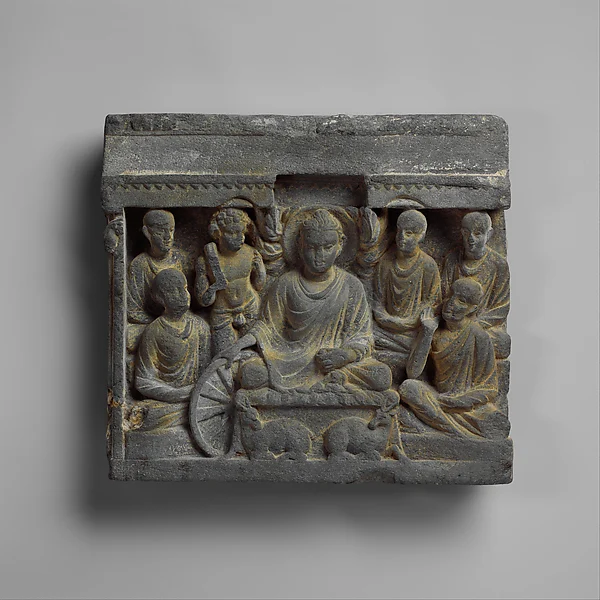
Vajrapāṇi beside the Buddha at his first sermon, Gandhāran schist relief, circa second century.
The Metropolitan Museum of Art. Gandhāra, circa second century. Gift of Daniel Slott, 1980. Accession 1980.527.4. · Image source ↗ · CC0
In the library
The Gods of Northern Buddhism
Reading note
Read Alice Getty’s illustrated discussion of Vajrapāṇi.
Sources
See references (5)
- The Gods of Northern Buddhism, printed p. 50, Reader page 102Alice Getty, The Gods of Northern Buddhism, 1928 revised second edition, Munshiram Manoharlal reprint. Lumitheca Library edition IMJ-0597-E001.Read this page in The Gods of Northern Buddhism ↗
- The Gods of Northern Buddhism, printed p. 51, Reader page 103Alice Getty, The Gods of Northern Buddhism, 1928 revised second edition, Munshiram Manoharlal reprint. Lumitheca Library edition IMJ-0597-E001.Read this page in The Gods of Northern Buddhism ↗
- The Gods of Northern Buddhism, printed p. 52, Reader page 104Alice Getty, The Gods of Northern Buddhism, 1928 revised second edition, Munshiram Manoharlal reprint. Lumitheca Library edition IMJ-0597-E001.Read this page in The Gods of Northern Buddhism ↗
- The Chapter on Medicines, Toh 1-6, §§ 6.35–6.37 ↗The Chapter on Medicines, Toh 1-6, §§ 6.35–6.37. Translation credit: Fumi Yao and the Bhaisajyavastu Translation Team. Published by 84000.
- Vajrapani Attends the Buddha at His First Sermon ↗The Metropolitan Museum of Art. Gandhāra, circa second century. Gift of Daniel Slott, 1980. Accession 1980.527.4.