Vairocana, the Cosmic Buddha
Who is Vairocana? Explore the cosmic Buddha called Dainichi in Japan, his place in Buddhist mandalas and the gesture known as the wisdom fist.
In this article
Who is Vairocana?
Vairocana is a Buddha of light and awakened wisdom. In many Esoteric Buddhist mandalas he sits at the centre, with other Buddhas around him. Japanese Shingon Buddhism knows him as Dainichi Nyorai, the Great Sun Buddha. [1][3][4][6]
The Gods of Northern Buddhism by Alice Getty
Alice Getty describes Vairocana both as one of five Buddhas and as a primordial figure in some accounts. In the Japanese Womb Realm mandala she describes, he sits in the centre of an eight-petalled lotus. The petals and the figures arranged around him give the mandala its form. [1][3]
Getty describes Vairocana with different gestures, including a teaching gesture and one she calls the Six Elements. In the latter, the right hand closes around the left index finger. She relates the joined hands to the spiritual and material elements. [2][3][4]
Vairocana’s light in The Essence of Vairocana
In Bruno Galasek-Hul’s translation of The Essence of Vairocana, the text opens by honouring Vairocana and the bodhisattva Ākāśagarbha. It associates recitation with a state of meditative absorption called stainless light. The association gives light a place in practice as well as in Vairocana’s name. [5][1][3]
The wisdom fist in a Japanese sculpture
The fingers of the right hand enclose the raised left index finger in this Heian sculpture. The Met calls the gesture the wisdom fist and associates it with Dainichi in the Diamond Realm. Getty’s Womb Realm account uses a different hand gesture at the lotus centre. The hands help identify which form is shown. [6][2][3]
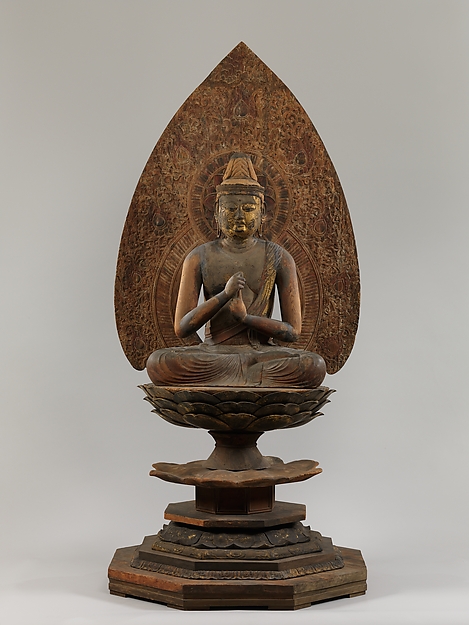
Dainichi, the Cosmic Buddha, Japan, 12th century. His hands form the wisdom fist.
The Metropolitan Museum of Art. Japan, Heian period, 12th century. Rogers Fund, 1926. Accession 26.118a, b. · Image source ↗ · CC0
In the library
The Gods of Northern Buddhism
Reading note
Read Alice Getty’s illustrated discussion of Vairocana.
Sources
See references (6)
- The Gods of Northern Buddhism, printed p. 31, Reader page 83Alice Getty, The Gods of Northern Buddhism, 1928 revised second edition, Munshiram Manoharlal reprint. Lumitheca Library edition IMJ-0597-E001.Read this page in The Gods of Northern Buddhism ↗
- The Gods of Northern Buddhism, printed p. 32, Reader page 84Alice Getty, The Gods of Northern Buddhism, 1928 revised second edition, Munshiram Manoharlal reprint. Lumitheca Library edition IMJ-0597-E001.Read this page in The Gods of Northern Buddhism ↗
- The Gods of Northern Buddhism, printed p. 33, Reader page 85Alice Getty, The Gods of Northern Buddhism, 1928 revised second edition, Munshiram Manoharlal reprint. Lumitheca Library edition IMJ-0597-E001.Read this page in The Gods of Northern Buddhism ↗
- The Gods of Northern Buddhism, printed p. 34, Reader page 86Alice Getty, The Gods of Northern Buddhism, 1928 revised second edition, Munshiram Manoharlal reprint. Lumitheca Library edition IMJ-0597-E001.Read this page in The Gods of Northern Buddhism ↗
- The Dhāraṇī “The Essence of Vairocana”, Toh 861, §§ 1.1–1.3 and introduction on the Sanskrit invocation ↗The Dhāraṇī “The Essence of Vairocana”, Toh 861, §§ 1.1–1.3 and introduction on the Sanskrit invocation. Source credit: Bruno Galasek-Hul, 84000.
- Dainichi, the Cosmic Buddha (Mahavairocana) ↗The Metropolitan Museum of Art. Japan, Heian period, 12th century. Rogers Fund, 1926. Accession 26.118a, b.