The Universal Pulse
What is the universal pulse in esoteric cosmology? Read how Manly P. Hall connects the heartbeat, cosmic motion and Shiva’s drum.
In this article
The heartbeat as a measure of the cosmos
The universal pulse is an esoteric image of rhythm shared by the body and the cosmos. A heartbeat gives that idea a familiar scale. Its repeated motion becomes a way to picture how the parts of a larger whole keep moving together. [2][3]
Guide for the Perplexed by Moses Maimonides
In The Guide for the Perplexed, Moses Maimonides compares the universe with a single ordered being. The heart communicates motion to the body through its pulsations. In his cosmology, the outermost sphere plays a corresponding role for the rest of the universe. [1]
Pulsus by Robert Fludd
In Pulsus, Robert Fludd sets the dimensions of the pulse beside the timing of motion and rest. The chart places these readings on shared scales and marks winter and summer hemispheres. [6]
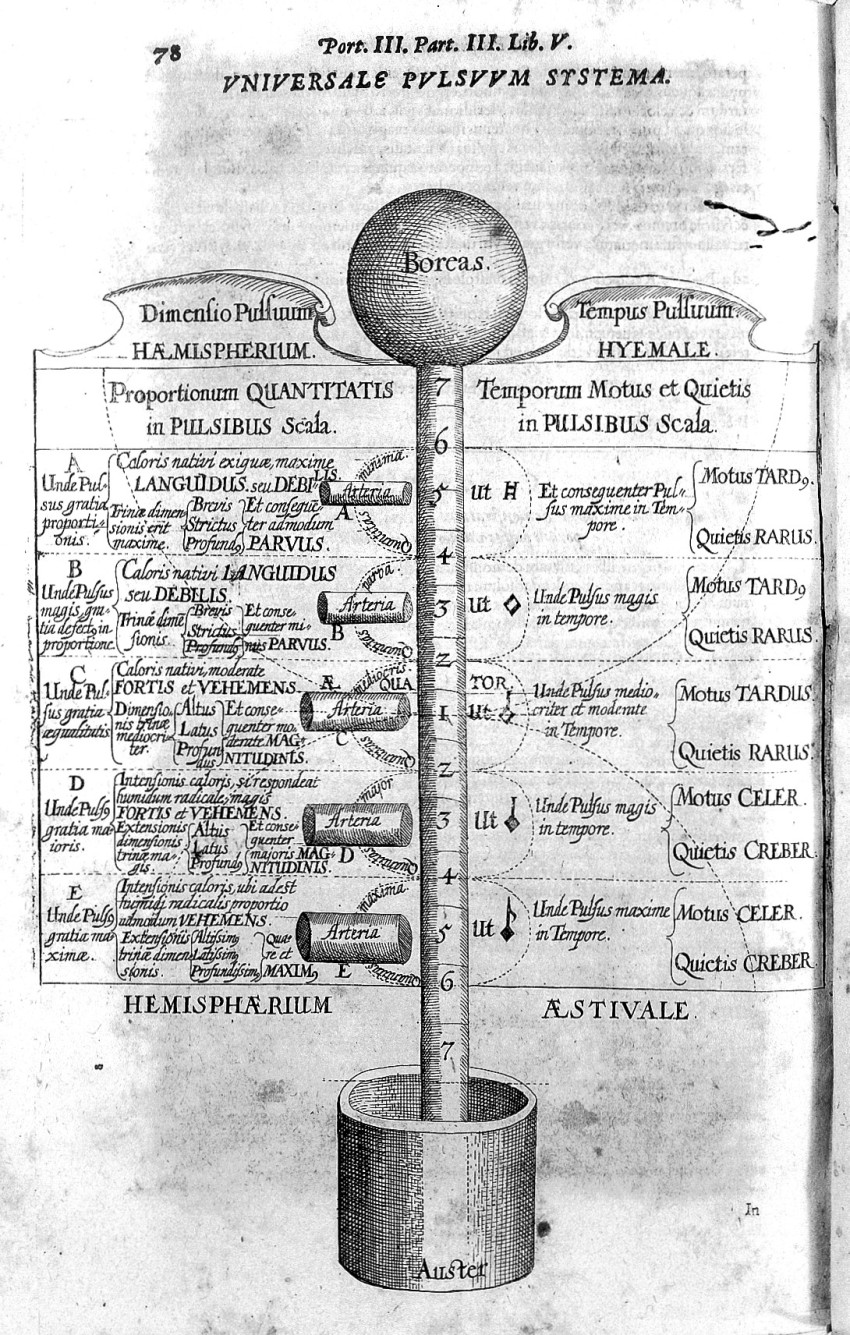
Fludd’s chart compares strength and timing in the pulse. Its central scale runs between the winter and summer hemispheres.
Robert Fludd, Pulsus, 1631, p. 78. Wellcome Library, London, L0016235, via Wikimedia Commons. Resized from the original scan. · Image source ↗ · CC BY 4.0
Man the Grand Symbol of the Mysteries by Manly P. Hall
In Man the Grand Symbol of the Mysteries, Manly P. Hall takes up Maimonides’s comparison between the heart and the outermost celestial sphere. He connects the human pulse with the measurement of time and evokes the drum of Shiva as an image of rhythm. [2][3]
Hall frames his chapter with material from Robert Fludd. It opens with the title page of Fludd’s 1631 treatise on the pulse and closes with Fludd’s diagram of the universal system of pulsation. [4][3][5][6]
See references (5)
- Man the Grand Symbol of the Mysteries, printed p. 254, Reader page 249
- Man the Grand Symbol of the Mysteries, printed p. 255, Reader page 250
- Man the Grand Symbol of the Mysteries, Reader page 229
- Man the Grand Symbol of the Mysteries, Reader page 251
- Pulsus seu nova et arcana pulsuum historia (1631), printed p. 78, Universale pulsuum systema
What the pulse explains
Maimonides uses the comparison to explain how the parts of an ordered whole receive motion. Hall makes rhythm itself the subject, placing the heartbeat and Shiva’s drum beside the older comparison. [2][3][1]
In the library
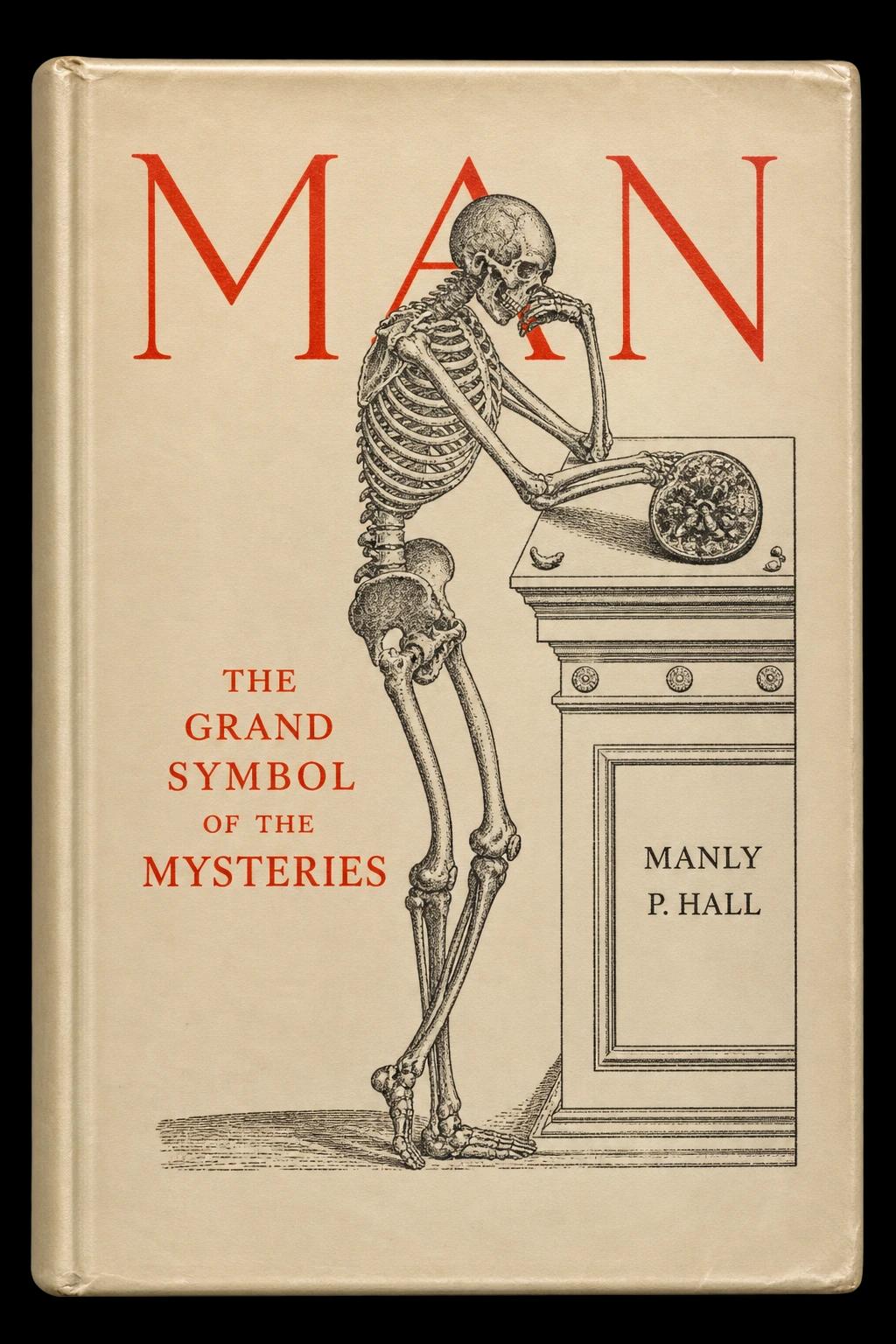
Man the Grand Symbol of the Mysteries
Reading note
The separately titled account draws on exact passages in the consulted Library edition.
Sources
See references (6)
- Guide for the Perplexed, Friedländer translation, part I, chapter 72 ↗Moses Maimonides, Guide for the Perplexed, part I, chapter 72, translated by M. Friedländer.
- Man the Grand Symbol of the Mysteries, printed p. 254, Reader page 249Manly P. Hall, Man the Grand Symbol of the Mysteries, Fourth Edition, The Philosophers Press, Los Angeles, 1937. Lumitheca Library edition IMJ-0603-E001.Read this page in Man the Grand Symbol of the Mysteries ↗
- Man the Grand Symbol of the Mysteries, printed p. 255, Reader page 250Manly P. Hall, Man the Grand Symbol of the Mysteries, Fourth Edition, The Philosophers Press, Los Angeles, 1937. Lumitheca Library edition IMJ-0603-E001.Read this page in Man the Grand Symbol of the Mysteries ↗
- Man the Grand Symbol of the Mysteries, Reader page 229Manly P. Hall, Man the Grand Symbol of the Mysteries, Fourth Edition, The Philosophers Press, Los Angeles, 1937. Lumitheca Library edition IMJ-0603-E001.Read this page in Man the Grand Symbol of the Mysteries ↗
- Man the Grand Symbol of the Mysteries, Reader page 251Manly P. Hall, Man the Grand Symbol of the Mysteries, Fourth Edition, The Philosophers Press, Los Angeles, 1937. Lumitheca Library edition IMJ-0603-E001.Read this page in Man the Grand Symbol of the Mysteries ↗
- Pulsus seu nova et arcana pulsuum historia (1631), printed p. 78, Universale pulsuum systema ↗Robert Fludd, Pulsus, 1631, p. 78. Wellcome Library, London, L0016235, via Wikimedia Commons. Resized from the original scan.