Tsok Shin: The Tibetan Buddhist Field of Merit
A tsok shin is a Tibetan Buddhist field of merit, an assembly of teachers and sacred figures used as a focus for offerings, prayer, or visualisation. Refuge-field paintings make a particular lineage and its figures visible together.
In this article
What is a field of merit?
A tsok shin, or field of merit, is an assembly of buddhas, teachers and other sacred figures in Tibetan Buddhist practice. Practitioners may picture the assembly as they take refuge, make offerings or recite a prayer. In paintings, the figure at the centre often helps identify the lineage or practice represented. [6][5][1]
The Nepalese painting in Alice Getty’s survey
Alice Getty reproduces a key to a Nepalese painting offered to a temple in 1809. Three medallions span the top. Below them, at the summit of the main assembly, Getty names Śākyamuni, Śāriputra, Maudgalyāyana and Atiśa. She numbers the figures in the lower rows and records colours that help identify them. [1][2][3]
One figure in the lower centre is marked as possibly the Medicine Buddha or Śākyamuni. Other details are easier to place. The key identifies guardians below the assembly and offerings for the five senses, such as a mirror for sight and a conch for hearing. [2][3][4]
An assembly as witnesses in Tibetan prayer
Jamyang Khyentse Chökyi Lodrö begins his recitation text with taking refuge and aspiring to awaken for all beings. He brings Śākyamuni, the bodhisattva Samantabhadra and other awakened figures to mind as witnesses to the prayer. The assembly has a role in the recitation as well as a place in art. [5][1][3]
See references (3)
A Gelug refuge field centred on Tsongkhapa
The Asian Art Museum’s Gelug painting places Tsongkhapa above rows of figures on a tree. Getty’s Nepalese example gives Śākyamuni the highest position in a pyramidal assembly. The central figure and the shape of the gathering are useful starting points when reading either image. [6][1][3]
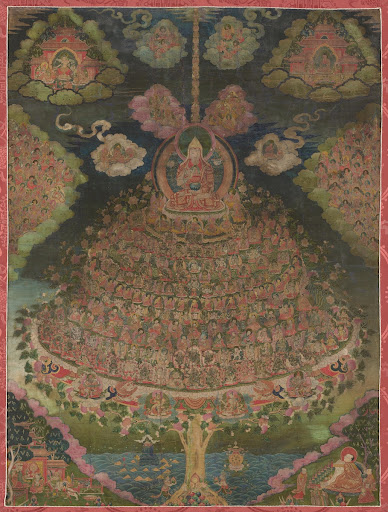
Tsongkhapa presides in this eighteenth-century Tibetan painting of the Gelug refuge field. The tree gives the crowded assembly a visible structure.
Asian Art Museum, The Avery Brundage Collection, B60D22+. Public domain. · Image source ↗ · Public Domain
In the library
The Gods of Northern Buddhism
Reading note
Read Alice Getty’s illustrated discussion of Tsok Shin.
Sources
See references (6)
- The Gods of Northern Buddhism, Tsok Shin key, Reader page 225Alice Getty, The Gods of Northern Buddhism, 1928 revised second edition, Munshiram Manoharlal reprint. Lumitheca Library edition IMJ-0597-E001.Read this page in The Gods of Northern Buddhism ↗
- The Gods of Northern Buddhism, printed p. 180, Reader page 226Alice Getty, The Gods of Northern Buddhism, 1928 revised second edition, Munshiram Manoharlal reprint. Lumitheca Library edition IMJ-0597-E001.Read this page in The Gods of Northern Buddhism ↗
- The Gods of Northern Buddhism, Tsok Shin diagram, Reader page 227Alice Getty, The Gods of Northern Buddhism, 1928 revised second edition, Munshiram Manoharlal reprint. Lumitheca Library edition IMJ-0597-E001.Read this page in The Gods of Northern Buddhism ↗
- The Gods of Northern Buddhism, printed p. 181, Reader page 228Alice Getty, The Gods of Northern Buddhism, 1928 revised second edition, Munshiram Manoharlal reprint. Lumitheca Library edition IMJ-0597-E001.Read this page in The Gods of Northern Buddhism ↗
- A Brief Method for Reciting Samantabhadra’s Prayer of Good Actions, refuge verses and the visualisation beginning with Śākyamuni; Collected Works, vol. 7, p. 611 ↗A Brief Method for Reciting Samantabhadra’s Prayer of Good Actions, refuge verses and the visualisation beginning with Śākyamuni; Collected Works, vol. 7, p. 611. Source credit: Jamyang Khyentse Chökyi Lodrö, translated by Adam Pearcey for Lotsawa House.
- The lama Tsongkhapa and the refuge field of the Gelug order ↗Asian Art Museum, The Avery Brundage Collection, B60D22+. Public domain.