Trikāya, the Three Bodies of a Buddha
What are the three bodies of a Buddha? Understand dharmakāya, saṃbhogakāya and nirmāṇakāya through a Buddhist sūtra and Alice Getty’s account.
In this article
What are the three bodies of a Buddha?
Trikāya is the Mahāyāna teaching of the three bodies of a Buddha. The truth body, dharmakāya, concerns the nature of awakening. The enjoyment body, saṃbhogakāya, is the form through which a Buddha appears to bodhisattvas. The manifestation body, nirmāṇakāya, is the form through which a Buddha acts in the world. [5][1]
The Gods of Northern Buddhism by Alice Getty
Alice Getty presents a system that links the earthly Buddha to the manifestation body, the celestial Buddha to the truth body, and the celestial bodhisattva to the enjoyment body. Her glossary illustrates one arrangement with Śākyamuni, Locana and Vairocana. [1][3][4]
Getty also records a reading that aligns the bodies with the Three Jewels of Buddha, Dharma and Saṅgha. Her examples show how interpreters use the same three terms to organise different sets of figures or ideas. [1][2]
Sky, cloud and rain in The Sūtra on the Three Bodies
In the Buddhavacana Translation Group’s version of the Sūtra on the Three Bodies, Kṣitigarbha asks whether a Buddha has a body. The reply describes the truth body as open as the sky, the enjoyment body as a cloud that forms, and the manifestation body as rain that reaches everything. The images move from the nature of awakening to the way its activity reaches others. [5][1][4]
A bronze of Vairocana from Java
The Met identifies this Javanese bronze as Vairocana, the central figure among five Transcendent Buddhas. Getty names Vairocana in her discussion of the truth body. The sculpture shows a historical image of the figure she names and the sūtra explains the body through its analogy of the sky. [6][4][5]
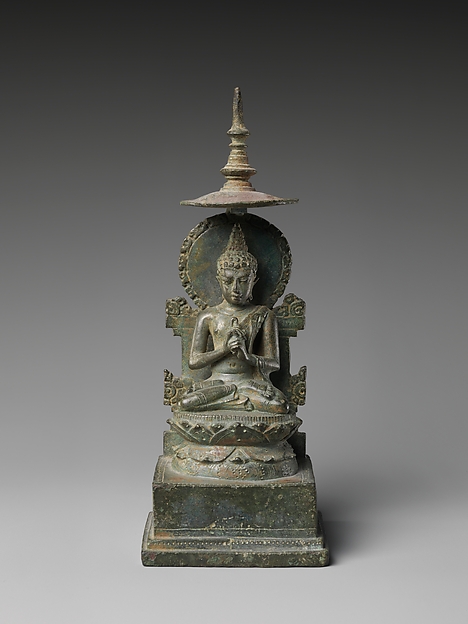
Seated Vairochana, the Transcendent Buddha of the Center, Java, first half of the tenth century.
The Metropolitan Museum of Art. Java, first half of the tenth century. Samuel Eilenberg Collection, Gift of Samuel Eilenberg, 1987. Accession 1987.142.21. · Image source ↗ · CC0
In the library
The Gods of Northern Buddhism
Reading note
Read Alice Getty’s illustrated discussion of Trikāya.
Sources
See references (6)
- The Gods of Northern Buddhism, printed p. 11, Reader page 63Alice Getty, The Gods of Northern Buddhism, 1928 revised second edition, Munshiram Manoharlal reprint. Lumitheca Library edition IMJ-0597-E001.Read this page in The Gods of Northern Buddhism ↗
- The Gods of Northern Buddhism, printed p. 12, Reader page 64Alice Getty, The Gods of Northern Buddhism, 1928 revised second edition, Munshiram Manoharlal reprint. Lumitheca Library edition IMJ-0597-E001.Read this page in The Gods of Northern Buddhism ↗
- The Gods of Northern Buddhism, printed p. 45, Reader page 97Alice Getty, The Gods of Northern Buddhism, 1928 revised second edition, Munshiram Manoharlal reprint. Lumitheca Library edition IMJ-0597-E001.Read this page in The Gods of Northern Buddhism ↗
- The Gods of Northern Buddhism, printed p. 197, Reader page 243Alice Getty, The Gods of Northern Buddhism, 1928 revised second edition, Munshiram Manoharlal reprint. Lumitheca Library edition IMJ-0597-E001.Read this page in The Gods of Northern Buddhism ↗
- The Sūtra on the Three Bodies, Toh 283, §§ 1.3–1.6 and translators’ introduction § i.3 ↗The Sūtra on the Three Bodies, Toh 283, §§ 1.3–1.6 and translators’ introduction § i.3. Translation credit: Rolf Scheuermann and Casey Kemp, Buddhavacana Translation Group.
- Seated Vairochana, the Transcendent Buddha of the Center ↗The Metropolitan Museum of Art. Java, first half of the tenth century. Samuel Eilenberg Collection, Gift of Samuel Eilenberg, 1987. Accession 1987.142.21.