Transhumanisation in Dante
Transhumanisation in Dante is a change beyond ordinary human experience. Read trasumanar in Paradise I and the analogy of Glaucus in Cary’s translation.
In this article
Understanding transhumanisation in dante
Transhumanisation in Dante is a change beyond the capacities of ordinary human experience. At the opening of Paradise, the pilgrim finds his perception changing in a way he says words cannot convey. [1][2][3]
Dante uses the verb trasumanar. Henry Francis Cary renders it as a transhuman change. The poem asks how grace can make someone capable of an experience their ordinary understanding could not receive. [2][3][13]
The Divine Comedy by Dante Alighieri
In Paradise I, Dante Alighieri watches Beatrice gazing upwards and then fixes his own attention on her. He compares the inward change to Glaucus, who became a companion of sea gods after tasting a herb. The myth supplies an analogy for an experience that the narrator says language cannot convey. [2]
The example of Glaucus gives something to a reader who has not shared the experience. Dante says grace can keep the fuller understanding for some people. He leaves it to God to know what happened to his body and soul in the ascent. [2]
His next uncertainty concerns rising beyond lighter bodies. Beatrice answers through an order in which creatures tend towards their proper ends. She presents this ascent as movement towards an intended home when impediments have been removed, rather than a self-generated feat of conquest. [3][4]
The poem had already announced a limit to recollection. The intellect’s approach to its desire can exceed what memory brings back. Difficulty in telling the experience is therefore part of the narrative’s design, not merely an absent explanation to be supplied by another esoteric system. [1][2]
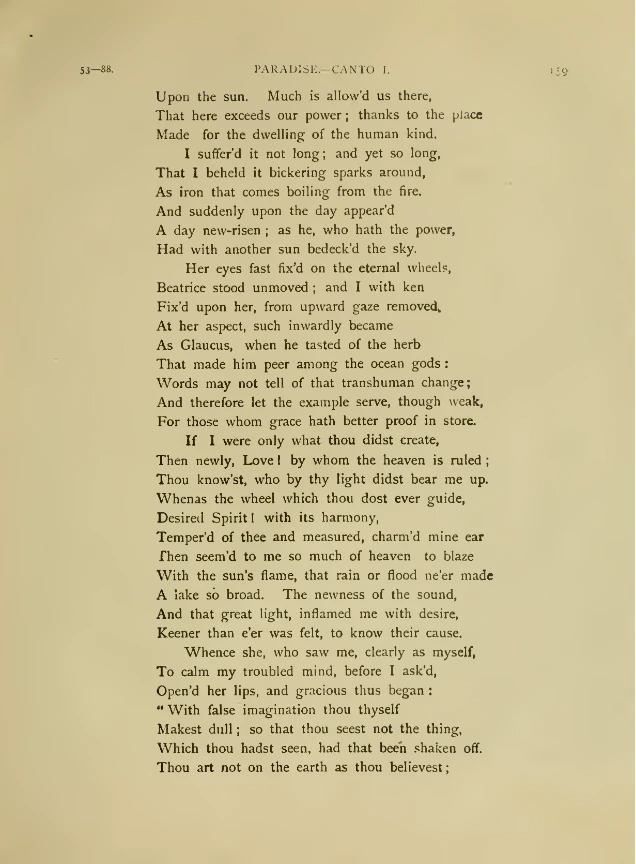
Paradise I in Henry Francis Cary’s translation, Library Reader page 207. Cary’s transhuman change follows Dante’s comparison with Glaucus.
Purgatory and Paradise, 1901. Dante Alighieri, translated by Henry Francis Cary, designs by Gustave Doré. Thompson & Thomas, Chicago. Historical text and original designs Public Domain. · Image source ↗ · Public Domain
Evolution of Immortality by Rosicruciæ
Freeman Benjamin Dowd, writing as Rosicruciæ in Evolution of Immortality, describes a further transformation into a fire body. It concerns the union of mind and soul, love and truth, and is distinguished from a mobile astral counterpart. [7][8][9][10][11][12]
See references (6)
- Evolution of Immortality, printed p. 18, Reader page 15
- Evolution of Immortality, printed p. 19, Reader page 16
- Evolution of Immortality, printed p. 20, Reader page 17
- Evolution of Immortality, printed p. 21, Reader page 18
- Evolution of Immortality, printed p. 74, Reader page 71
- Evolution of Immortality, printed p. 75, Reader page 72
What the traveller becomes able to perceive
Glaucus supplies a story of becoming able to live in a different element. When Dante later enters the Empyrean, light overwhelms him and his sight grows stronger. Both scenes ask what the traveller must become capable of receiving. [2][5][6]
Dowd gives transformation a proposed form, the fire body. Dante gives the traveller a new capacity to perceive and repeatedly shows where memory and language fall short of it. One account explains the form a person may take. The other asks how much of a changed experience the narrator can bring back. [7][8][9][10][11][12][1][2][3]
See references (11)
- Purgatory and Paradise, Reader page 205
- Purgatory and Paradise, Reader page 207
- Purgatory and Paradise, Reader page 208
- Purgatory and Paradise, Reader page 350
- Purgatory and Paradise, Reader page 351
- Evolution of Immortality, printed p. 18, Reader page 15
- Evolution of Immortality, printed p. 19, Reader page 16
- Evolution of Immortality, printed p. 20, Reader page 17
- Evolution of Immortality, printed p. 21, Reader page 18
- Evolution of Immortality, printed p. 74, Reader page 71
- Evolution of Immortality, printed p. 75, Reader page 72
Read further in the library
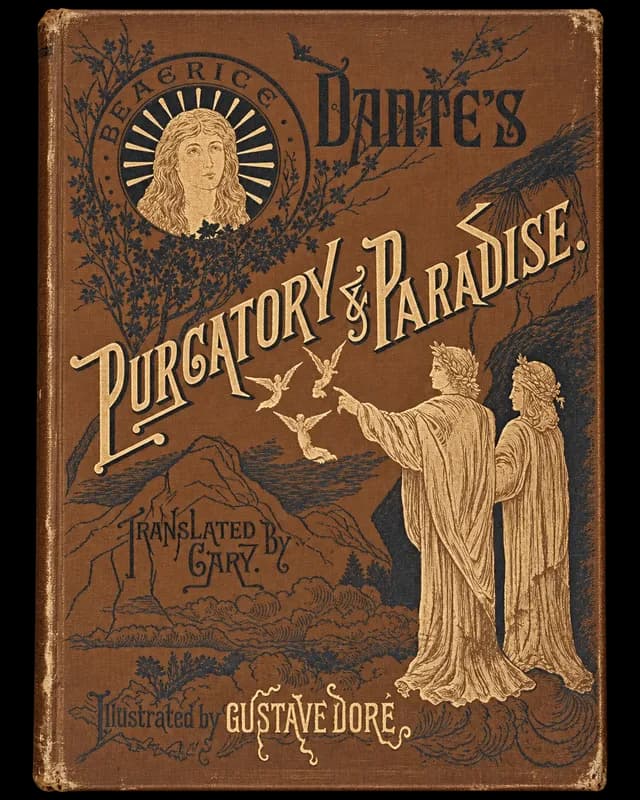
Purgatory and Paradise: The Vision of Dante
Reading note
Exact consulted edition and PageRefs in a separately titled book account.
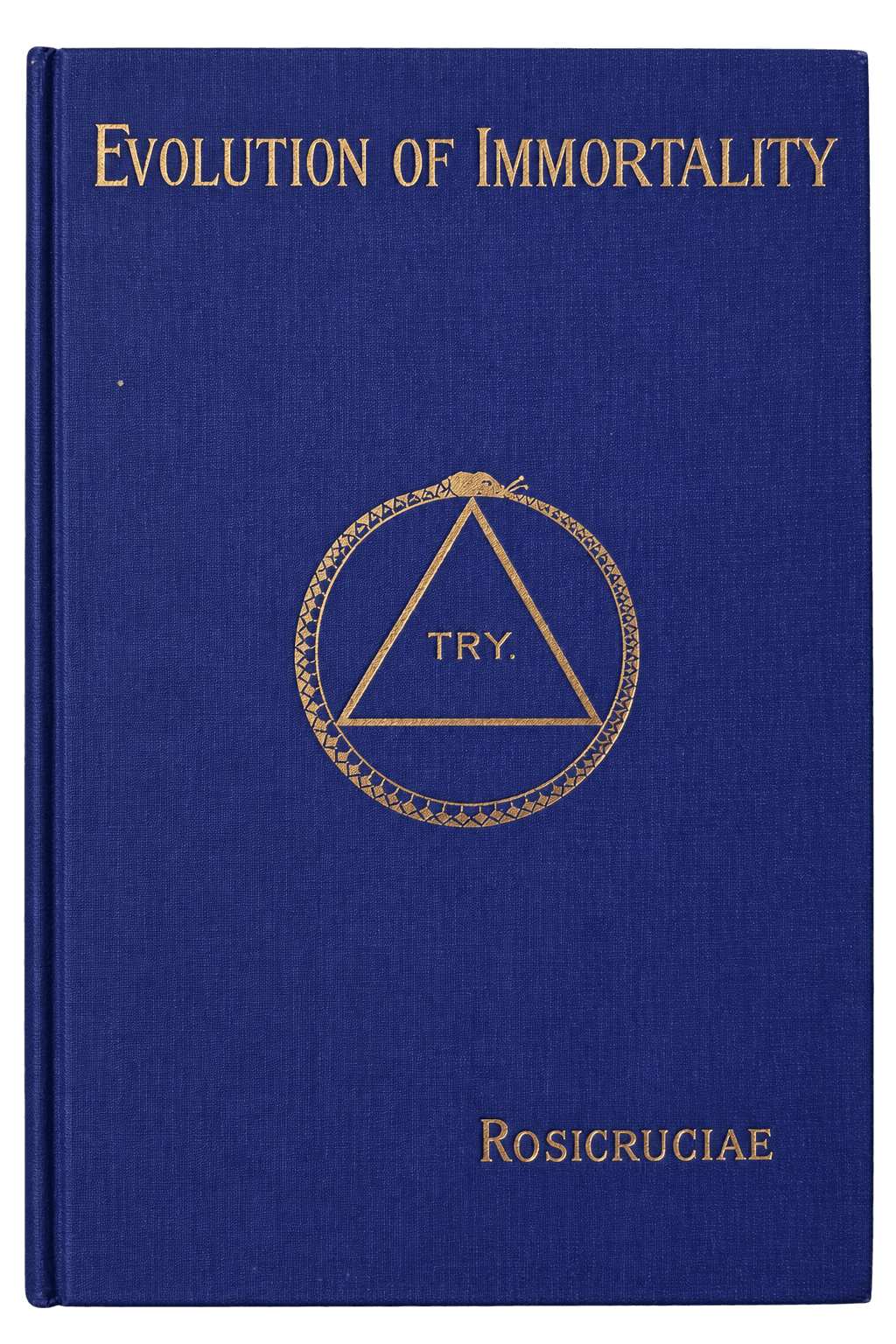
Evolution of Immortality
Reading note
Exact consulted edition and PageRefs in a separately titled book account.
Sources
See references (13)
- Purgatory and Paradise, Reader page 205Dante Alighieri, The Divine Comedy, translated by Henry Francis Cary, designs by Gustave Doré. Inferno: undated New Edition, Thompson & Thomas, Chicago. Purgatory and Paradise: New Edition, Thompson & Thomas, Chicago, 1901. Canto arguments are editorial matter and are distinguished from the poem.Read this page in Purgatory and Paradise: The Vision of Dante ↗Return to text ↑
- Purgatory and Paradise, Reader page 207Dante Alighieri, The Divine Comedy, translated by Henry Francis Cary, designs by Gustave Doré. Inferno: undated New Edition, Thompson & Thomas, Chicago. Purgatory and Paradise: New Edition, Thompson & Thomas, Chicago, 1901. Canto arguments are editorial matter and are distinguished from the poem.Read this page in Purgatory and Paradise: The Vision of Dante ↗Return to text ↑
- Purgatory and Paradise, Reader page 208Dante Alighieri, The Divine Comedy, translated by Henry Francis Cary, designs by Gustave Doré. Inferno: undated New Edition, Thompson & Thomas, Chicago. Purgatory and Paradise: New Edition, Thompson & Thomas, Chicago, 1901. Canto arguments are editorial matter and are distinguished from the poem.Read this page in Purgatory and Paradise: The Vision of Dante ↗Return to text ↑
- Purgatory and Paradise, Reader page 211Dante Alighieri, The Divine Comedy, translated by Henry Francis Cary, designs by Gustave Doré. Inferno: undated New Edition, Thompson & Thomas, Chicago. Purgatory and Paradise: New Edition, Thompson & Thomas, Chicago, 1901. Canto arguments are editorial matter and are distinguished from the poem.Read this page in Purgatory and Paradise: The Vision of Dante ↗Return to text ↑
- Purgatory and Paradise, Reader page 350Dante Alighieri, The Divine Comedy, translated by Henry Francis Cary, designs by Gustave Doré. Inferno: undated New Edition, Thompson & Thomas, Chicago. Purgatory and Paradise: New Edition, Thompson & Thomas, Chicago, 1901. Canto arguments are editorial matter and are distinguished from the poem.Read this page in Purgatory and Paradise: The Vision of Dante ↗Return to text ↑
- Purgatory and Paradise, Reader page 351Dante Alighieri, The Divine Comedy, translated by Henry Francis Cary, designs by Gustave Doré. Inferno: undated New Edition, Thompson & Thomas, Chicago. Purgatory and Paradise: New Edition, Thompson & Thomas, Chicago, 1901. Canto arguments are editorial matter and are distinguished from the poem.Read this page in Purgatory and Paradise: The Vision of Dante ↗Return to text ↑
- Evolution of Immortality, printed p. 18, Reader page 15Rosicruciæ (catalogued as Freeman Benjamin Dowd), Evolution of Immortality. Eulian Publishing Company, Salem, 1900.Read this page in Evolution of Immortality ↗Return to text ↑
- Evolution of Immortality, printed p. 19, Reader page 16Rosicruciæ (catalogued as Freeman Benjamin Dowd), Evolution of Immortality. Eulian Publishing Company, Salem, 1900.Read this page in Evolution of Immortality ↗Return to text ↑
- Evolution of Immortality, printed p. 20, Reader page 17Rosicruciæ (catalogued as Freeman Benjamin Dowd), Evolution of Immortality. Eulian Publishing Company, Salem, 1900.Read this page in Evolution of Immortality ↗Return to text ↑
- Evolution of Immortality, printed p. 21, Reader page 18Rosicruciæ (catalogued as Freeman Benjamin Dowd), Evolution of Immortality. Eulian Publishing Company, Salem, 1900.Read this page in Evolution of Immortality ↗Return to text ↑
- Evolution of Immortality, printed p. 74, Reader page 71Rosicruciæ (catalogued as Freeman Benjamin Dowd), Evolution of Immortality. Eulian Publishing Company, Salem, 1900.Read this page in Evolution of Immortality ↗Return to text ↑
- Evolution of Immortality, printed p. 75, Reader page 72Rosicruciæ (catalogued as Freeman Benjamin Dowd), Evolution of Immortality. Eulian Publishing Company, Salem, 1900.Read this page in Evolution of Immortality ↗Return to text ↑
- Dante, Paradise I, lines 64–75, Italian text ↗Dante Alighieri, Paradiso, Italian text and English translation.Return to text ↑