The Tornado Principle in Walter Russell
Why did Walter Russell make the tornado a model of cosmic motion? Read his paired cone diagram and compare it with the science of tornadoes.
In this article
What the funnel represents
Walter Russell’s Tornado Principle uses a whirlwind to picture how matter gathers and spreads out. He gives the vortex a role at scales far beyond a storm. The familiar funnel becomes an image for his theory of motion. [4][5][6][7]
The Universal One by Walter Russell
In The Universal One, Walter Russell draws closing spirals as cones. He has matter move toward the apex while pressure and rotation change. In the surrounding chapter he applies the image to the solar system, with planets moving within a much larger whirl. [8][4][9][5][6]
The Tornado Principle plate puts narrowing and widening forms together. Russell links them with his explanations for attraction, repulsion and falling objects. It shows how he turns the shape of a vortex into a model for other kinds of motion. [5][6][7]
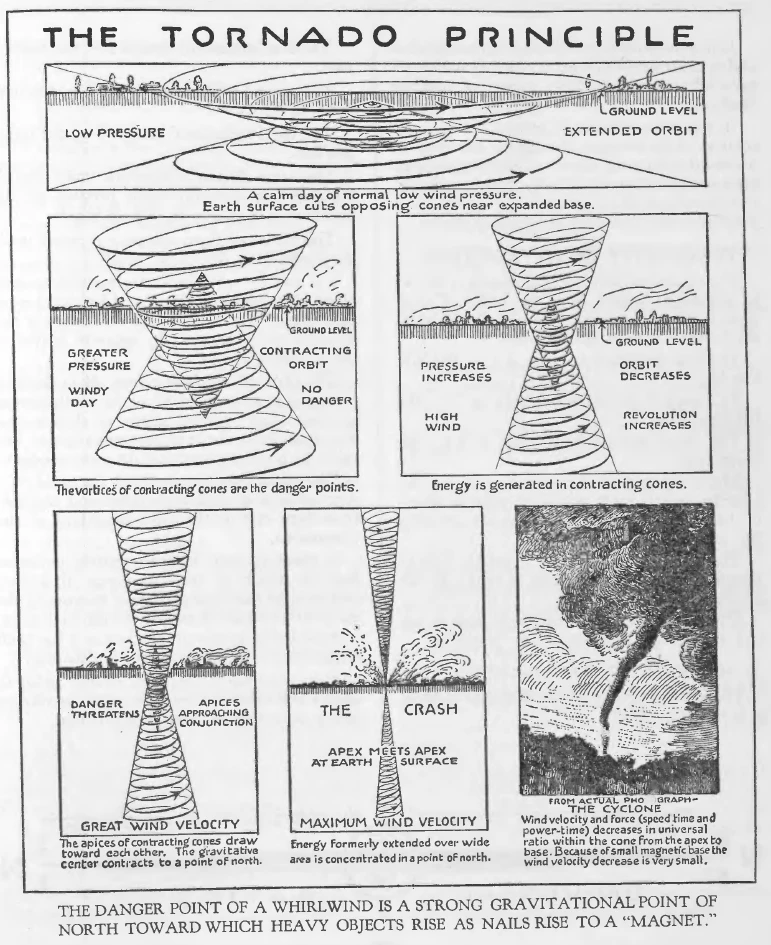
Russell’s Tornado Principle plate places closing and opening forms side by side. He interprets narrowing and widening as opposing directions of motion.
Walter Russell, The Tornado Principle. Brieger Press, New York, copyright 1926, Library of Congress LCCN 27004508. Library of Congress, public domain. · Image source ↗ · Public Domain
See references (6)
- The Universal One, printed p. 173, Reader page 172
- The Universal One, printed p. 178, Reader page 177
- The Universal One, printed p. 179, Reader page 178
- The Universal One, printed p. 180, Reader page 179
- The Universal One, printed p. 172, Reader page 171
- The Universal One, printed p. 177, Reader page 176
A storm and a universal pattern
NOAA describes a tornado as a rotating column of air in contact with the ground. Its account of supercell tornadoes concerns processes such as wind shear and rotating updrafts. Russell gives the funnel a wider role as a model for matter and the motion of planets. [5][6][7][2][3]
In the library
The Universal One
Reading note
The separately titled account draws on exact passages in the consulted Library edition.
Sources
See references (9)
- The Tornado Principle ↗Walter Russell, The Tornado Principle. Brieger Press, New York, copyright 1926, Library of Congress LCCN 27004508. Library of Congress, public domain.
- NOAA Severe Weather 101, Tornado Basics ↗NOAA National Severe Storms Laboratory, Severe Weather 101.
- NOAA Severe Weather 101, Types of Tornadoes ↗NOAA National Severe Storms Laboratory, Types of Tornadoes.
- The Universal One, printed p. 173, Reader page 172Walter Russell, The Universal One, edited by Louise Russell, University of Science and Philosophy, Limited Edition De Luxe. Lumitheca Library edition IMJ-0605-E001.Read this page in The Universal One ↗
- The Universal One, printed p. 178, Reader page 177Walter Russell, The Universal One, edited by Louise Russell, University of Science and Philosophy, Limited Edition De Luxe. Lumitheca Library edition IMJ-0605-E001.Read this page in The Universal One ↗
- The Universal One, printed p. 179, Reader page 178Walter Russell, The Universal One, edited by Louise Russell, University of Science and Philosophy, Limited Edition De Luxe. Lumitheca Library edition IMJ-0605-E001.Read this page in The Universal One ↗
- The Universal One, printed p. 180, Reader page 179Walter Russell, The Universal One, edited by Louise Russell, University of Science and Philosophy, Limited Edition De Luxe. Lumitheca Library edition IMJ-0605-E001.Read this page in The Universal One ↗
- The Universal One, printed p. 172, Reader page 171Walter Russell, The Universal One, edited by Louise Russell, University of Science and Philosophy, Limited Edition De Luxe. Lumitheca Library edition IMJ-0605-E001.Read this page in The Universal One ↗
- The Universal One, printed p. 177, Reader page 176Walter Russell, The Universal One, edited by Louise Russell, University of Science and Philosophy, Limited Edition De Luxe. Lumitheca Library edition IMJ-0605-E001.Read this page in The Universal One ↗