Tonal Mates and Master Tones in Walter Russell
What were Walter Russell’s tonal mates and master tones? Explore his element pairings, supposed stability and the role he gives the inert gases.
In this article
The roles of pairs and points of balance
Tonal mates are substances Walter Russell pairs in corresponding positions of his octave system. He uses the pairs to explain which combinations he expects to be stable. Master tones mark points of balance within the same system. [3][4][5][6]
The Universal One by Walter Russell
In The Universal One, Walter Russell expects the most stable union between substances of equal potential on opposite sides of his scheme. Greater differences in potential weaken the combination or prevent it. The plate draws the connections between these proposed mates. [4][5][6][7]
Russell associates master tones with motion-in-inertia and likens their place among the tones to white among colours. He links them to inert gases and names proposed substances, including hydron, within his speculative scheme. [3][8][9][6]
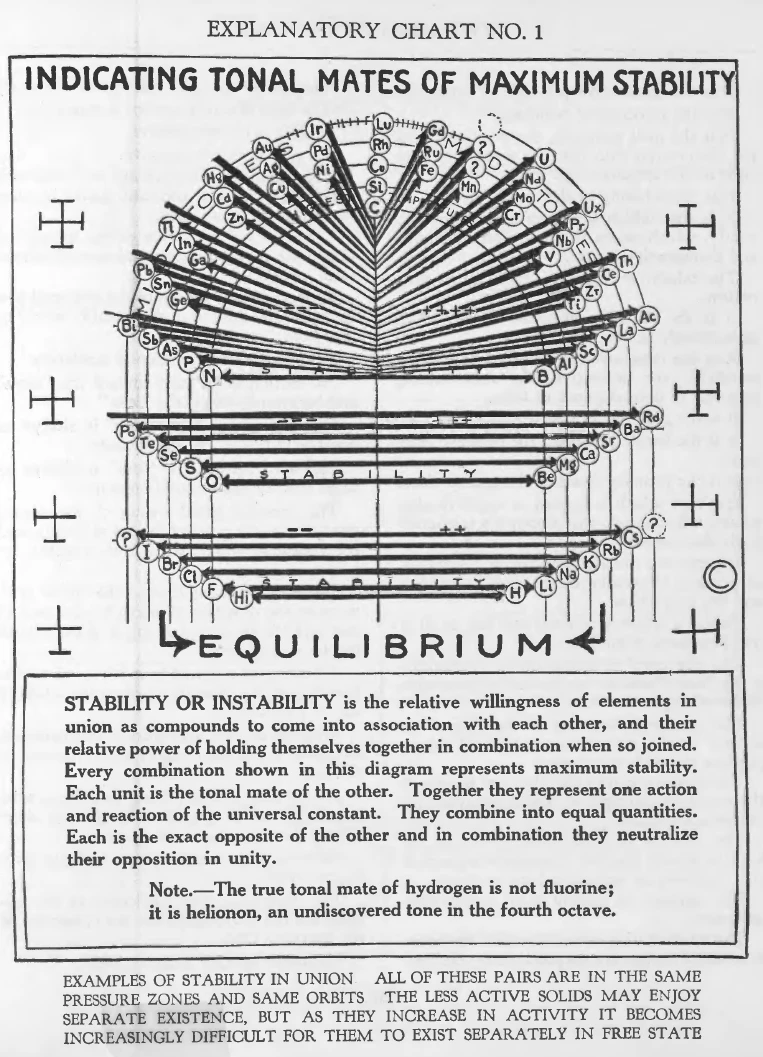
Russell’s Maximum Stability of Matter plate joins positions he calls tonal mates. The connections express which combinations he expects to be stable.
Walter Russell, Indicating Tonal Mates of Maximum Stability. Brieger Press, New York, copyright 1926, Library of Congress LCCN 27004508. Library of Congress, public domain. · Image source ↗ · Public Domain
See references (7)
- The Universal One, printed p. 23, Reader page 22
- The Universal One, printed p. 50, Reader page 49
- The Universal One, printed p. 51, Reader page 50
- The Universal One, printed p. 145, Reader page 144
- The Universal One, printed p. 147, Reader page 146
- The Universal One, printed p. 137, Reader page 136
- The Universal One, printed p. 138, Reader page 137
Russell’s tones and the periodic table
Russell gives inert gases a governing role in his octave cycles. In the IUPAC table, the noble gases are elements with distinct atomic numbers. Russell’s chart is a proposal about the stability of paired substances. [3][8][6][2]
In the library
The Universal One
Reading note
The separately titled account draws on exact passages in the consulted Library edition.
Sources
See references (9)
- Indicating Tonal Mates of Maximum Stability ↗Walter Russell, Indicating Tonal Mates of Maximum Stability. Brieger Press, New York, copyright 1926, Library of Congress LCCN 27004508. Library of Congress, public domain.
- IUPAC Periodic Table of Elements ↗International Union of Pure and Applied Chemistry, official periodic table.
- The Universal One, printed p. 23, Reader page 22Walter Russell, The Universal One, edited by Louise Russell, University of Science and Philosophy, Limited Edition De Luxe. Lumitheca Library edition IMJ-0605-E001.Read this page in The Universal One ↗
- The Universal One, printed p. 50, Reader page 49Walter Russell, The Universal One, edited by Louise Russell, University of Science and Philosophy, Limited Edition De Luxe. Lumitheca Library edition IMJ-0605-E001.Read this page in The Universal One ↗
- The Universal One, printed p. 51, Reader page 50Walter Russell, The Universal One, edited by Louise Russell, University of Science and Philosophy, Limited Edition De Luxe. Lumitheca Library edition IMJ-0605-E001.Read this page in The Universal One ↗
- The Universal One, printed p. 145, Reader page 144Walter Russell, The Universal One, edited by Louise Russell, University of Science and Philosophy, Limited Edition De Luxe. Lumitheca Library edition IMJ-0605-E001.Read this page in The Universal One ↗
- The Universal One, printed p. 147, Reader page 146Walter Russell, The Universal One, edited by Louise Russell, University of Science and Philosophy, Limited Edition De Luxe. Lumitheca Library edition IMJ-0605-E001.Read this page in The Universal One ↗
- The Universal One, printed p. 137, Reader page 136Walter Russell, The Universal One, edited by Louise Russell, University of Science and Philosophy, Limited Edition De Luxe. Lumitheca Library edition IMJ-0605-E001.Read this page in The Universal One ↗
- The Universal One, printed p. 138, Reader page 137Walter Russell, The Universal One, edited by Louise Russell, University of Science and Philosophy, Limited Edition De Luxe. Lumitheca Library edition IMJ-0605-E001.Read this page in The Universal One ↗