Time and Universal Repetition in Walter Russell
Walter Russell connects time to repeated events and changing motion. Explore his ideas of speed-time and power-time, with a comparison to Aristotle.
In this article
Time as an interval between events
Walter Russell understands time as the interval between successive events. Repetition allows those intervals to be measured. Time belongs to what changes, while the underlying substance has no measurable duration in his cosmology. [3][4][5][6]
The Universal One by Walter Russell
In The Universal One, Walter Russell uses regular rotations and revolutions as examples. A rotation gives a day and a revolution around a sun gives a year. Such events let an observer measure an interval through motion. [4][5][6][7][8]
Russell also distinguishes speed-time from power-time. He associates generation and accumulating mass with slowing, and radiation and dispersal with increasing speed. He builds these relationships into his ten-octave cycle. [6][9][10]
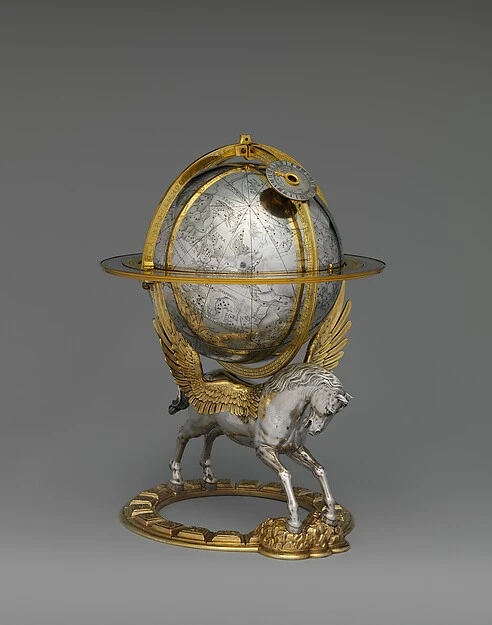
This celestial clock gives repeated motions visible markers. Russell takes easily recognised recurrences, such as days and years, as examples of measured time.
Gerhard Emmoser, Celestial Globe with Clockwork. The Metropolitan Museum of Art. Gift of J. Pierpont Morgan, 1917. · Image source ↗ · CC0
See references (7)
- The Universal One, printed p. 33, Reader page 32
- The Universal One, printed p. 34, Reader page 33
- The Universal One, printed p. 232, Reader page 231
- The Universal One, printed p. 236, Reader page 235
- The Universal One, printed p. 239, Reader page 238
- The Universal One, printed p. 233, Reader page 232
- The Universal One, printed p. 234, Reader page 233
Physics by Aristotle
In Book IV of the Physics, Aristotle describes time as the number of motion with respect to before and after. When the before and after of a movement can be distinguished and counted, there is a way to measure time. [2]
From sequence to a cosmology
Aristotle begins from the order of before and after. Russell also begins from sequence, then links intervals to accumulating and releasing potential. Those mechanisms belong to his own account of what is changing. [6][10][8][2]
In the library
The Universal One
Reading note
The separately titled account draws on exact passages in the consulted Library edition.
Sources
See references (10)
- Gerhard Emmoser, Celestial Globe with Clockwork ↗Gerhard Emmoser, Celestial Globe with Clockwork. The Metropolitan Museum of Art. Gift of J. Pierpont Morgan, 1917.
- Physics, IV.11, 219b1–2 ↗Aristotle, Physics, Book IV, chapter 11, translated by R. P. Hardie and R. K. Gaye, University of South Florida digital edition.
- The Universal One, printed p. 28, Reader page 27Walter Russell, The Universal One, edited by Louise Russell, University of Science and Philosophy, Limited Edition De Luxe. Lumitheca Library edition IMJ-0605-E001.Read this page in The Universal One ↗
- The Universal One, printed p. 33, Reader page 32Walter Russell, The Universal One, edited by Louise Russell, University of Science and Philosophy, Limited Edition De Luxe. Lumitheca Library edition IMJ-0605-E001.Read this page in The Universal One ↗
- The Universal One, printed p. 34, Reader page 33Walter Russell, The Universal One, edited by Louise Russell, University of Science and Philosophy, Limited Edition De Luxe. Lumitheca Library edition IMJ-0605-E001.Read this page in The Universal One ↗
- The Universal One, printed p. 232, Reader page 231Walter Russell, The Universal One, edited by Louise Russell, University of Science and Philosophy, Limited Edition De Luxe. Lumitheca Library edition IMJ-0605-E001.Read this page in The Universal One ↗
- The Universal One, printed p. 236, Reader page 235Walter Russell, The Universal One, edited by Louise Russell, University of Science and Philosophy, Limited Edition De Luxe. Lumitheca Library edition IMJ-0605-E001.Read this page in The Universal One ↗
- The Universal One, printed p. 239, Reader page 238Walter Russell, The Universal One, edited by Louise Russell, University of Science and Philosophy, Limited Edition De Luxe. Lumitheca Library edition IMJ-0605-E001.Read this page in The Universal One ↗
- The Universal One, printed p. 233, Reader page 232Walter Russell, The Universal One, edited by Louise Russell, University of Science and Philosophy, Limited Edition De Luxe. Lumitheca Library edition IMJ-0605-E001.Read this page in The Universal One ↗
- The Universal One, printed p. 234, Reader page 233Walter Russell, The Universal One, edited by Louise Russell, University of Science and Philosophy, Limited Edition De Luxe. Lumitheca Library edition IMJ-0605-E001.Read this page in The Universal One ↗