The Threshold of Dimensional Perception
What limits the dimensions we perceive? Read how Bragdon extends Carl du Prel’s movable threshold into a theory of higher space.
In this article
A boundary on what an observer can perceive
A threshold of perception is a limit on what an observer can notice or represent. An observer confined to a plane can register an outline changing as a solid passes through, yet see only the part that meets the plane. Claude Bragdon uses that gap to ask what our own senses might leave out. [3][4][5][6][7]
The Philosophy of Mysticism by Carl du Prel
In the passage of The Philosophy of Mysticism quoted by Bragdon, Carl du Prel distinguishes the parts of the world an organism can sense from those outside its awareness. He argues that the boundary shifts as sensory capacities change. [6]
A Primer of Higher Space by Claude Bragdon
In A Primer of Higher Space, Claude Bragdon draws on Carl du Prel’s account of the limits of sensation. On Plate 17, Bragdon gives those limits a geometric form. A stem offers one main direction of movement. A leaf offers two across its surface. [4][8][6][9][10]
The stem and leaf are three-dimensional. Their shape limits movement enough to suggest what a narrower range of experience could be like. Bragdon then speculates that human consciousness might one day perceive an additional direction. [11][6][9][7][10]
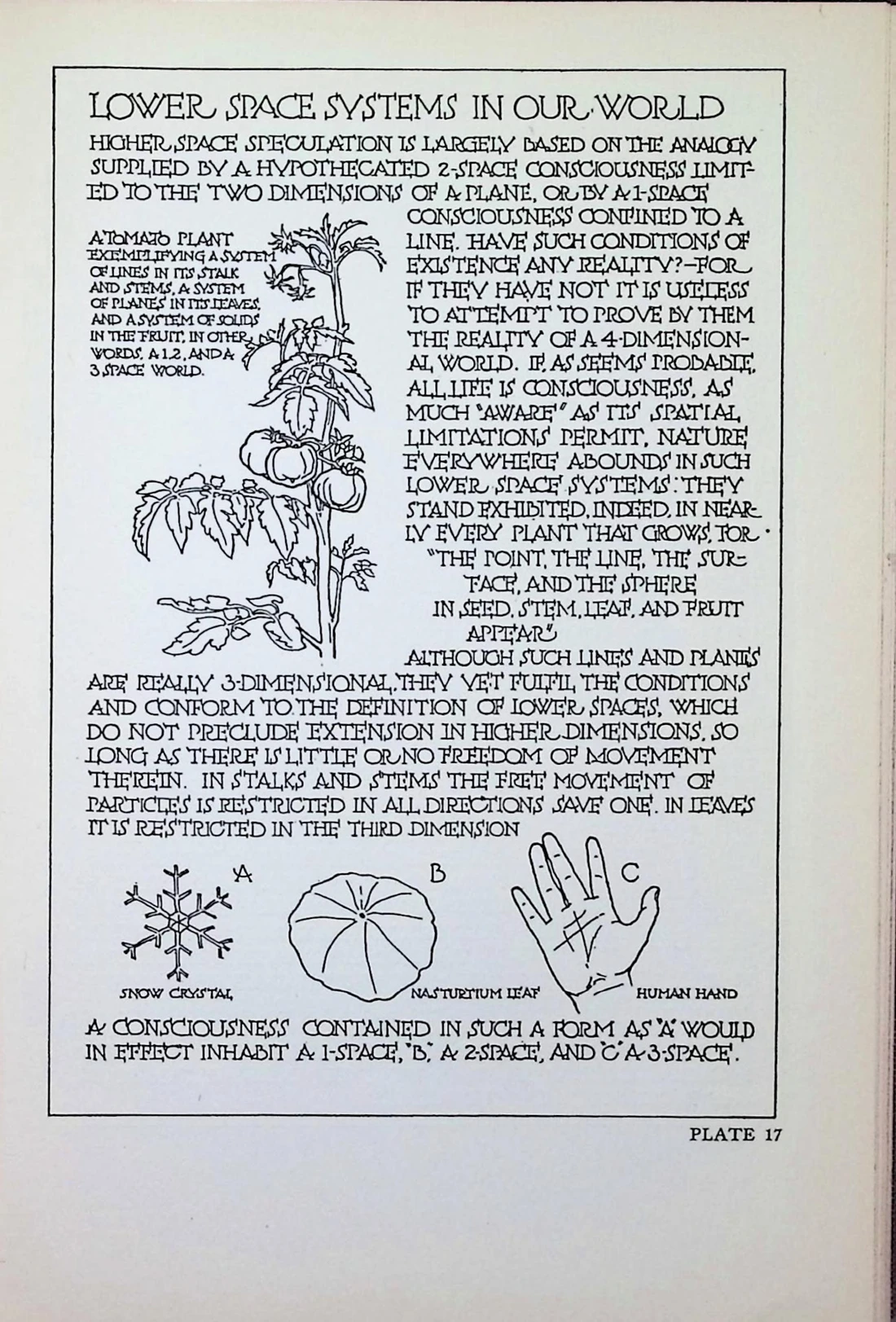
Plate 17 uses the shape of stems and leaves to illustrate how freedom of movement can approximate life along a line or across a surface.
Claude Bragdon, A Primer of Higher Space, The Manas Press, 1913. Stickley Museum scan via Internet Archive. · Image source ↗ · Public Domain
See references (7)
- A Primer of Higher Space, printed p. 6, Reader page 13
- A Primer of Higher Space, printed p. 14, Reader page 21
- A Primer of Higher Space, printed p. 16, Reader page 23
- A Primer of Higher Space, printed p. 13, Reader page 20
- A Primer of Higher Space, printed p. 15, Reader page 22
- A Primer of Higher Space, Plate 17, Reader page 46
- A Primer of Higher Space, printed p. 7, Reader page 14
The Varieties of Religious Experience by William James
In The Varieties of Religious Experience, William James treats ordinary waking consciousness as one form of awareness among others. His lectures on mysticism ask what experiences beyond that ordinary range might contribute to our understanding. [2]
A limit on awareness and a limit on movement
James asks how far ordinary awareness can take us in explaining unusual experiences. Bragdon gives the question a geometric form by asking what it would take to perceive a direction unavailable to our senses. [6][9][7][2]
In the library
A Primer of Higher Space
Reading note
The separately titled account draws on exact passages in the consulted Library edition.
Sources
See references (11)
- Plate 17, lower-space systems in nature ↗Claude Bragdon, A Primer of Higher Space, The Manas Press, 1913. Stickley Museum scan via Internet Archive.
- The Varieties of Religious Experience, lectures XVI and XVII, Mysticism ↗William James, The Varieties of Religious Experience (1902), lectures XVI and XVII, Mysticism. Text via Wikisource.
- A Primer of Higher Space, printed p. 5, Reader page 12Claude Bragdon, A Primer of Higher Space (The Fourth Dimension), The Manas Press, Rochester, New York, 1913. Lumitheca Library edition IMJ-0599-E001.Read this page in A Primer of Higher Space ↗
- A Primer of Higher Space, printed p. 6, Reader page 13Claude Bragdon, A Primer of Higher Space (The Fourth Dimension), The Manas Press, Rochester, New York, 1913. Lumitheca Library edition IMJ-0599-E001.Read this page in A Primer of Higher Space ↗
- A Primer of Higher Space, printed p. 11, Reader page 18Claude Bragdon, A Primer of Higher Space (The Fourth Dimension), The Manas Press, Rochester, New York, 1913. Lumitheca Library edition IMJ-0599-E001.Read this page in A Primer of Higher Space ↗
- A Primer of Higher Space, printed p. 14, Reader page 21Claude Bragdon, A Primer of Higher Space (The Fourth Dimension), The Manas Press, Rochester, New York, 1913. Lumitheca Library edition IMJ-0599-E001.Read this page in A Primer of Higher Space ↗
- A Primer of Higher Space, printed p. 16, Reader page 23Claude Bragdon, A Primer of Higher Space (The Fourth Dimension), The Manas Press, Rochester, New York, 1913. Lumitheca Library edition IMJ-0599-E001.Read this page in A Primer of Higher Space ↗
- A Primer of Higher Space, printed p. 13, Reader page 20Claude Bragdon, A Primer of Higher Space (The Fourth Dimension), The Manas Press, Rochester, New York, 1913. Lumitheca Library edition IMJ-0599-E001.Read this page in A Primer of Higher Space ↗
- A Primer of Higher Space, printed p. 15, Reader page 22Claude Bragdon, A Primer of Higher Space (The Fourth Dimension), The Manas Press, Rochester, New York, 1913. Lumitheca Library edition IMJ-0599-E001.Read this page in A Primer of Higher Space ↗
- A Primer of Higher Space, Plate 17, Reader page 46Claude Bragdon, A Primer of Higher Space (The Fourth Dimension), The Manas Press, Rochester, New York, 1913. Lumitheca Library edition IMJ-0599-E001.Read this page in A Primer of Higher Space ↗
- A Primer of Higher Space, printed p. 7, Reader page 14Claude Bragdon, A Primer of Higher Space (The Fourth Dimension), The Manas Press, Rochester, New York, 1913. Lumitheca Library edition IMJ-0599-E001.Read this page in A Primer of Higher Space ↗