The Three Wise Planemen
Meet Planewisdom, Planelove and Planebeauty, whose different paths to a square life lead to an encounter with Christos in Bragdon’s flat world.
In this article
Three paths to the same square form
The Three Wise Planemen are Planewisdom, Planelove and Planebeauty in Claude Bragdon’s Man the Square. Each becomes a stable square by following a different path. When they meet, their contact in the plane gives them a glimpse of the larger world they share. [3][4][5][6][7][8]
See references (6)
- A Primer of Higher Space, printed p. 67, Reader page 70
- A Primer of Higher Space, printed p. 68, Reader page 71
- A Primer of Higher Space, printed p. 69, Reader page 72
- A Primer of Higher Space, printed p. 70, Reader page 73
- A Primer of Higher Space, printed p. 71, Reader page 74
- A Primer of Higher Space, printed p. 72, Reader page 75
A Primer of Higher Space by Claude Bragdon
In Man the Square, Claude Bragdon gives Planewisdom to reflection, Planelove to affection and Planebeauty to proportion. Planewisdom questions the changing form of his life. Planelove seeks a more lasting connection with others. Planebeauty finds in the square a balance he wants to embody. [3][4][5][6][7]
When they bring their edges together, the faces of their unseen cubes touch. They still wonder why their world must change and why its inhabitants die. They ask for a teacher. A ray of the One Light comes in answer, appears to them as a star and takes form as Christos. [7][8][9][10]
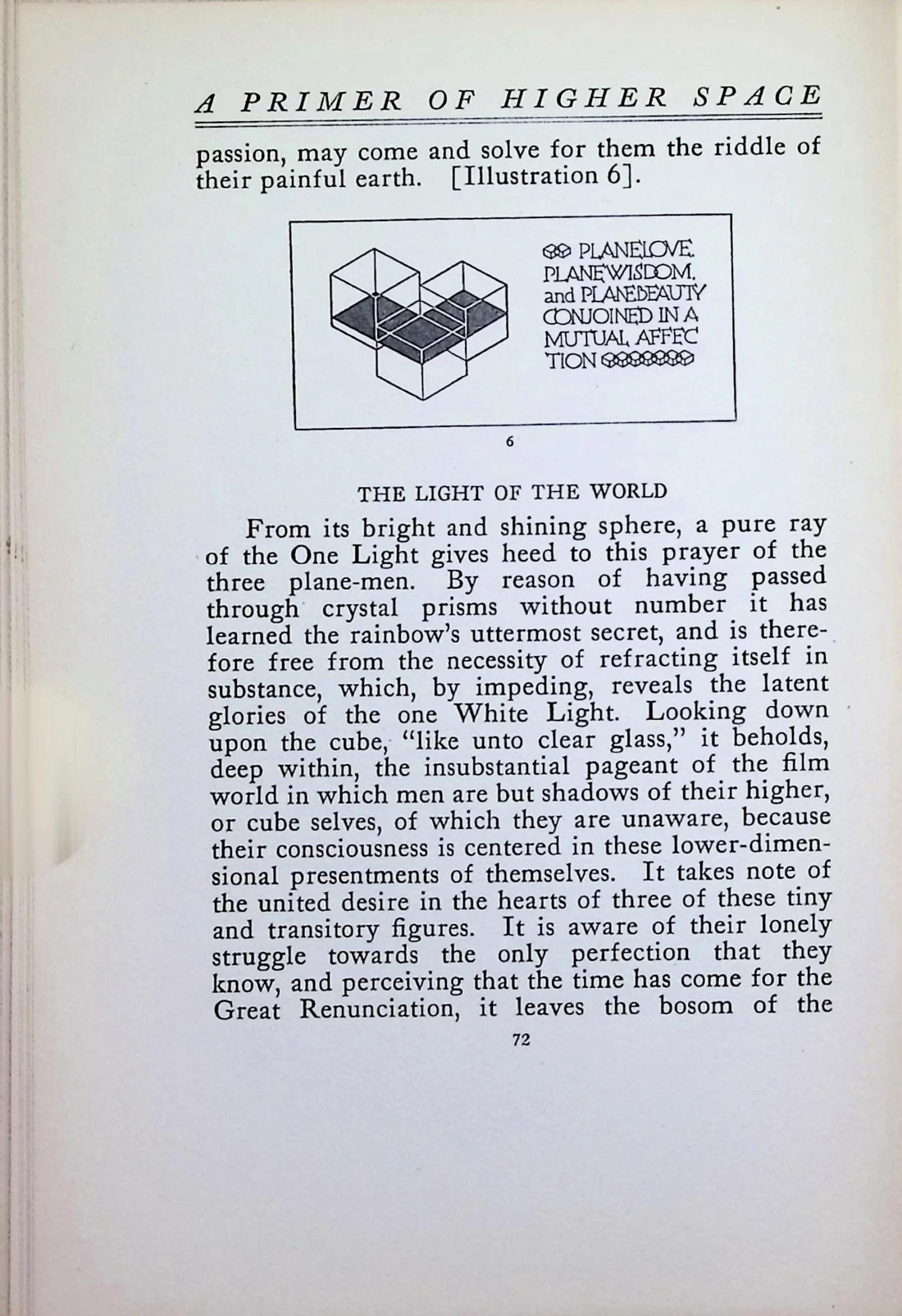
Illustration 6 shows how contact between the three figures in the plane corresponds to contact between the faces of their cubes.
Claude Bragdon, A Primer of Higher Space, The Manas Press, 1913. Stickley Museum scan via Internet Archive. · Image source ↗ · Public Domain
See references (8)
- A Primer of Higher Space, printed p. 67, Reader page 70
- A Primer of Higher Space, printed p. 68, Reader page 71
- A Primer of Higher Space, printed p. 69, Reader page 72
- A Primer of Higher Space, printed p. 70, Reader page 73
- A Primer of Higher Space, printed p. 71, Reader page 74
- A Primer of Higher Space, printed p. 72, Reader page 75
- A Primer of Higher Space, printed p. 73, Reader page 76
- A Primer of Higher Space, printed p. 74, Reader page 77
The Visit of the Magi in the Gospel of Matthew
In Matthew 2, Magi from the east follow a star and find the child with Mary. They offer gold, frankincense and myrrh. The passage names three gifts and leaves the number of visitors open. [2]
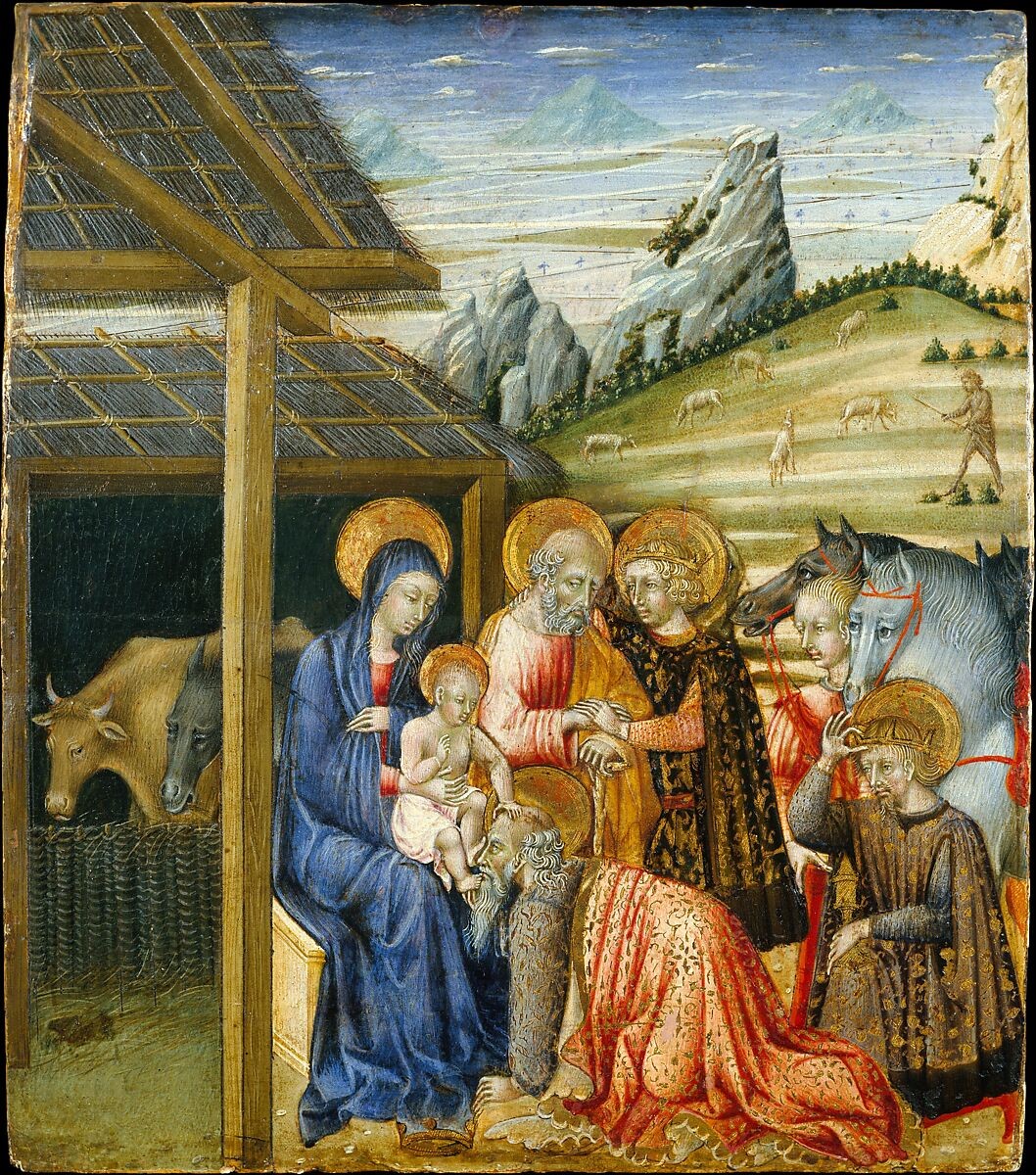
In Giovanni di Paolo’s fifteenth-century painting, the visitors arrive at the stable. The painter follows the tradition of picturing three Magi.
Giovanni di Paolo, The Adoration of the Magi. The Metropolitan Museum of Art, The Jack and Belle Linsky Collection, 1982, 1982.60.4. Open Access. · Image source ↗ · CC0
From the Magi to the three plane dwellers
Bragdon uses the star and the visit to recall Matthew’s story. He also gives his three visitors individual paths that converge before the encounter. Their meeting lets them ask together what they had been unable to answer alone. [3][5][6][7][8][9][10][2]
See references (8)
- Matthew 2:1–12, the visit of the Magi
- A Primer of Higher Space, printed p. 67, Reader page 70
- A Primer of Higher Space, printed p. 69, Reader page 72
- A Primer of Higher Space, printed p. 70, Reader page 73
- A Primer of Higher Space, printed p. 71, Reader page 74
- A Primer of Higher Space, printed p. 72, Reader page 75
- A Primer of Higher Space, printed p. 73, Reader page 76
- A Primer of Higher Space, printed p. 74, Reader page 77
In the library
A Primer of Higher Space
Reading note
The separately titled account draws on exact passages in the consulted Library edition.
Sources
See references (11)
- Man the Square, illustration 6, the three plane dwellers joined ↗Claude Bragdon, A Primer of Higher Space, The Manas Press, 1913. Stickley Museum scan via Internet Archive.
- Matthew 2:1–12, the visit of the Magi ↗Matthew 2:1–12, New American Bible, Revised Edition, United States Conference of Catholic Bishops.
- A Primer of Higher Space, printed p. 67, Reader page 70Claude Bragdon, A Primer of Higher Space (The Fourth Dimension), The Manas Press, Rochester, New York, 1913. Lumitheca Library edition IMJ-0599-E001.Read this page in A Primer of Higher Space ↗
- A Primer of Higher Space, printed p. 68, Reader page 71Claude Bragdon, A Primer of Higher Space (The Fourth Dimension), The Manas Press, Rochester, New York, 1913. Lumitheca Library edition IMJ-0599-E001.Read this page in A Primer of Higher Space ↗
- A Primer of Higher Space, printed p. 69, Reader page 72Claude Bragdon, A Primer of Higher Space (The Fourth Dimension), The Manas Press, Rochester, New York, 1913. Lumitheca Library edition IMJ-0599-E001.Read this page in A Primer of Higher Space ↗
- A Primer of Higher Space, printed p. 70, Reader page 73Claude Bragdon, A Primer of Higher Space (The Fourth Dimension), The Manas Press, Rochester, New York, 1913. Lumitheca Library edition IMJ-0599-E001.Read this page in A Primer of Higher Space ↗
- A Primer of Higher Space, printed p. 71, Reader page 74Claude Bragdon, A Primer of Higher Space (The Fourth Dimension), The Manas Press, Rochester, New York, 1913. Lumitheca Library edition IMJ-0599-E001.Read this page in A Primer of Higher Space ↗
- A Primer of Higher Space, printed p. 72, Reader page 75Claude Bragdon, A Primer of Higher Space (The Fourth Dimension), The Manas Press, Rochester, New York, 1913. Lumitheca Library edition IMJ-0599-E001.Read this page in A Primer of Higher Space ↗
- A Primer of Higher Space, printed p. 73, Reader page 76Claude Bragdon, A Primer of Higher Space (The Fourth Dimension), The Manas Press, Rochester, New York, 1913. Lumitheca Library edition IMJ-0599-E001.Read this page in A Primer of Higher Space ↗
- A Primer of Higher Space, printed p. 74, Reader page 77Claude Bragdon, A Primer of Higher Space (The Fourth Dimension), The Manas Press, Rochester, New York, 1913. Lumitheca Library edition IMJ-0599-E001.Read this page in A Primer of Higher Space ↗
- The Adoration of the Magi by Giovanni di Paolo ↗Giovanni di Paolo, The Adoration of the Magi. The Metropolitan Museum of Art, The Jack and Belle Linsky Collection, 1982, 1982.60.4. Open Access.