The Three-Legged Sun Crow
The three-legged crow lives in the sun in Chinese mythology. One tale gives the bird an appetite for the same mushrooms that make people immortal.
In this article
What is the three-legged Sun Crow?
The three-legged Sun Crow is a bird imagined inside the sun in Chinese mythology. The extra leg distinguishes it in pictures. Early Chinese texts mention it alongside animals thought to live in the moon, among them a hare and a three-legged toad. [2][1][3][5]
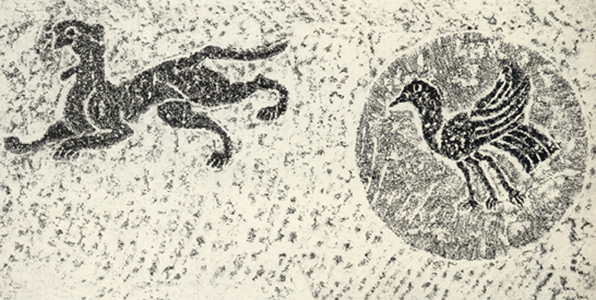
Han mural from Henan showing a three-legged bird, a visual parallel to the solar creature described in early texts.
Unidentified artist. Three-legged bird in a Han mural. Han dynasty. Wikimedia Commons. Reproduction credited to Chiculture.net. Public Domain. · Image source ↗ · Public Domain
In The Chinese Fairy Book
In Richard Wilhelm’s The Chinese Fairy Book, translated by Frederick H. Martens, Emperor Wu asks the magician Sky O’Dawn how to keep the empress from growing old. The magician says a crow in the sun wants to come down to eat mushrooms that confer immortality. The sun god will not let it leave. [3][4]
In the same chapter, a dragon holds a fiery mirror to light a mountain beyond the ordinary reach of the sun and moon. At the end an astrologer identifies Sky O’Dawn with the Star of the Great Year, which the note identifies as Jupiter. The editor pairs the sun crow with the moon’s three-legged toad, another being used to give a familiar light in the sky a visible inhabitant. [4][5]
A mythic image and an early debate
Wang Chong reports that some scholars place a three-legged crow in the sun and rabbits and toads in the moon. He asks how animals could live in bodies made of fire or water. The tale of the mushrooms starts from the same familiar bird and asks what it might want to eat. [1][3][5]
In the library
The Chinese Fairy Book
Reading note
Read the magician’s account of the crow and the mushrooms that interest Emperor Wu.
Sources
See references (5)
- Wang Chong, Lunheng, On the Sun ↗Chinese Text Project
- Three-legged bird in a Han mural ↗Unidentified artist. Three-legged bird in a Han mural. Han dynasty. Wikimedia Commons. Reproduction credited to Chiculture.net. Public Domain.
- The Chinese Fairy Book, Library Reader page 107Richard Wilhelm, editor. Frederick H. Martens, translator. The Chinese Fairy Book. Frederick A. Stokes Company, New York, 1921. Lumitheca Library edition IMJ-0478-E002.Read this page in The Chinese Fairy Book ↗
- The Chinese Fairy Book, Library Reader page 108Richard Wilhelm, editor. Frederick H. Martens, translator. The Chinese Fairy Book. Frederick A. Stokes Company, New York, 1921. Lumitheca Library edition IMJ-0478-E002.Read this page in The Chinese Fairy Book ↗
- The Chinese Fairy Book, Library Reader page 110Richard Wilhelm, editor. Frederick H. Martens, translator. The Chinese Fairy Book. Frederick A. Stokes Company, New York, 1921. Lumitheca Library edition IMJ-0478-E002.Read this page in The Chinese Fairy Book ↗