The Three Worlds and the Human Body
How did Western esoteric writers map three worlds onto the human body? Compare Robert Fludd’s cosmic imagery, Manly P. Hall’s account and Plato’s division of the soul.
In this article
How three worlds fit onto a body
A three-world cosmology divides reality into three regions. In the strand of Western esotericism discussed here, the head, chest and abdomen provide a bodily counterpart. Each region gives a visible place to a set of qualities or powers. [3][4][5][6][7]
The map has several uses. Robert Fludd’s figures relate the body to a larger cosmic order. Manly P. Hall uses the cavities of the body to explain the relations between upper, middle and lower worlds. [4][8][6][9][1]
See references (8)
- The microcosm (man) and the macrocosm (the world), 1617: Wellcome Collection 2989i
- Man the Grand Symbol of the Mysteries, printed p. 73, Reader page 72
- Man the Grand Symbol of the Mysteries, printed p. 74, Reader page 73
- Man the Grand Symbol of the Mysteries, printed p. 75, Reader page 74
- Man the Grand Symbol of the Mysteries, printed p. 79, Reader page 78
- Man the Grand Symbol of the Mysteries, printed p. 81, Reader page 80
- Man the Grand Symbol of the Mysteries, printed p. 78, Reader page 77
- Man the Grand Symbol of the Mysteries, printed p. 83, Reader page 82
Timaeus by Plato
In Plato’s Timaeus, the makers of the body separate the mortal functions of the soul from its divine part. They place courage and spirit between the diaphragm and neck, near reason, and give the appetites a place below the diaphragm. [2]
Man the Grand Symbol of the Mysteries by Manly P. Hall
In Man the Grand Symbol of the Mysteries, Manly P. Hall places the upper world in the head and describes the heart as central to a sphere of life in the chest. He relates the abdominal region to the elemental world and uses the image of an inferno for it. [5][10][6][7][9]
Hall also reads heaven, earth and hell as conditions of being. The visible body gives those conditions a form that a reader can follow from the head downward. [10][8][6][9]
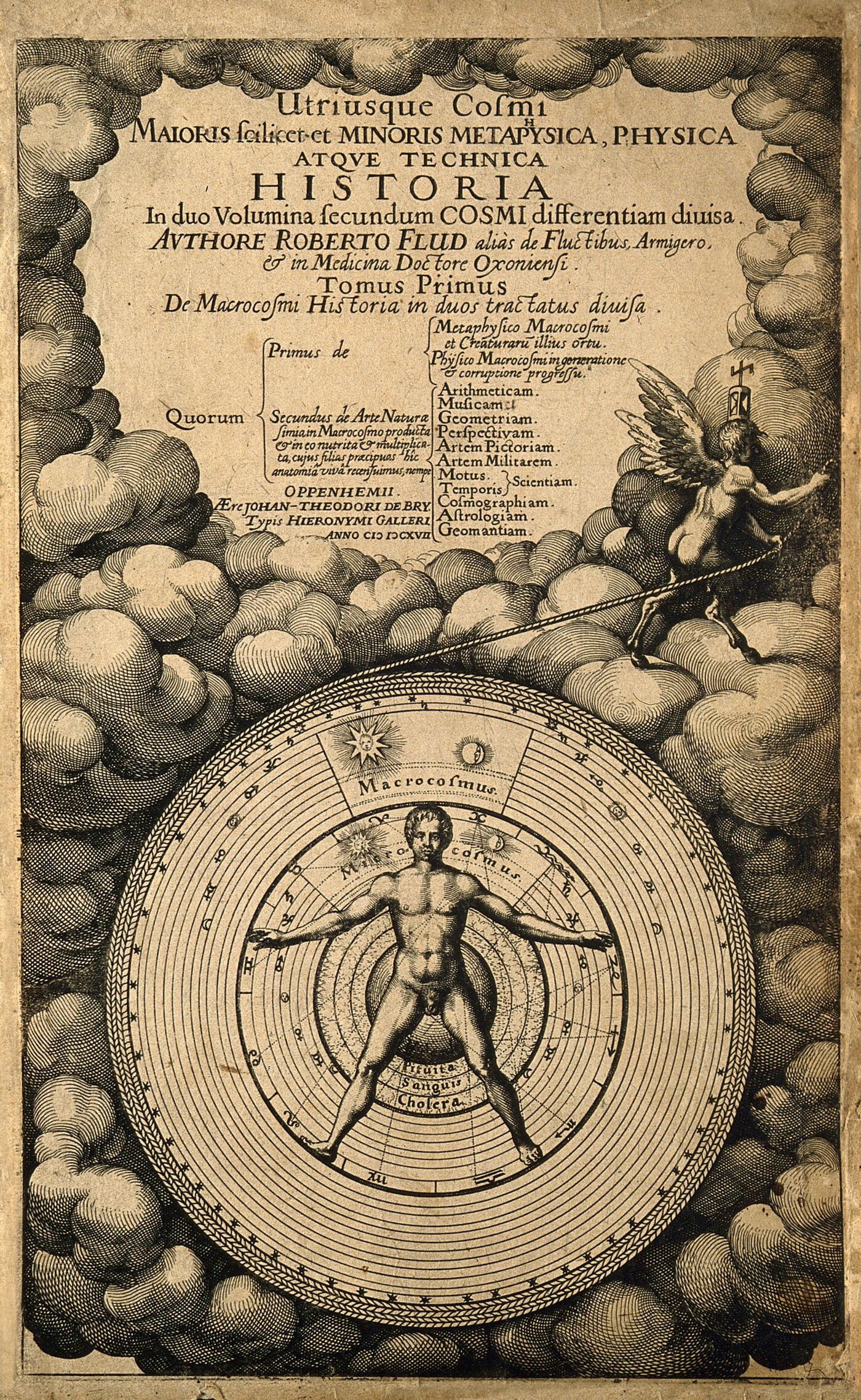
Fludd’s 1617 title page pictures the person within a larger world. Hall’s reading associates parts of the human body with regions of that whole.
Wellcome Collection, 2989i. Public Domain Mark. · Image source ↗ · Public Domain
See references (6)
- Man the Grand Symbol of the Mysteries, printed p. 75, Reader page 74
- Man the Grand Symbol of the Mysteries, printed p. 79, Reader page 78
- Man the Grand Symbol of the Mysteries, printed p. 81, Reader page 80
- Man the Grand Symbol of the Mysteries, printed p. 78, Reader page 77
- Man the Grand Symbol of the Mysteries, printed p. 83, Reader page 82
- Man the Grand Symbol of the Mysteries, printed p. 77, Reader page 76
Two ways to read the same regions
Hall cites the Timaeus when discussing the chest. Plato gives different activities of the soul different bodily seats. Hall uses that division within a wider map of cosmic regions. [6][7][9][2]
In the library
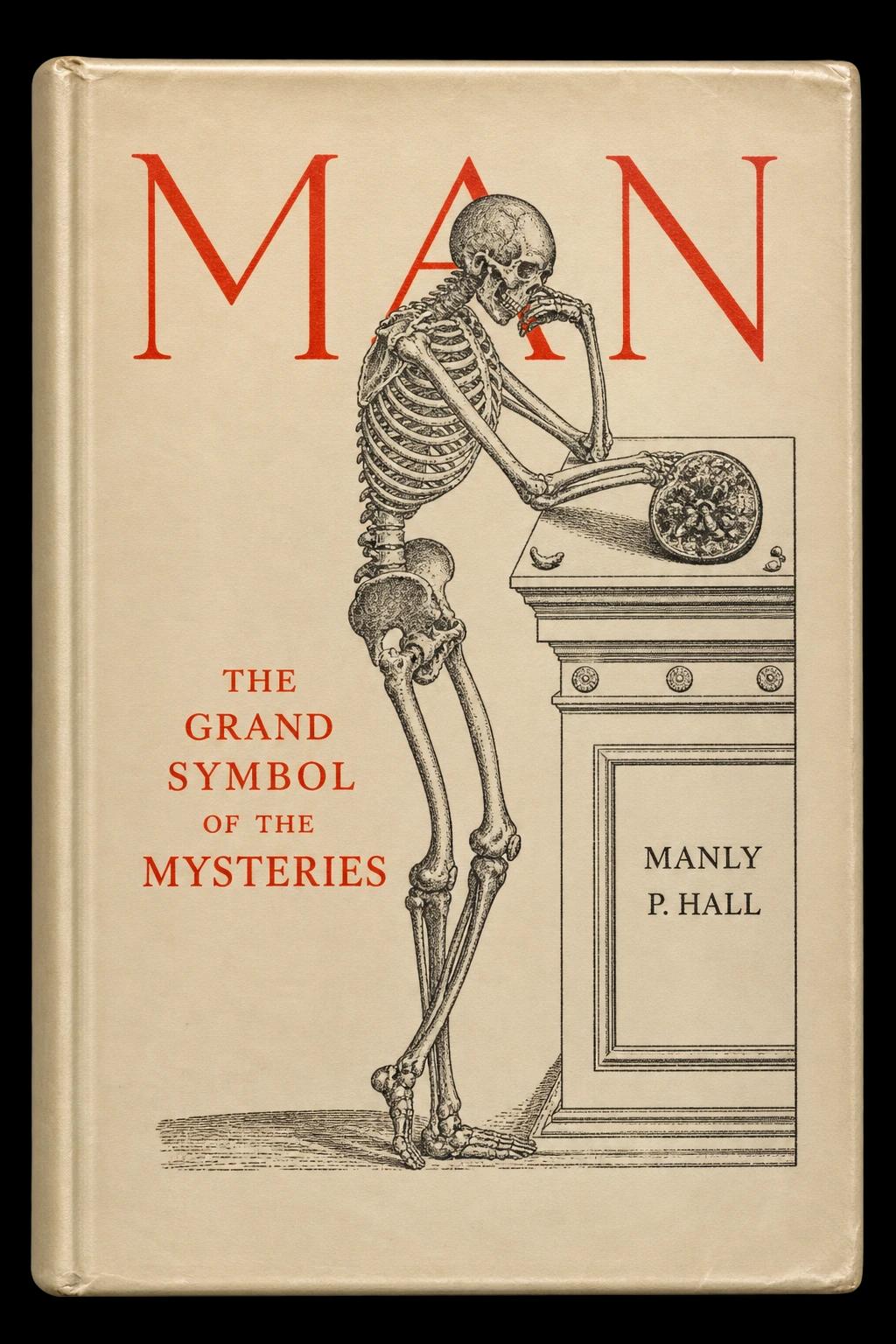
Man the Grand Symbol of the Mysteries
Reading note
The separately titled account draws on exact passages in the consulted Library edition.
Sources
See references (10)
- The microcosm (man) and the macrocosm (the world), 1617: Wellcome Collection 2989i ↗Wellcome Collection, 2989i. Engraving credited to T. de Bry, 1617; associated with Robert Fludd. Public Domain Mark.
- Timaeus 69d to 71a ↗Plato, Timaeus 69d to 71a, Greek text and English translation, Ad Fontes Library.
- Man the Grand Symbol of the Mysteries, printed p. 73, Reader page 72Manly P. Hall, Man the Grand Symbol of the Mysteries, Fourth Edition, The Philosophers Press, Los Angeles, 1937. Lumitheca Library edition IMJ-0603-E001.Read this page in Man the Grand Symbol of the Mysteries ↗
- Man the Grand Symbol of the Mysteries, printed p. 74, Reader page 73Manly P. Hall, Man the Grand Symbol of the Mysteries, Fourth Edition, The Philosophers Press, Los Angeles, 1937. Lumitheca Library edition IMJ-0603-E001.Read this page in Man the Grand Symbol of the Mysteries ↗
- Man the Grand Symbol of the Mysteries, printed p. 75, Reader page 74Manly P. Hall, Man the Grand Symbol of the Mysteries, Fourth Edition, The Philosophers Press, Los Angeles, 1937. Lumitheca Library edition IMJ-0603-E001.Read this page in Man the Grand Symbol of the Mysteries ↗
- Man the Grand Symbol of the Mysteries, printed p. 79, Reader page 78Manly P. Hall, Man the Grand Symbol of the Mysteries, Fourth Edition, The Philosophers Press, Los Angeles, 1937. Lumitheca Library edition IMJ-0603-E001.Read this page in Man the Grand Symbol of the Mysteries ↗
- Man the Grand Symbol of the Mysteries, printed p. 81, Reader page 80Manly P. Hall, Man the Grand Symbol of the Mysteries, Fourth Edition, The Philosophers Press, Los Angeles, 1937. Lumitheca Library edition IMJ-0603-E001.Read this page in Man the Grand Symbol of the Mysteries ↗
- Man the Grand Symbol of the Mysteries, printed p. 78, Reader page 77Manly P. Hall, Man the Grand Symbol of the Mysteries, Fourth Edition, The Philosophers Press, Los Angeles, 1937. Lumitheca Library edition IMJ-0603-E001.Read this page in Man the Grand Symbol of the Mysteries ↗
- Man the Grand Symbol of the Mysteries, printed p. 83, Reader page 82Manly P. Hall, Man the Grand Symbol of the Mysteries, Fourth Edition, The Philosophers Press, Los Angeles, 1937. Lumitheca Library edition IMJ-0603-E001.Read this page in Man the Grand Symbol of the Mysteries ↗
- Man the Grand Symbol of the Mysteries, printed p. 77, Reader page 76Manly P. Hall, Man the Grand Symbol of the Mysteries, Fourth Edition, The Philosophers Press, Los Angeles, 1937. Lumitheca Library edition IMJ-0603-E001.Read this page in Man the Grand Symbol of the Mysteries ↗