Ten-Petalled Lotus
Steiner’s ten-petalled lotus is a proposed organ near the stomach. Its chapter considers spiritual colour, overlooked clues and an apparent premonition.
In this article
Understanding the concept
The ten-petalled lotus is a proposed organ in what Rudolf Steiner calls the pit of the stomach. He associates it with seeing colour and discerning capacities in people or roles in nature. [1][2][3][4][5][6]
Its chapter also follows a more ordinary problem. A thought can seem to come from nowhere when the person has missed the sight or memory that brought it to mind. [4][5][7]
See references (7)
- Initiation and Its Results, printed p. 14, Reader page 14
- Initiation and Its Results, printed p. 15, Reader page 15
- Initiation and Its Results, printed p. 30, Reader page 30
- Initiation and Its Results, printed p. 31, Reader page 31
- Initiation and Its Results, printed p. 32, Reader page 32
- Initiation and Its Results, printed p. 34, Reader page 34
- Initiation and Its Results, printed p. 33, Reader page 33
Initiation and Its Results by Rudolf Steiner
In Initiation and Its Results, Rudolf Steiner has a railway passenger glimpse a face that resembles someone from the past. The memory returns, but the passenger misses the resemblance that brought it back. Another example traces a dislike of a colour to a feared teacher’s coat. [4]
The apparent premonition starts with a newspaper the person does not remember reading. An unnoticed report of a dangerous illness could explain why they thought someone would die. The event feels like foreknowledge until the earlier encounter is brought back into view. [4][5]
Steiner puts attention to ordinary associations beside the spiritual colour he says the lotus adds. The same chapter asks the student to consider both what an impression looks like and how it might have arisen. [5][7][6]
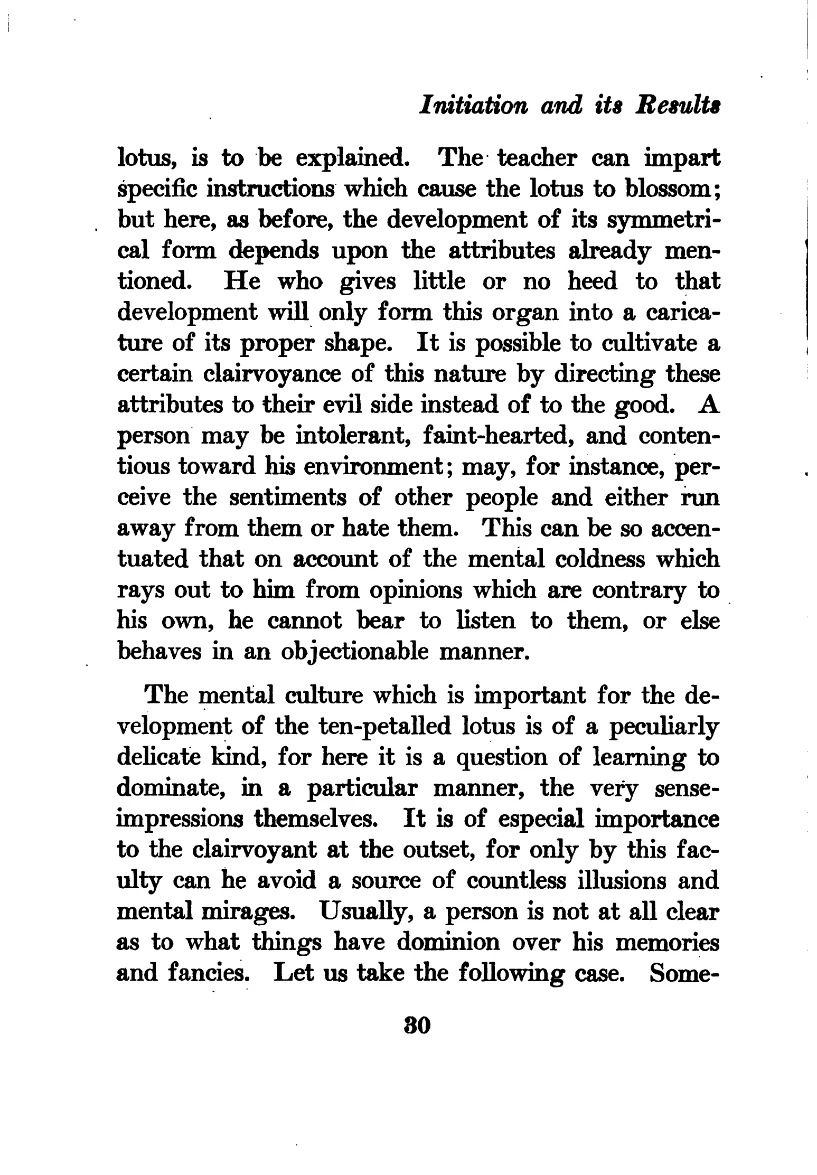
Initiation and Its Results (1909), printed p. 30, Library Reader page 30. Steiner opens the ten-petalled lotus discussion by distinguishing development from activity.
Rudolf Steiner, Initiation and Its Results, Clifford Bax translation, First American Edition, 1909. Public-domain historical page from the checksum-verified Library PDF. · Image source ↗ · Public Domain
How the 1909 edition counts the lower lotuses
Printed page 15 names a ten-petalled organ in the pit of the stomach. The discussion on pages 30–34 continues with that count. Page 42 describes rays reaching lower lotuses of eight, six and four petals. The later passage gives another list and leaves the relation between the eight- and ten-petalled organs unclear. [2][3][6][8]
Heaven and Its Wonders and Hell by Emanuel Swedenborg
Emanuel Swedenborg distinguishes a retained inward record from the changed use of natural memory after death. A spirit who feels deprived of familiar knowledge is told that nothing has actually been erased. Retention and present access therefore need not coincide within his account. [11][12][13][14]
What gets noticed and what can be recalled
Steiner distinguishes this organ’s colour from the form and warmth assigned to the throat and heart lotuses. The newspaper example adds a question that applies across the account. A striking impression can still be misunderstood if the observer misses where it came from. [1][9][10][6][4][5]
Steiner looks for impressions that have entered unnoticed during ordinary life. Swedenborg asks what someone can recall after death from a record that he says endures. The comparison turns on access to what a person has already experienced. [11][12][13][14][4][5][7][6]
See references (11)
- Initiation and Its Results, printed p. 14, Reader page 14
- Initiation and Its Results, printed p. 31, Reader page 31
- Initiation and Its Results, printed p. 32, Reader page 32
- Initiation and Its Results, printed p. 34, Reader page 34
- Initiation and Its Results, printed p. 33, Reader page 33
- Initiation and Its Results, printed p. 25, Reader page 25
- Initiation and Its Results, printed p. 26, Reader page 26
- Heaven and Its Wonders and Hell, printed p. 404, Reader page 411
- Heaven and Its Wonders and Hell, printed p. 405, Reader page 412
- Heaven and Its Wonders and Hell, printed p. 406, Reader page 413
- Heaven and Its Wonders and Hell, printed p. 409, Reader page 416
Read further in the library

Initiation and Its Results
Reading note
The separately titled account draws on exact passages in the consulted Library edition.

Heaven and Its Wonders and Hell
Reading note
Separately attributed comparison with exact previously researched Library passages.
Sources
See references (14)
- Initiation and Its Results, printed p. 14, Reader page 14Rudolf Steiner, Initiation and Its Results: A Sequel to The Way of Initiation, translated by Clifford Bax. First American Edition, 1909. Macoy Publishing and Masonic Supply Co., New York; Max Gysi, London. Claims of clairvoyant perception and subtle organs remain attributed. References identify the exact consulted Library edition.Read this page in Initiation and Its Results ↗Return to text ↑
- Initiation and Its Results, printed p. 15, Reader page 15Rudolf Steiner, Initiation and Its Results: A Sequel to The Way of Initiation, translated by Clifford Bax. First American Edition, 1909. Macoy Publishing and Masonic Supply Co., New York; Max Gysi, London. Claims of clairvoyant perception and subtle organs remain attributed. References identify the exact consulted Library edition.Read this page in Initiation and Its Results ↗Return to text ↑
- Initiation and Its Results, printed p. 30, Reader page 30Rudolf Steiner, Initiation and Its Results: A Sequel to The Way of Initiation, translated by Clifford Bax. First American Edition, 1909. Macoy Publishing and Masonic Supply Co., New York; Max Gysi, London. Claims of clairvoyant perception and subtle organs remain attributed. References identify the exact consulted Library edition.Read this page in Initiation and Its Results ↗Return to text ↑
- Initiation and Its Results, printed p. 31, Reader page 31Rudolf Steiner, Initiation and Its Results: A Sequel to The Way of Initiation, translated by Clifford Bax. First American Edition, 1909. Macoy Publishing and Masonic Supply Co., New York; Max Gysi, London. Claims of clairvoyant perception and subtle organs remain attributed. References identify the exact consulted Library edition.Read this page in Initiation and Its Results ↗Return to text ↑
- Initiation and Its Results, printed p. 32, Reader page 32Rudolf Steiner, Initiation and Its Results: A Sequel to The Way of Initiation, translated by Clifford Bax. First American Edition, 1909. Macoy Publishing and Masonic Supply Co., New York; Max Gysi, London. Claims of clairvoyant perception and subtle organs remain attributed. References identify the exact consulted Library edition.Read this page in Initiation and Its Results ↗Return to text ↑
- Initiation and Its Results, printed p. 34, Reader page 34Rudolf Steiner, Initiation and Its Results: A Sequel to The Way of Initiation, translated by Clifford Bax. First American Edition, 1909. Macoy Publishing and Masonic Supply Co., New York; Max Gysi, London. Claims of clairvoyant perception and subtle organs remain attributed. References identify the exact consulted Library edition.Read this page in Initiation and Its Results ↗Return to text ↑
- Initiation and Its Results, printed p. 33, Reader page 33Rudolf Steiner, Initiation and Its Results: A Sequel to The Way of Initiation, translated by Clifford Bax. First American Edition, 1909. Macoy Publishing and Masonic Supply Co., New York; Max Gysi, London. Claims of clairvoyant perception and subtle organs remain attributed. References identify the exact consulted Library edition.Read this page in Initiation and Its Results ↗Return to text ↑
- Initiation and Its Results, printed p. 42, Reader page 41Rudolf Steiner, Initiation and Its Results: A Sequel to The Way of Initiation, translated by Clifford Bax. First American Edition, 1909. Macoy Publishing and Masonic Supply Co., New York; Max Gysi, London. Claims of clairvoyant perception and subtle organs remain attributed. References identify the exact consulted Library edition.Read this page in Initiation and Its Results ↗Return to text ↑
- Initiation and Its Results, printed p. 25, Reader page 25Rudolf Steiner, Initiation and Its Results: A Sequel to The Way of Initiation, translated by Clifford Bax. First American Edition, 1909. Macoy Publishing and Masonic Supply Co., New York; Max Gysi, London. Claims of clairvoyant perception and subtle organs remain attributed. References identify the exact consulted Library edition.Read this page in Initiation and Its Results ↗Return to text ↑
- Initiation and Its Results, printed p. 26, Reader page 26Rudolf Steiner, Initiation and Its Results: A Sequel to The Way of Initiation, translated by Clifford Bax. First American Edition, 1909. Macoy Publishing and Masonic Supply Co., New York; Max Gysi, London. Claims of clairvoyant perception and subtle organs remain attributed. References identify the exact consulted Library edition.Read this page in Initiation and Its Results ↗Return to text ↑
- Heaven and Its Wonders and Hell, printed p. 404, Reader page 411Emanuel Swedenborg, Heaven and Its Wonders and Hell, From Things Heard and Seen, translated by J. C. Ager. American Swedenborg Printing and Publishing Society, New York, 1916. Latin original first published in 1758. Numbered sections and exact pages refer to this consulted edition. Claims of spiritual experience remain attributed.Read this page in Heaven and Its Wonders and Hell ↗Return to text ↑
- Heaven and Its Wonders and Hell, printed p. 405, Reader page 412Emanuel Swedenborg, Heaven and Its Wonders and Hell, From Things Heard and Seen, translated by J. C. Ager. American Swedenborg Printing and Publishing Society, New York, 1916. Latin original first published in 1758. Numbered sections and exact pages refer to this consulted edition. Claims of spiritual experience remain attributed.Read this page in Heaven and Its Wonders and Hell ↗Return to text ↑
- Heaven and Its Wonders and Hell, printed p. 406, Reader page 413Emanuel Swedenborg, Heaven and Its Wonders and Hell, From Things Heard and Seen, translated by J. C. Ager. American Swedenborg Printing and Publishing Society, New York, 1916. Latin original first published in 1758. Numbered sections and exact pages refer to this consulted edition. Claims of spiritual experience remain attributed.Read this page in Heaven and Its Wonders and Hell ↗Return to text ↑
- Heaven and Its Wonders and Hell, printed p. 409, Reader page 416Emanuel Swedenborg, Heaven and Its Wonders and Hell, From Things Heard and Seen, translated by J. C. Ager. American Swedenborg Printing and Publishing Society, New York, 1916. Latin original first published in 1758. Numbered sections and exact pages refer to this consulted edition. Claims of spiritual experience remain attributed.Read this page in Heaven and Its Wonders and Hell ↗Return to text ↑