Tārā, the Buddhist Saviouress
Meet Tārā, the Buddhist figure of compassion and protection. Read the legend of her birth, learn about the eight dangers, and see how artists picture her.
In this article
Who is Tārā?
Tārā is a female figure of compassion and protection in Mahāyāna and Vajrayāna Buddhism. Devotees call on her for help in immediate danger and for support on the path to awakening. Green and White Tārā are familiar forms among the many figures named in prayers and paintings. [1][2][3][4]
The Gods of Northern Buddhism by Alice Getty
Alice Getty records a story in which Avalokiteśvara’s tear falls into a valley and forms a lake. A lotus grows from the water and Tārā appears in it. Getty also associates the saviouress with crossing the ocean of existence. [2]
Getty describes a Tibetan banner with Green Tārā surrounded by other forms, including White Tārā of the Seven Eyes. The figures share one devotional setting while retaining attributes that help viewers recognise them. [3]
Tārā Who Protects from the Eight Dangers
In the sūtra translated by Stefan Mang and Peter Woods, petitioners seek protection from animals, fire, robbers and dangerous waters. The prayer goes on to ask for qualities, including generosity and insight, that will help them reach the other shore. The two requests connect help in a crisis with the longer work of Buddhist practice. [4][2]
A Tibetan painting of Green Tārā
In the Cleveland painting, Green Tārā sits on a lotus with one leg lowered. Smaller figures fill the space around her. The museum also records a mantra on the reverse, a part of the object that a viewer looking at the painted side would miss. [5][1]
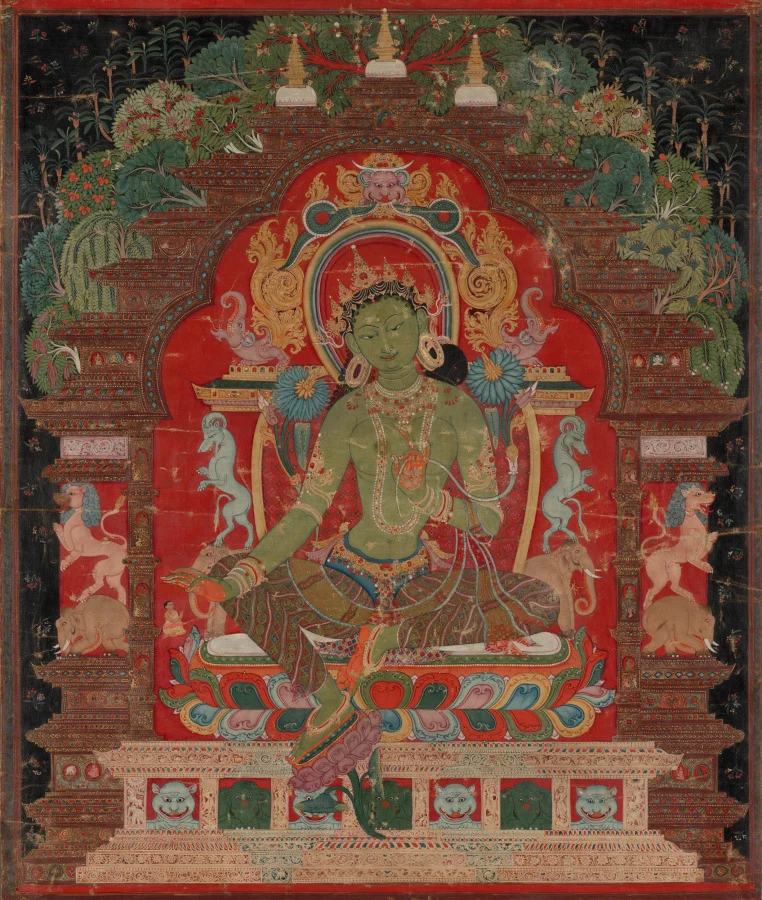
Green Tārā, circa 1260s. The Cleveland Museum of Art attributes the painted thangka to Aniko.
The Cleveland Museum of Art. Green Tara, circa 1260s. Attributed to Aniko. Purchase from the J. H. Wade Fund by exchange, 1970.156. · Image source ↗ · CC0
See references (2)
In the library
The Gods of Northern Buddhism
Reading note
Read Alice Getty’s illustrated discussion of Tārā.
Sources
See references (5)
- The Gods of Northern Buddhism, printed p. 119, Reader page 167Alice Getty, The Gods of Northern Buddhism, 1928 revised second edition, Munshiram Manoharlal reprint. Lumitheca Library edition IMJ-0597-E001.Read this page in The Gods of Northern Buddhism ↗
- The Gods of Northern Buddhism, printed p. 120, Reader page 168Alice Getty, The Gods of Northern Buddhism, 1928 revised second edition, Munshiram Manoharlal reprint. Lumitheca Library edition IMJ-0597-E001.Read this page in The Gods of Northern Buddhism ↗
- The Gods of Northern Buddhism, printed p. 124, Reader page 172Alice Getty, The Gods of Northern Buddhism, 1928 revised second edition, Munshiram Manoharlal reprint. Lumitheca Library edition IMJ-0597-E001.Read this page in The Gods of Northern Buddhism ↗
- Tārā Who Protects from the Eight Dangers, Toh 731, §§ 1.21–1.29 ↗Tārā Who Protects from the Eight Dangers, Toh 731, §§ 1.21–1.29. Translation credit: Samye Translations, Stefan Mang and Peter Woods. Published by 84000.
- Green Tara ↗The Cleveland Museum of Art. Green Tara, circa 1260s. Attributed to Aniko. Purchase from the J. H. Wade Fund by exchange, 1970.156.