Swan maidens
Swan maidens pass between woman and bird in folklore. See how feather robes, stolen garments and promises shape marriage and departure in Frank Hamel’s tales.
In this article
What is a swan maiden?
A swan maiden is a woman in a folktale who moves between human and bird form, often by putting on or taking off a feather garment. Whoever hides the garment can prevent her from returning to her other life. [1][2]
Recovering the garment often ends a marriage or sends a spouse looking for the woman who has left. The garment becomes the means of deciding whether to stay, and its return can change the balance between the two people. [1][2][3][4]
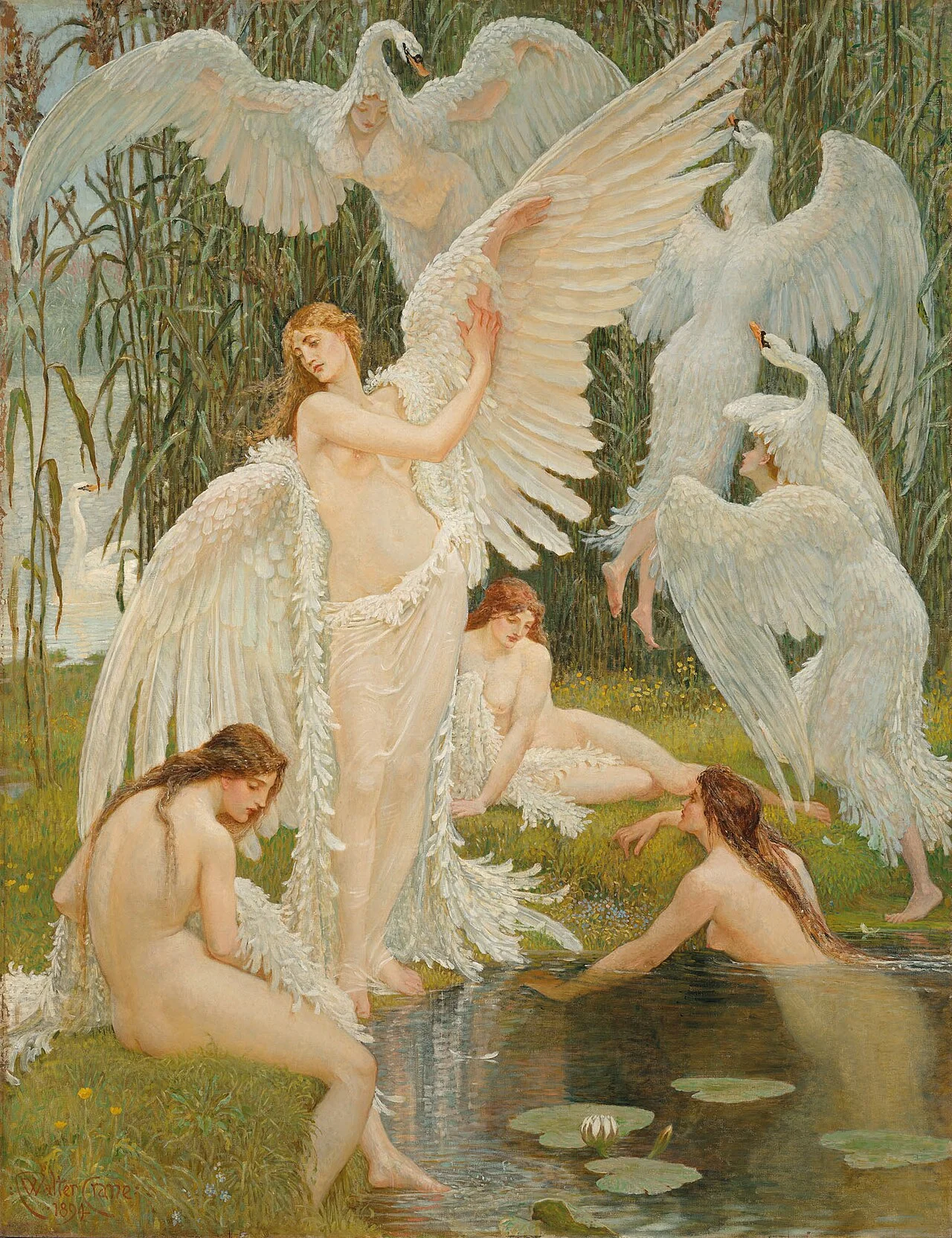
Walter Crane, The Swan Maidens, 1894. Women and birds share one visual field, an artistic treatment of the feather-robed maiden motif.
Walter Crane, 1845–1915. Faithful reproduction of a public-domain painting, via Wikimedia Commons. · Image source ↗ · Public Domain
Human Animals by Frank Hamel
Frank Hamel’s Human Animals describes bird-maidens among its marriage and transformation stories. A feather robe can be both the means of change and the condition of return. When someone hides it, the woman’s human appearance no longer means that she has freely abandoned her other life. [1][2]
Hamel’s bird chapter includes versions in which a promise or a family’s intervention changes what happens. The grey-gull bride makes the relationship conditional on a promise. Shamsah leaves when her feather robe is restored, and Janshah goes searching. In the Ghulab Bano story, family confinement complicates a promised return. [5][3][4]
Hamel also discusses Andersen’s Wild Swans, where transformed brothers must be released from a curse. Birds, human identity and recovery recur, but this is not a marriage secured through a stolen robe. Placing it nearby broadens his comparison without making it another version of precisely the same plot. [4][6]
What changes across the stories
Animal-spouse tales can involve a removable skin, a concealed identity or a condition that must not be broken. Swan-maiden stories are a particular bird-related strand within that larger field. Their details matter more than simply counting all marriages to transformed beings as equivalent. [7][1][2][8]
Hamel also compares bird-women with figures from several religious and literary traditions. The point of comparison is specific: some fly, some cross between worlds and some take part in marriages. A Valkyrie or an apsara carries a role within its own tradition that the feather-robe motif alone cannot explain. [1][2][3]
Read further in the library
Human Animals
Reading note
Frank Hamel collects the particular stories and interpretations discussed here; the account identifies exact printed and Library Reader pages.
Sources
See references (9)
- Human Animals, printed p. 145, Reader page 154Frank Hamel, Human Animals. Frederick A. Stokes Co., New York, undated title page; preface dated London, 1915. Exact printed pages refer to the retained Library scan.Read this page in Human Animals ↗Return to text ↑
- Human Animals, printed p. 146, Reader page 155Frank Hamel, Human Animals. Frederick A. Stokes Co., New York, undated title page; preface dated London, 1915. Exact printed pages refer to the retained Library scan.Read this page in Human Animals ↗Return to text ↑
- Human Animals, printed p. 211, Reader page 220Frank Hamel, Human Animals. Frederick A. Stokes Co., New York, undated title page; preface dated London, 1915. Exact printed pages refer to the retained Library scan.Read this page in Human Animals ↗Return to text ↑
- Human Animals, printed p. 212, Reader page 221Frank Hamel, Human Animals. Frederick A. Stokes Co., New York, undated title page; preface dated London, 1915. Exact printed pages refer to the retained Library scan.Read this page in Human Animals ↗Return to text ↑
- Human Animals, printed p. 210, Reader page 219Frank Hamel, Human Animals. Frederick A. Stokes Co., New York, undated title page; preface dated London, 1915. Exact printed pages refer to the retained Library scan.Read this page in Human Animals ↗Return to text ↑
- Human Animals, printed p. 213, Reader page 222Frank Hamel, Human Animals. Frederick A. Stokes Co., New York, undated title page; preface dated London, 1915. Exact printed pages refer to the retained Library scan.Read this page in Human Animals ↗Return to text ↑
- Human Animals, printed p. 141, Reader page 150Frank Hamel, Human Animals. Frederick A. Stokes Co., New York, undated title page; preface dated London, 1915. Exact printed pages refer to the retained Library scan.Read this page in Human Animals ↗Return to text ↑
- Human Animals, printed p. 179, Reader page 188Frank Hamel, Human Animals. Frederick A. Stokes Co., New York, undated title page; preface dated London, 1915. Exact printed pages refer to the retained Library scan.Read this page in Human Animals ↗Return to text ↑
- Walter Crane, The Swan Maidens, 1894 ↗Walter Crane, 1845–1915. Faithful reproduction of a public-domain painting, via Wikimedia Commons.