Spiritualism
Explore Spiritualism’s beliefs, mediumship, history and churches, with spirit photography and debates about evidence for communication after death.
In this article
Origins and religious teachings
What is Spiritualism?
Spiritualism is a modern religious movement centred on the belief that individual life continues after bodily death and that communication with the deceased is possible through mediumship. It also includes worship, moral teaching and community life. This article focuses on its British and American histories and on named organizations that continue to explain and practise the religion. [1]
The Spiritualists’ National Union presents Spiritualism as a religion with a belief in God, education and regular services. Its account includes prayer, song, reflection, an inspirational address and, in many services, a demonstration interpreted as evidence of continued life. This is more specific than the everyday description of someone as spiritual. A person can be interested in meaning or meditation without accepting Spiritualist teachings or belonging to a Spiritualist church. [1]
The Fox sisters and the beginnings of the movement
The events associated with the Fox family at Hydesville, New York, in 1848 became a defining origin story of modern Spiritualism. Sounds heard in the house were interpreted as replies from a deceased person. Neighbours came to witness the rappings, and the two younger sisters, Maggie and Katie, became public mediums. Their older sister Leah was also part of the developing story. [2]
The significance lies in the movement that formed around the claim. Communication through a simple code could be presented to an audience as an encounter with the dead, rather than merely a belief about a distant afterlife. Public demonstrations and paid performances helped turn a household episode into a wider phenomenon. Reporting that this happened is different from confirming the family’s explanation of the sounds. The claim and its circulation are both parts of the historical record. [2]
The source also records favourable reactions from figures such as newspaper editor Horace Greeley and Judge John Edmonds, alongside early doubts about the sisters’ integrity. Public credibility was contested from the beginning. The movement spread through networks of audiences, prominent supporters and critics, rather than receiving one unanimous response. [2]
The Seven Principles: more than mediumship
The SNU’s Seven Principles link God, human kinship, spirit communication and the soul’s continued existence with personal responsibility, moral consequences and the possibility of enduring progress. The organization attributes their reception to the mediumship of Emma Hardinge Britten. They form a framework for this branch of Spiritualism, rather than a creed that can be assumed for every related group. [3]
The moral teaching places responsibility on thought and conduct. Growth remains possible beyond death, and wrongdoing has consequences. This creates a religious universe in which relationships and character continue to matter. The SNU also explains the soul’s persistence through the language of energy. That is part of its religious argument; a physical conservation law by itself does not establish the survival of a person’s memories or identity. [3]
The principles also connect human kinship with practical service. A common divine origin creates obligations towards other people, while the possibility of progress gives ethical effort a continuing horizon. This makes the afterlife more than a destination: it is part of an account of character, consequence and relationship that begins in present conduct. [3]
An American declaration and the idea of progress
The National Spiritualist Association of Churches offers a different formulation in its nine principles. These affirm Infinite Intelligence, the expression of divine reality through nature, personal survival, spirit communication and moral responsibility. The document identifies stages of adoption in 1899, 1909 and 1944, giving the declaration a history of development. [4]
Its account rejects an eternally closed possibility of reform. Spiritual growth remains open, and people bear responsibility for overcoming wrongdoing. The document also explicitly calls mediumship scientifically proven. That statement records the association’s conviction; it does not, on its own, supply independent confirmation of the claim. Comparing this declaration with the SNU’s principles shows both shared themes and different institutional language, without forcing every Spiritualist into one identical theological system. [4]
Infinite Intelligence is explained as an impersonal power present throughout nature, even though people understand it through personal perception. The declaration’s language of natural law also gives it a distinctive account of religion: conduct is to align with the order understood to govern both physical and spiritual life. [4]
Communication, images and identity
What is a medium understood to do?
In the SNU’s explanation, a medium receives and conveys personal information from a communicating spirit. The intended identification may involve memories, personality and other details associated with the deceased. The stated purpose is to support belief in survival, rather than to predict the future or offer counselling. The organization describes training and accreditation for people who represent it. [5]
This account explains why identity matters so much to Spiritualist testimony. A general statement about an afterlife differs from a message that a sitter recognizes as coming from a particular person. Recognition is meaningful to the participant, while the question of where the information originated remains a separate evidential problem. Training or accreditation identifies a relationship to the organization and its standards. It does not independently settle the supernatural explanation of a message. [5]
Spirit photography and the appearance of evidence
Photography seemed to offer an especially striking witness: an image might show a presence that ordinary sight had missed. Yet the medium itself could produce ghostlike forms. The National Science and Media Museum explains how movement during long exposures created blurred, transparent figures, and how photographers later made ghost images deliberately for entertainment. [6]
That technical history matters when an image is offered as evidence of a spirit. A visible effect requires an account of how the photograph was made, not just a description of what it resembles. Harding’s museum account distinguishes accidental images, novelty pictures and fraudulent claims. These categories should remain separate. A manufactured photographic ghost is evidence of a photographic process and its presentation, rather than a direct view into an afterlife. [6]
One museum example shows Prince Arthur’s nurse becoming a faint presence when she moved into the frame during an exposure. Here the ghostlike appearance has an ordinary account. The example is especially instructive because it separates an effect visible on the print from an interpretation that someone might later attach to it. [6]
Ghost imagery as popular entertainment
The Ghost in the Stereoscope, published around 1856 by the London Stereoscopic Company, shows a staged supernatural encounter in two nearly identical photographs. Viewed through a stereoscope, the paired pictures create an illusion of depth. The Met places such scenes within a market for theatrical and comic tableaux. The object gives the article’s distinction between photographic entertainment and evidential claims a concrete historical example. [13]
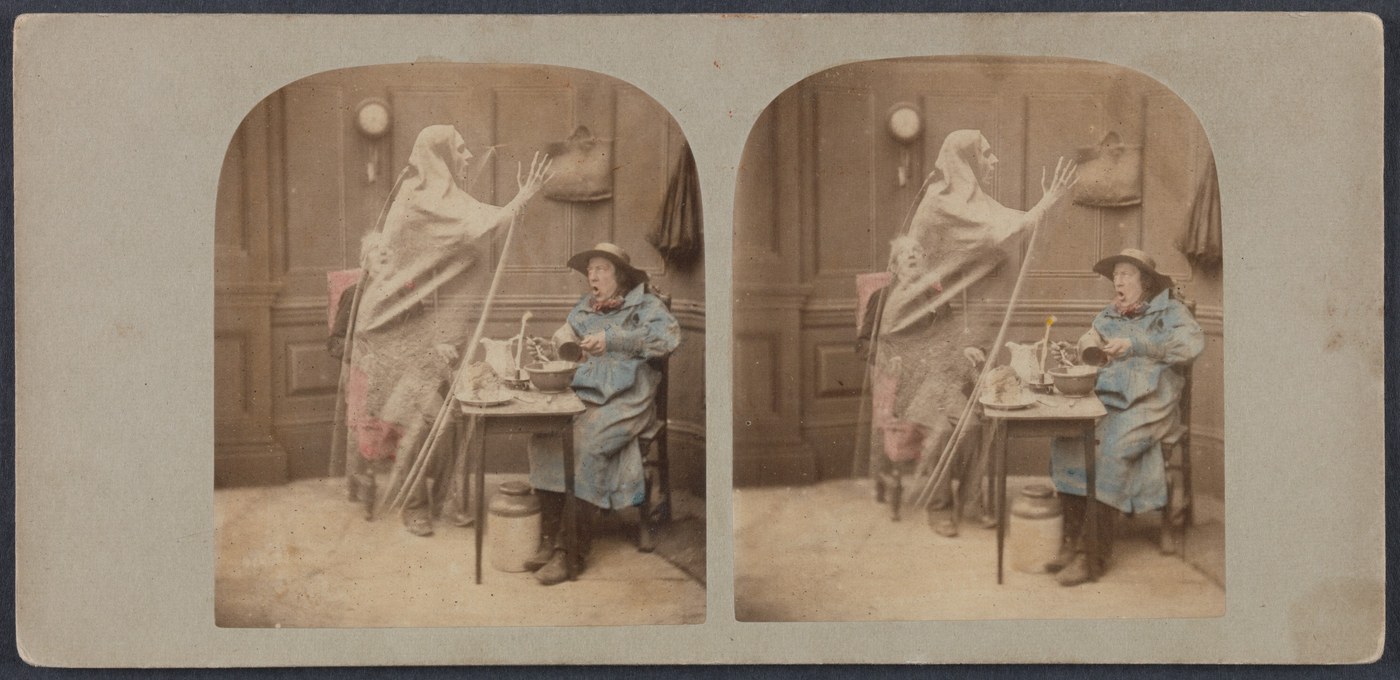
The Ghost in the Stereoscope, London Stereoscopic Company, ca. 1856. Albumen silver prints with applied colour.
The Metropolitan Museum of Art. Gift of Weston J. Naef, in memory of Kathleen W. Naef and Weston J. Naef Sr., 1982. Accession 1982.1182.1284. Public Domain (CC0). · Museum record ↗ · CC0
William Mumler and the problem of identification
William Mumler marketed portraits in which hazy additional figures appeared beside living sitters. The Met’s account describes the support he attracted from Spiritualists and a revealing difficulty: a supposed spirit appearing in photographs was recognized as a person who was still alive. Mumler subsequently opened a New York studio and was arrested in 1869 on charges of fraud and larceny. [7]
The museum records a later photograph, dated 1872, under the title Bronson Murray in a Trance with the Spirit of Ella Bonner. The title preserves the image’s claimed identification. It should not be read as the museum establishing that a deceased person was present. The object is an albumen print from a glass negative. Its material form, attribution and claimed meaning provide different kinds of information about the history of Spiritualism and photography. [7]
Séances and the study of evidence
Spiritualism and psychical research
The Society for Psychical Research was founded in London in 1882 to investigate phenomena including mediumship, apparitions and mesmerism. Its history describes collecting testimony, comparing reports and examining possible trickery. Some investigations involved reproducing apparently mysterious effects, including slate-writing, to show how sitters could be deceived. [8]
Psychical research and Spiritualist religion overlap in subject matter while asking different questions. A church may treat communication as part of religious life; an investigation asks what happened and which explanation the evidence supports. The SPR states that it holds no corporate view on the ultimate origin and meaning of the phenomena it studies. Its existence, or the scientific reputation of an investigator, cannot substitute for assessing the evidence of a particular case. Its historical account is also an institutional perspective, rather than an independent verdict on every controversy. [8]
The Society’s journals and proceedings preserve arguments as well as conclusions. Their value for a historian includes the methods investigators proposed and the disagreements those methods exposed. A case can therefore illuminate the development of inquiry even where its claimed supernatural interpretation remains disputed. [8]
Why Victorian scientists attended séances
Séances drew people who were also building the institutions of modern science. Alison Petch’s study for the Pitt Rivers Museum examines the involvement of Augustus Lane Fox Pitt-Rivers and Edward Burnett Tylor, alongside figures such as William Crookes and Alfred Russel Wallace. Responses differed: some investigators became convinced, while others remained sceptical. [10]
The disagreement complicates a simple story of religion opposing science. Participants argued about observation, testimony, deception and what counted as an adequate explanation. The same event could be interpreted as a religious manifestation, an experiment or a performance with concealed methods. A scientist’s participation establishes historical interest and involvement; it does not make every conclusion correct. The séance became one setting in which people contested the boundaries between credible observation and the desire to believe. [10]
Community, related traditions and care
Philosophy and everyday religious life
The SNU describes philosophy as central to Spiritualist life. Its account of Spirit in Action emphasizes healing, peace, respect and evolution. In this context, evolution includes spiritual growth and constructive change, rather than merely a biological theory. The principles are intended to shape conduct and relationships. [9]
This side of the religion can disappear when attention rests entirely on extraordinary demonstrations. Churches and teaching programmes also offer places where people discuss responsibilities, grief, hope and how to live with one another. The SNU’s philosophy material invites reflection through members’ experiences and arguments. Its contemporary publications therefore belong to the continuing life of the tradition, alongside the older records of séances, investigations and mediumistic communications found in historical collections. [9]
Spiritualism, Spiritism and the vocabulary of belief
Allan Kardec begins the introduction to The Spirits’ Book by defining terms. He uses spiritualism broadly for belief in something beyond matter, then introduces Spiritism for the particular doctrine concerning relations between the physical world and spirits. The book’s followers are called Spiritists. His distinction was intended to reduce confusion between a broad philosophical position and a defined body of teaching. [11]
English usage adds another layer: modern Spiritualism also names the movement and churches described in this article. The terms therefore need their context. An author’s use of spiritualist may indicate a philosophical position, an organized religion or a relationship to spirit communication. Kardec’s own vocabulary should remain visible when discussing Spiritism, rather than treating every group interested in spirits as one undifferentiated tradition. [11]
Spiritualist healing and care
Spiritualist healing is described by the SNU as the transmission of divine energy through touch, thought or prayer. Its account distinguishes contact healing from practices performed without contact or without the recipient’s physical presence. It also identifies a code of conduct and training for its healing mediums. [12]
These descriptions explain a religious practice and the organization’s understanding of it. They do not establish clinical effectiveness. The SNU itself presents spiritual healing as complementary to medical treatment. A historical or religious account can describe its place in worship, care and community while keeping claims about treating illness subject to the evidence required for medical decisions. For readers of historical healing literature, that distinction is particularly useful: the author’s reported experience and a demonstrated treatment effect are different kinds of claim. [12]
Read further in the library
Spirit Identity: Higher Aspects of Spiritualism
Reading note
A Spiritualist argument about identifying people through claimed communications. Read it as testimony and interpretation from within the movement.
Behind the Scenes with the Mediums
Reading note
David P. Abbott examines specific techniques behind apparently supernatural effects. It provides a critical historical companion to claims about mediumship.
Sources
- About Spiritualism ↗The Spiritualists’ National UnionReturn to text ↑
- Spiritualism in context ↗Georgina Byrne, Modern Spiritualism and the Church of England, 1850–1939, Boydell & Brewer, 2010; Cambridge Core chapter summaryReturn to text ↑
- The Seven Principles ↗The Spiritualists’ National UnionReturn to text ↑
- Declaration of Principles ↗National Spiritualist Association of Churches; interpretation by Joseph P. WhitwellReturn to text ↑
- Mediumship ↗The Spiritualists’ National UnionReturn to text ↑
- G is for Ghosts: The birth and rise of spirit photography ↗Colin Harding, National Science and Media Museum, 2013Return to text ↑
- Bronson Murray in a Trance with the Spirit of Ella Bonner ↗The Metropolitan Museum of Art; photograph by William Mumler, 1872, on loan from the J. Paul Getty MuseumReturn to text ↑
- Our History ↗Zofia Weaver, Society for Psychical ResearchReturn to text ↑
- Our Philosophy ↗The Spiritualists’ National UnionReturn to text ↑
- Spirited Enquiry: Pitt-Rivers, Tylor, and the Séance ↗Alison Petch, Pitt Rivers Museum, University of Oxford, 2013Return to text ↑
- The Spirits’ Book, Introduction I ↗Allan Kardec, The Spirits’ Book; KardecPedia, Instituto de Divulgação Espírita Allan KardecReturn to text ↑
- Healing ↗The Spiritualists’ National UnionReturn to text ↑
- The Ghost in the Stereoscope ↗The Metropolitan Museum of Art; object 1982.1182.1284Return to text ↑
About this article & its sources
An introduction focused on modern British and American Spiritualism. Named religious beliefs, testimony, historical investigation and demonstrated photographic effects are distinguished. Spiritism is identified separately.
Passage attributions
What is Spiritualism?
Passage 1: The Spiritualists’ National Union.
Passage 2: The Spiritualists’ National Union.
The Fox sisters and the beginnings of the movement
Passage 1: Georgina Byrne, Modern Spiritualism and the Church of England, 1850–1939, Boydell & Brewer, 2010; Cambridge Core chapter summary.
Passage 2: Georgina Byrne, Modern Spiritualism and the Church of England, 1850–1939, Boydell & Brewer, 2010; Cambridge Core chapter summary.
Passage 3: Georgina Byrne, Modern Spiritualism and the Church of England, 1850–1939, Boydell & Brewer, 2010; Cambridge Core chapter summary.
The Seven Principles: more than mediumship
Passage 1: The Spiritualists’ National Union.
Passage 2: The Spiritualists’ National Union.
Passage 3: The Spiritualists’ National Union.
An American declaration and the idea of progress
Passage 1: National Spiritualist Association of Churches; interpretation by Joseph P. Whitwell.
Passage 2: National Spiritualist Association of Churches; interpretation by Joseph P. Whitwell.
Passage 3: National Spiritualist Association of Churches; interpretation by Joseph P. Whitwell.
What is a medium understood to do?
Passage 1: The Spiritualists’ National Union.
Passage 2: The Spiritualists’ National Union.
Spirit photography and the appearance of evidence
Passage 1: Colin Harding, National Science and Media Museum, 2013.
Passage 2: Colin Harding, National Science and Media Museum, 2013.
Passage 3: Colin Harding, National Science and Media Museum, 2013.
Ghost imagery as popular entertainment
Passage 1: The Metropolitan Museum of Art; curatorial interpretation and inspected historical image.
William Mumler and the problem of identification
Passage 1: The Metropolitan Museum of Art; photograph by William Mumler, 1872, on loan from the J. Paul Getty Museum.
Passage 2: The Metropolitan Museum of Art; photograph by William Mumler, 1872, on loan from the J. Paul Getty Museum.
Spiritualism and psychical research
Passage 1: Zofia Weaver, Society for Psychical Research.
Passage 2: Zofia Weaver, Society for Psychical Research.
Passage 3: Zofia Weaver, Society for Psychical Research.
Why Victorian scientists attended séances
Passage 1: Alison Petch, Pitt Rivers Museum, University of Oxford, 2013.
Passage 2: Alison Petch, Pitt Rivers Museum, University of Oxford, 2013.
Philosophy and everyday religious life
Passage 1: The Spiritualists’ National Union.
Passage 2: The Spiritualists’ National Union.