Spiritual Self-Knowledge
Spiritual self-knowledge examines the motives and habits that shape perception. Compare Steiner’s mirror images with Swedenborg’s spiritual record of a life.
In this article
Understanding the concept
Spiritual self-knowledge means recognising the motives, habits and limits that shape a person’s choices. Some esoteric writers give that recognition a further purpose. Knowing what a person brings to an experience can change how they understand what appears before them. [1][2][3][4][5][6][7]
See references (7)
- Initiation and Its Results, printed p. 18, Reader page 18
- Initiation and Its Results, printed p. 19, Reader page 19
- Initiation and Its Results, printed p. 53, Reader page 52
- Initiation and Its Results, printed p. 54, Reader page 53
- Initiation and Its Results, printed p. 55, Reader page 54
- Initiation and Its Results, printed p. 56, Reader page 55
- Initiation and Its Results, printed p. 57, Reader page 56
Initiation and Its Results by Rudolf Steiner
In Initiation and Its Results, Rudolf Steiner begins with a practical question. What can the student actually do at this stage? He connects an honest answer with duties, promises and the aims by which someone directs a life. [1][2]
The etheric-body chapter gives this examination a more unfamiliar consequence. Desires and purposes are said to appear as outward shapes. Steiner describes the observer encountering a picture of personal character, sometimes through animal-like forms, rather than simply looking into an environment unrelated to the self. [3][4]
The mirror comparison changes how the image is to be read. An outward wish can seem to approach its maker. Steiner argues that a person who has already examined that wish is better placed to recognise its origin. Without such preparation, an observer might mistake the picture for a foreign presence or dismiss it in alarm. [5][6]
A learner who knows their own character already has something to compare with a disturbing or unfamiliar image. Steiner gives this prior knowledge a place in how someone learns to interpret what they think they see. [6][7]
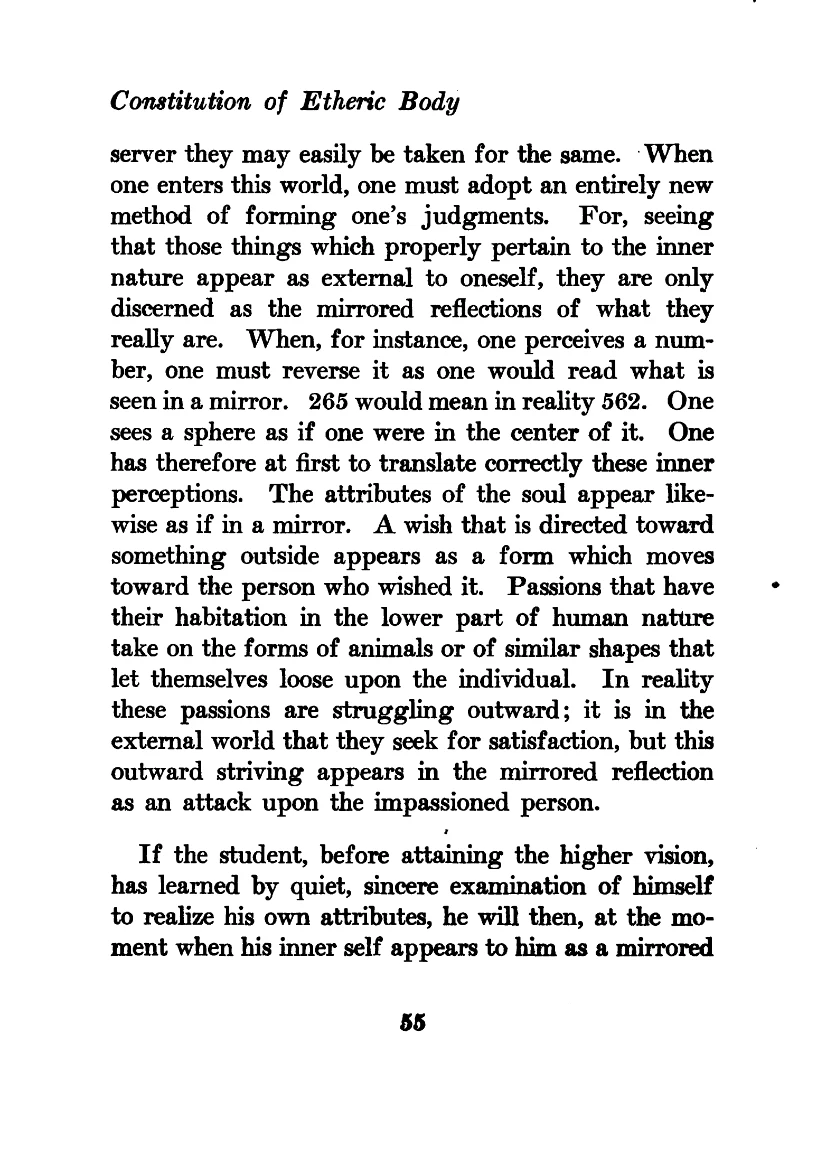
Source facsimile: Initiation and Its Results (1909), printed p. 55, Reader page 54.
Rudolf Steiner, Initiation and Its Results, Clifford Bax translation, First American Edition, 1909. Public-domain historical page from the checksum-verified Library PDF. · Image source ↗ · Public Domain
See references (7)
- Initiation and Its Results, printed p. 18, Reader page 18
- Initiation and Its Results, printed p. 19, Reader page 19
- Initiation and Its Results, printed p. 53, Reader page 52
- Initiation and Its Results, printed p. 54, Reader page 53
- Initiation and Its Results, printed p. 55, Reader page 54
- Initiation and Its Results, printed p. 56, Reader page 55
- Initiation and Its Results, printed p. 57, Reader page 56
Heaven and Its Wonders and Hell by Emanuel Swedenborg
Emanuel Swedenborg’s Heaven and Its Wonders and Hell describes hidden acts being disclosed together with their circumstances and intentions. The detail comes, in his account, from the person’s own spiritual memory, which he understands as a record of the whole life. [8][9][10][11]
Recognising one’s motives and having them disclosed
The mirror scene tests whether the learner can recognise a wish that appears to belong to the world outside. If the wish is familiar, they have a reason to reconsider whose activity the picture represents. [3][4][5][6][7]
In Steiner, the learner prepares to make that judgment during training. In Swedenborg, a life’s motives are disclosed after death through a record the person already carries. The two accounts give recognition a different moment and purpose. [8][9][10][11][3][4][5][6]
See references (9)
- Initiation and Its Results, printed p. 53, Reader page 52
- Initiation and Its Results, printed p. 54, Reader page 53
- Initiation and Its Results, printed p. 55, Reader page 54
- Initiation and Its Results, printed p. 56, Reader page 55
- Initiation and Its Results, printed p. 57, Reader page 56
- Heaven and Its Wonders and Hell, printed p. 401, Reader page 408
- Heaven and Its Wonders and Hell, printed p. 402, Reader page 409
- Heaven and Its Wonders and Hell, printed p. 403, Reader page 410
- Heaven and Its Wonders and Hell, printed p. 404, Reader page 411
Read further in the library

Initiation and Its Results
Reading note
The separately titled account draws on exact passages in the consulted Library edition.

Heaven and Its Wonders and Hell
Reading note
Separately attributed comparison with exact previously researched Library passages.
Sources
See references (11)
- Initiation and Its Results, printed p. 18, Reader page 18Rudolf Steiner, Initiation and Its Results: A Sequel to The Way of Initiation, translated by Clifford Bax. First American Edition, 1909. Macoy Publishing and Masonic Supply Co., New York; Max Gysi, London. Claims of clairvoyant perception and subtle organs remain attributed. References identify the exact consulted Library edition.Read this page in Initiation and Its Results ↗Return to text ↑
- Initiation and Its Results, printed p. 19, Reader page 19Rudolf Steiner, Initiation and Its Results: A Sequel to The Way of Initiation, translated by Clifford Bax. First American Edition, 1909. Macoy Publishing and Masonic Supply Co., New York; Max Gysi, London. Claims of clairvoyant perception and subtle organs remain attributed. References identify the exact consulted Library edition.Read this page in Initiation and Its Results ↗Return to text ↑
- Initiation and Its Results, printed p. 53, Reader page 52Rudolf Steiner, Initiation and Its Results: A Sequel to The Way of Initiation, translated by Clifford Bax. First American Edition, 1909. Macoy Publishing and Masonic Supply Co., New York; Max Gysi, London. Claims of clairvoyant perception and subtle organs remain attributed. References identify the exact consulted Library edition.Read this page in Initiation and Its Results ↗Return to text ↑
- Initiation and Its Results, printed p. 54, Reader page 53Rudolf Steiner, Initiation and Its Results: A Sequel to The Way of Initiation, translated by Clifford Bax. First American Edition, 1909. Macoy Publishing and Masonic Supply Co., New York; Max Gysi, London. Claims of clairvoyant perception and subtle organs remain attributed. References identify the exact consulted Library edition.Read this page in Initiation and Its Results ↗Return to text ↑
- Initiation and Its Results, printed p. 55, Reader page 54Rudolf Steiner, Initiation and Its Results: A Sequel to The Way of Initiation, translated by Clifford Bax. First American Edition, 1909. Macoy Publishing and Masonic Supply Co., New York; Max Gysi, London. Claims of clairvoyant perception and subtle organs remain attributed. References identify the exact consulted Library edition.Read this page in Initiation and Its Results ↗Return to text ↑
- Initiation and Its Results, printed p. 56, Reader page 55Rudolf Steiner, Initiation and Its Results: A Sequel to The Way of Initiation, translated by Clifford Bax. First American Edition, 1909. Macoy Publishing and Masonic Supply Co., New York; Max Gysi, London. Claims of clairvoyant perception and subtle organs remain attributed. References identify the exact consulted Library edition.Read this page in Initiation and Its Results ↗Return to text ↑
- Initiation and Its Results, printed p. 57, Reader page 56Rudolf Steiner, Initiation and Its Results: A Sequel to The Way of Initiation, translated by Clifford Bax. First American Edition, 1909. Macoy Publishing and Masonic Supply Co., New York; Max Gysi, London. Claims of clairvoyant perception and subtle organs remain attributed. References identify the exact consulted Library edition.Read this page in Initiation and Its Results ↗Return to text ↑
- Heaven and Its Wonders and Hell, printed p. 401, Reader page 408Emanuel Swedenborg, Heaven and Its Wonders and Hell, From Things Heard and Seen, translated by J. C. Ager. American Swedenborg Printing and Publishing Society, New York, 1916. Latin original first published in 1758. Numbered sections and exact pages refer to this consulted edition. Claims of spiritual experience remain attributed.Read this page in Heaven and Its Wonders and Hell ↗Return to text ↑
- Heaven and Its Wonders and Hell, printed p. 402, Reader page 409Emanuel Swedenborg, Heaven and Its Wonders and Hell, From Things Heard and Seen, translated by J. C. Ager. American Swedenborg Printing and Publishing Society, New York, 1916. Latin original first published in 1758. Numbered sections and exact pages refer to this consulted edition. Claims of spiritual experience remain attributed.Read this page in Heaven and Its Wonders and Hell ↗Return to text ↑
- Heaven and Its Wonders and Hell, printed p. 403, Reader page 410Emanuel Swedenborg, Heaven and Its Wonders and Hell, From Things Heard and Seen, translated by J. C. Ager. American Swedenborg Printing and Publishing Society, New York, 1916. Latin original first published in 1758. Numbered sections and exact pages refer to this consulted edition. Claims of spiritual experience remain attributed.Read this page in Heaven and Its Wonders and Hell ↗Return to text ↑
- Heaven and Its Wonders and Hell, printed p. 404, Reader page 411Emanuel Swedenborg, Heaven and Its Wonders and Hell, From Things Heard and Seen, translated by J. C. Ager. American Swedenborg Printing and Publishing Society, New York, 1916. Latin original first published in 1758. Numbered sections and exact pages refer to this consulted edition. Claims of spiritual experience remain attributed.Read this page in Heaven and Its Wonders and Hell ↗Return to text ↑