Spiritual Formation of Planets
In A Wanderer in the Spirit Lands, planets form from matter while afterlife spheres grow around them. Read Hassein’s account and compare Celestion Study of Man.
In this article
Understanding the concept
The spiritual formation of planets is the idea that a world develops invisible regions as well as a material body. In A Wanderer in the Spirit Lands, these spheres change with the conduct of the people who live on the planet. [1][2][3][4]
Hassein traces the process from a fiery mass to a community that survives the physical planet. His account makes the moral history of the inhabitants part of a world’s life cycle. [1][3][4][5]
See references (5)
- A Wanderer in the Spirit Lands, printed p. 253, Reader page 262
- A Wanderer in the Spirit Lands, printed p. 254, Reader page 263
- A Wanderer in the Spirit Lands, printed p. 256, Reader page 265
- A Wanderer in the Spirit Lands, printed p. 257, Reader page 266
- A Wanderer in the Spirit Lands, printed p. 258, Reader page 267
A Wanderer in the Spirit Lands: Franchezzo, transcribed by A. Farnese
Hassein gives the explanation to Franchezzo in the account transcribed by A. Farnese. He first distinguishes planetary and solar spheres from immense intellectual circles of art, philosophy, music and literature. Excellence in an intellectual pursuit does not, in his account, automatically confer a higher moral condition. [6][7][1]
He then describes a planet as a fiery nebulous mass cast off from a parent sun. It attracts minute particles from space. Under pressure, grosser material gathers into the planet while more ethereal elements escape. He distinguishes physical matter, spiritual covering matter and an animating soul essence. [1][2][8]
Hassein describes the lower spheres as larger at first. As he imagines the inhabitants becoming less selfish, the lower regions shrink and the upper regions expand. The changing proportions make his idea of moral history visible. [3][4]
At the end, the planet disperses and its community joins the spheres of its solar system. Hassein insists that a soul does not lose its individual identity through this wider association. Planetary affiliation can gradually merge into a larger community without annihilating the person. [4][5]
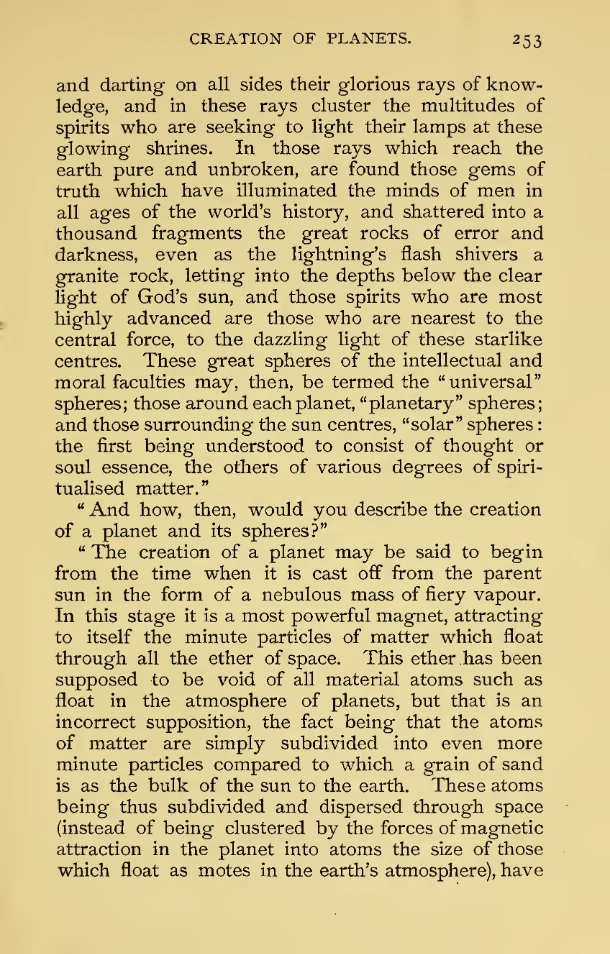
A Wanderer in the Spirit Lands (1896), printed p. 253, Library Reader page 262. Hassein introduces his account of a fiery mass separating from a parent sun.
A Wanderer in the Spirit Lands, W. J. Sinkins, London, preface dated 1896. Public-domain historical page from the checksum-verified Library PDF. · Image source ↗ · Public Domain
See references (8)
- A Wanderer in the Spirit Lands, printed p. 253, Reader page 262
- A Wanderer in the Spirit Lands, printed p. 254, Reader page 263
- A Wanderer in the Spirit Lands, printed p. 256, Reader page 265
- A Wanderer in the Spirit Lands, printed p. 257, Reader page 266
- A Wanderer in the Spirit Lands, printed p. 258, Reader page 267
- A Wanderer in the Spirit Lands, printed p. 251, Reader page 260
- A Wanderer in the Spirit Lands, printed p. 252, Reader page 261
- A Wanderer in the Spirit Lands, printed p. 255, Reader page 264
The Angels’ Diary and Celestion Study of Man
The volume published under the names of Effie M. Shirey and Charles Samson describes travel into regions where planetary systems are forming. Star dust and worlds at different stages of development appear within a visionary journey that also describes Martian and Venusian inhabitants and their instruments. [9][10]
A traveller’s view and a world’s life cycle
Celestion Study of Man takes its traveller past forming systems and inhabited worlds. Hassein gives Franchezzo a sequence from the first gathering of matter to the survival of a community after the planet disperses. One passage describes what a traveller claims to see; the other asks how matter and moral life could develop together. [1][2][3][4][9][10][5]
Hassein places artists, philosophers and musicians in intellectual circles that can extend beyond any planet. A person’s skill helps explain one affiliation. Their way of treating others helps explain the moral sphere to which they belong. [6][7][1]
See references (9)
- A Wanderer in the Spirit Lands, printed p. 253, Reader page 262
- A Wanderer in the Spirit Lands, printed p. 254, Reader page 263
- A Wanderer in the Spirit Lands, printed p. 256, Reader page 265
- A Wanderer in the Spirit Lands, printed p. 257, Reader page 266
- A Wanderer in the Spirit Lands, printed p. 258, Reader page 267
- A Wanderer in the Spirit Lands, printed p. 251, Reader page 260
- A Wanderer in the Spirit Lands, printed p. 252, Reader page 261
- The Angels’ Diary and Celestion Study of Man, Reader page 109
- The Angels’ Diary and Celestion Study of Man, Reader page 110
Read further in the library
A Wanderer in the Spirit Lands
Reading note
The separately titled account draws on exact passages in the consulted Library edition.
The Angels’ Diary and Celestion Study of Man
Reading note
Separately attributed comparison with exact previously researched Library passages.
Sources
See references (10)
- A Wanderer in the Spirit Lands, printed p. 253, Reader page 262A Wanderer in the Spirit Lands, attributed to the spirit Franchezzo and transcribed by A. Farnese. W. J. Sinkins, London. Title page undated; preface dated 1896. The narrator’s experiences and the guides’ explanations are reported claims, not independently established observations.Read this page in A Wanderer in the Spirit Lands ↗Return to text ↑
- A Wanderer in the Spirit Lands, printed p. 254, Reader page 263A Wanderer in the Spirit Lands, attributed to the spirit Franchezzo and transcribed by A. Farnese. W. J. Sinkins, London. Title page undated; preface dated 1896. The narrator’s experiences and the guides’ explanations are reported claims, not independently established observations.Read this page in A Wanderer in the Spirit Lands ↗Return to text ↑
- A Wanderer in the Spirit Lands, printed p. 256, Reader page 265A Wanderer in the Spirit Lands, attributed to the spirit Franchezzo and transcribed by A. Farnese. W. J. Sinkins, London. Title page undated; preface dated 1896. The narrator’s experiences and the guides’ explanations are reported claims, not independently established observations.Read this page in A Wanderer in the Spirit Lands ↗Return to text ↑
- A Wanderer in the Spirit Lands, printed p. 257, Reader page 266A Wanderer in the Spirit Lands, attributed to the spirit Franchezzo and transcribed by A. Farnese. W. J. Sinkins, London. Title page undated; preface dated 1896. The narrator’s experiences and the guides’ explanations are reported claims, not independently established observations.Read this page in A Wanderer in the Spirit Lands ↗Return to text ↑
- A Wanderer in the Spirit Lands, printed p. 258, Reader page 267A Wanderer in the Spirit Lands, attributed to the spirit Franchezzo and transcribed by A. Farnese. W. J. Sinkins, London. Title page undated; preface dated 1896. The narrator’s experiences and the guides’ explanations are reported claims, not independently established observations.Read this page in A Wanderer in the Spirit Lands ↗Return to text ↑
- A Wanderer in the Spirit Lands, printed p. 251, Reader page 260A Wanderer in the Spirit Lands, attributed to the spirit Franchezzo and transcribed by A. Farnese. W. J. Sinkins, London. Title page undated; preface dated 1896. The narrator’s experiences and the guides’ explanations are reported claims, not independently established observations.Read this page in A Wanderer in the Spirit Lands ↗Return to text ↑
- A Wanderer in the Spirit Lands, printed p. 252, Reader page 261A Wanderer in the Spirit Lands, attributed to the spirit Franchezzo and transcribed by A. Farnese. W. J. Sinkins, London. Title page undated; preface dated 1896. The narrator’s experiences and the guides’ explanations are reported claims, not independently established observations.Read this page in A Wanderer in the Spirit Lands ↗Return to text ↑
- A Wanderer in the Spirit Lands, printed p. 255, Reader page 264A Wanderer in the Spirit Lands, attributed to the spirit Franchezzo and transcribed by A. Farnese. W. J. Sinkins, London. Title page undated; preface dated 1896. The narrator’s experiences and the guides’ explanations are reported claims, not independently established observations.Read this page in A Wanderer in the Spirit Lands ↗Return to text ↑
- The Angels’ Diary and Celestion Study of Man, Reader page 109Effie M. Shirey and Charles Samson, The Angels’ Diary and Celestion Study of Man (1903), communicated through Elizabeth Maud Weatherhead according to the volume’s acknowledgment. Accounts below refer to the exact retained Library edition IMJ-0055-E001.Read this page in The Angels’ Diary and Celestion Study of Man ↗Return to text ↑
- The Angels’ Diary and Celestion Study of Man, Reader page 110Effie M. Shirey and Charles Samson, The Angels’ Diary and Celestion Study of Man (1903), communicated through Elizabeth Maud Weatherhead according to the volume’s acknowledgment. Accounts below refer to the exact retained Library edition IMJ-0055-E001.Read this page in The Angels’ Diary and Celestion Study of Man ↗Return to text ↑