Spirits who do not know they are dead
Why do some spirits in afterlife stories think they are still alive? Compare the clues described by Ward, Swedenborg, Dresser and Rafferty.
In this article
Understanding spirits who do not know they are dead
Some afterlife stories describe a person who has died but still thinks they are living on Earth. Familiar speech, surroundings and the ability to move all seem to support that belief. The person has to find another way to understand what has happened. [1][2][3][4]
A character may think they recovered from an illness, explain the change as a dream or trust the familiarity of their neighbourhood. A story about someone slowly recognising death can therefore also be a story about what counts as evidence to them. [1][5][3][4][12][13][14][15]
See references (9)
- Gone West, printed p. 79, Reader page 92
- Gone West, printed p. 156, Reader page 169
- Gone West, printed p. 158, Reader page 171
- Gone West, printed p. 159, Reader page 172
- Gone West, printed p. 153, Reader page 166
- Life Here and Hereafter, Reader page 159
- Life Here and Hereafter, Reader page 160
- Life Here and Hereafter, Reader page 161
- Life Here and Hereafter, Reader page 162
Life Here and Hereafter: Charlotte E. Dresser and Fred Rafferty
Life Here and Hereafter, received through Charlotte E. Dresser and Fred Rafferty, repeatedly turns on a simple difficulty: a person who can move and answer questions takes those abilities as proof that death has not occurred. The account of Dr Walker uses memories of illness and his former medical practice to introduce the possibility that his own body has died. He initially rejects the explanation because he feels alive. [12][13][14][15]
Two business partners misrecognise the change in another way. After a fatal railway accident, each thinks himself physically alive and the other a ghost. The football boy likewise reads regained strength as recovery, while unfamiliar clothes and a translucent hand challenge that explanation. The circle postpones one conversation rather than force the whole recognition at once. [16][17][18][19][20][21][22]
The book also describes people who already know they have died but cannot see their guides. Its scenes distinguish knowing what happened, finding one’s bearings and learning what to do next. [23][24][25][26][27][28]
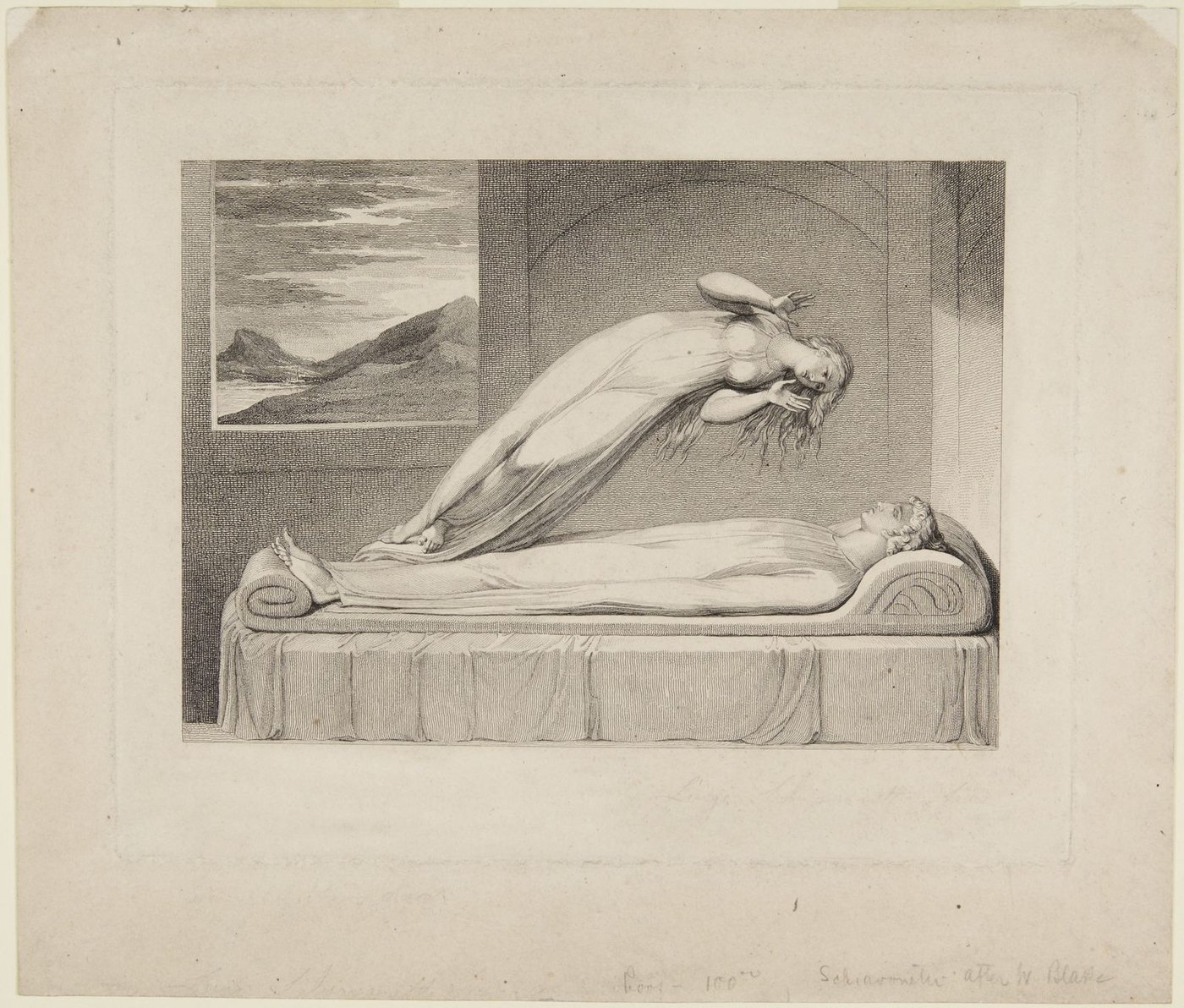
Luigi Schiavonetti after William Blake, The Soul Hovering over the Body Reluctantly Parting with Life, 1805–08, for Robert Blair’s The Grave. The soul looks toward the body left behind. The poetic separation gives visual context to the narratives’ distinction between continued personal awareness and the death of a physical body.
Princeton University Art Museum. Gift of Frank Jewett Mather Jr., x1947-85. Public Domain. · Image source ↗ · Public Domain
See references (17)
- Life Here and Hereafter, Reader page 159
- Life Here and Hereafter, Reader page 160
- Life Here and Hereafter, Reader page 161
- Life Here and Hereafter, Reader page 162
- Life Here and Hereafter, Reader page 23
- Life Here and Hereafter, Reader page 24
- Life Here and Hereafter, Reader page 189
- Life Here and Hereafter, Reader page 190
- Life Here and Hereafter, Reader page 191
- Life Here and Hereafter, Reader page 192
- Life Here and Hereafter, Reader page 193
- Life Here and Hereafter, Reader page 14
- Life Here and Hereafter, Reader page 15
- Life Here and Hereafter, Reader page 16
- Life Here and Hereafter, Reader page 209
- Life Here and Hereafter, Reader page 210
- Life Here and Hereafter, Reader page 211
Gone West by J. S. M. Ward
J. S. M. Ward’s Gone West first raises the possibility while describing living visitors to the astral plane. H. J. L. says some retain little memory of earthly waking and suppose that they live only in their astral world. If they die, the absence of a return to physical waking may be the main change they notice. [1]
The Officer later encounters inhabitants who insist that they remain on earth. One man takes offence at being told that his apparently respectable city is in Hell. His confidence rests on familiar manners and institutions, which give continuity to his experience even while the Officer interprets them differently. [2]
A vicar supplies a more elaborate account. He recalls illness, unconsciousness and disturbing experiences he dismisses as delirious dreams. He interprets his present circumstances as recovery in another community and has taken over an absent clergyman’s duties. People’s unexplained disappearances are assigned an earthly explanation rather than recognised as transitions between spiritual conditions. [3][4]
W. A. gradually identifies his coffin and then sees it lowered into the grave. The burial gives him a clue to what has happened. The vicar instead settles into life at the church and explains away the details he cannot account for. [6]
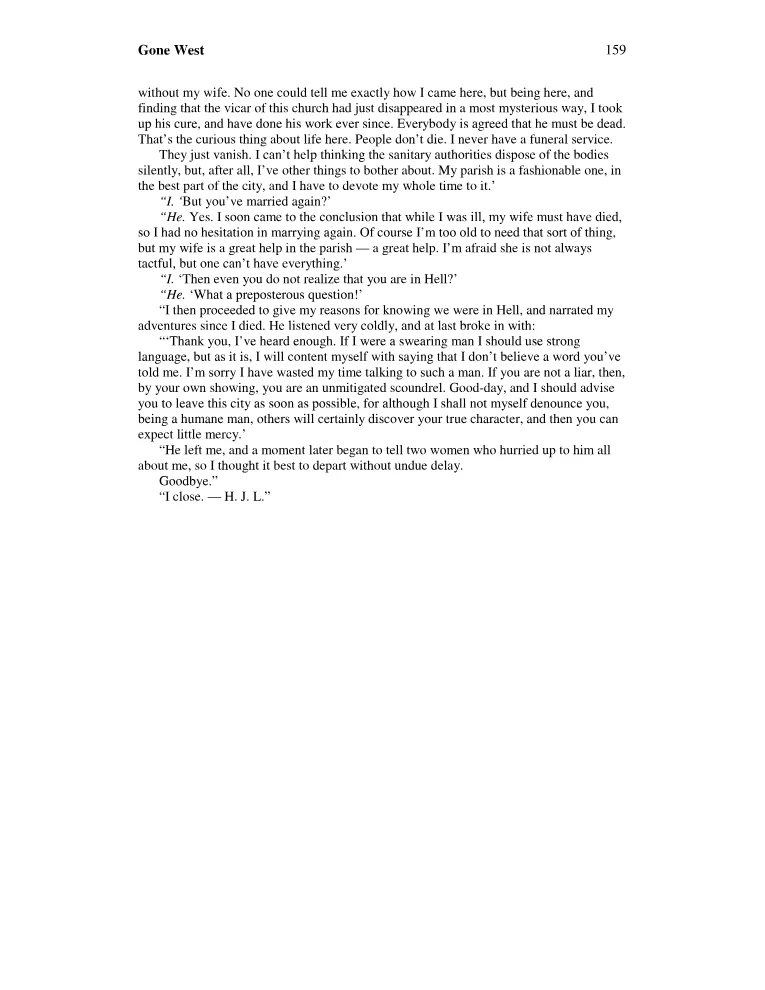
Source page: Gone West, Reader page 172. Ward’s 1920 text is shown in Geoff Cutler’s 2009 digital transcription, rather than an original printed facsimile.
J. S. M. Ward, Gone West, historical text in the public domain. Geoff Cutler’s 2009 transcription expressly permits reuse for any purpose on source leaf2. This image shows the digital transcription, not an original printed facsimile. · Image source ↗ · Public Domain
Heaven and Its Wonders and Hell by Emanuel Swedenborg
Emanuel Swedenborg’s Heaven and Its Wonders and Hell describes an initial state in which the newcomer retains familiar outward habits, speech and appearance. Friends and relatives can recognise the person and show them places in the spiritual world. This continuity can make the fact of death difficult to recognise at first. [7][8][9][10]
Which clues convince the newcomer?
The Officer encounters both people who think they are still on Earth and people who misunderstand the condition they are in. Some have become comfortable in organised communities. Recognising death and knowing where a person has gone remain separate problems. [5][2][3][4][1]
Swedenborg makes ordinary appearance and speech continue into a first state. In Dresser and Rafferty, the ability to move and speak makes characters insist they are alive. Ward also gives familiarity a social form: cities, professions and institutions let characters build a convincing account of where they think they are. [7][8][9][10][1][2][3][4][16][17][12][13][14][15]
See references (15)
- Gone West, printed p. 79, Reader page 92
- Gone West, printed p. 156, Reader page 169
- Gone West, printed p. 158, Reader page 171
- Gone West, printed p. 159, Reader page 172
- Gone West, printed p. 153, Reader page 166
- Heaven and Its Wonders and Hell, printed p. 445, Reader page 452
- Heaven and Its Wonders and Hell, printed p. 446, Reader page 453
- Heaven and Its Wonders and Hell, printed p. 447, Reader page 454
- Heaven and Its Wonders and Hell, printed p. 448, Reader page 455
- Life Here and Hereafter, Reader page 159
- Life Here and Hereafter, Reader page 160
- Life Here and Hereafter, Reader page 161
- Life Here and Hereafter, Reader page 162
- Life Here and Hereafter, Reader page 23
- Life Here and Hereafter, Reader page 24
Read further in the library
Gone West
Reading note
The separately titled account draws on exact passages in the consulted Library edition.

Heaven and Its Wonders and Hell
Reading note
Separately attributed comparison with exact previously researched Library passages.

Life Here and Hereafter
Reading note
The separately titled account draws on exact passages in the consulted Library edition.
Sources
See references (28)
- Gone West, printed p. 79, Reader page 92J. S. M. Ward, Gone West: Three Narratives of After-Death Experiences, third impression, William Rider & Son, London, 1920, as reproduced in Geoff Cutler’s December 2009 digital transcription. Ward’s introduction is distinct from the supplied 1974 foreword.Read this page in Gone West ↗Return to text ↑
- Gone West, printed p. 156, Reader page 169J. S. M. Ward, Gone West: Three Narratives of After-Death Experiences, third impression, William Rider & Son, London, 1920, as reproduced in Geoff Cutler’s December 2009 digital transcription. Ward’s introduction is distinct from the supplied 1974 foreword.Read this page in Gone West ↗Return to text ↑
- Gone West, printed p. 158, Reader page 171J. S. M. Ward, Gone West: Three Narratives of After-Death Experiences, third impression, William Rider & Son, London, 1920, as reproduced in Geoff Cutler’s December 2009 digital transcription. Ward’s introduction is distinct from the supplied 1974 foreword.Read this page in Gone West ↗Return to text ↑
- Gone West, printed p. 159, Reader page 172J. S. M. Ward, Gone West: Three Narratives of After-Death Experiences, third impression, William Rider & Son, London, 1920, as reproduced in Geoff Cutler’s December 2009 digital transcription. Ward’s introduction is distinct from the supplied 1974 foreword.Read this page in Gone West ↗Return to text ↑
- Gone West, printed p. 153, Reader page 166J. S. M. Ward, Gone West: Three Narratives of After-Death Experiences, third impression, William Rider & Son, London, 1920, as reproduced in Geoff Cutler’s December 2009 digital transcription. Ward’s introduction is distinct from the supplied 1974 foreword.Read this page in Gone West ↗Return to text ↑
- Gone West, printed p. 164, Reader page 177J. S. M. Ward, Gone West: Three Narratives of After-Death Experiences, third impression, William Rider & Son, London, 1920, as reproduced in Geoff Cutler’s December 2009 digital transcription. Ward’s introduction is distinct from the supplied 1974 foreword.Read this page in Gone West ↗Return to text ↑
- Heaven and Its Wonders and Hell, printed p. 445, Reader page 452Emanuel Swedenborg, Heaven and Its Wonders and Hell, translated by J. C. Ager. The American Swedenborg Printing and Publishing Society, New York, 1916. Original Latin work first published in 1758.Read this page in Heaven and Its Wonders and Hell ↗Return to text ↑
- Heaven and Its Wonders and Hell, printed p. 446, Reader page 453Emanuel Swedenborg, Heaven and Its Wonders and Hell, translated by J. C. Ager. The American Swedenborg Printing and Publishing Society, New York, 1916. Original Latin work first published in 1758.Read this page in Heaven and Its Wonders and Hell ↗Return to text ↑
- Heaven and Its Wonders and Hell, printed p. 447, Reader page 454Emanuel Swedenborg, Heaven and Its Wonders and Hell, translated by J. C. Ager. The American Swedenborg Printing and Publishing Society, New York, 1916. Original Latin work first published in 1758.Read this page in Heaven and Its Wonders and Hell ↗Return to text ↑
- Heaven and Its Wonders and Hell, printed p. 448, Reader page 455Emanuel Swedenborg, Heaven and Its Wonders and Hell, translated by J. C. Ager. The American Swedenborg Printing and Publishing Society, New York, 1916. Original Latin work first published in 1758.Read this page in Heaven and Its Wonders and Hell ↗Return to text ↑
- Luigi Schiavonetti after William Blake, The Soul Hovering over the Body Reluctantly Parting with Life, 1805–08. ↗Princeton University Art Museum. Gift of Frank Jewett Mather Jr., x1947-85. Public Domain.
- Life Here and Hereafter, Reader page 159Charlotte E. Dresser and Fred Rafferty, Life Here and Hereafter, edited by Fred Rafferty. Modern transcription reproducing the Author’s Edition, San Jose, California, 1927. Exact selected Library edition IMJ-0447-E001; original PageIDs and current Reader positions verified. Communications and their claimed spiritual origins remain attributed to this source.Read this page in Life Here and Hereafter ↗Return to text ↑
- Life Here and Hereafter, Reader page 160Charlotte E. Dresser and Fred Rafferty, Life Here and Hereafter, edited by Fred Rafferty. Modern transcription reproducing the Author’s Edition, San Jose, California, 1927. Exact selected Library edition IMJ-0447-E001; original PageIDs and current Reader positions verified. Communications and their claimed spiritual origins remain attributed to this source.Read this page in Life Here and Hereafter ↗Return to text ↑
- Life Here and Hereafter, Reader page 161Charlotte E. Dresser and Fred Rafferty, Life Here and Hereafter, edited by Fred Rafferty. Modern transcription reproducing the Author’s Edition, San Jose, California, 1927. Exact selected Library edition IMJ-0447-E001; original PageIDs and current Reader positions verified. Communications and their claimed spiritual origins remain attributed to this source.Read this page in Life Here and Hereafter ↗Return to text ↑
- Life Here and Hereafter, Reader page 162Charlotte E. Dresser and Fred Rafferty, Life Here and Hereafter, edited by Fred Rafferty. Modern transcription reproducing the Author’s Edition, San Jose, California, 1927. Exact selected Library edition IMJ-0447-E001; original PageIDs and current Reader positions verified. Communications and their claimed spiritual origins remain attributed to this source.Read this page in Life Here and Hereafter ↗Return to text ↑
- Life Here and Hereafter, Reader page 23Charlotte E. Dresser and Fred Rafferty, Life Here and Hereafter, edited by Fred Rafferty. Modern transcription reproducing the Author’s Edition, San Jose, California, 1927. Exact selected Library edition IMJ-0447-E001; original PageIDs and current Reader positions verified. Communications and their claimed spiritual origins remain attributed to this source.Read this page in Life Here and Hereafter ↗Return to text ↑
- Life Here and Hereafter, Reader page 24Charlotte E. Dresser and Fred Rafferty, Life Here and Hereafter, edited by Fred Rafferty. Modern transcription reproducing the Author’s Edition, San Jose, California, 1927. Exact selected Library edition IMJ-0447-E001; original PageIDs and current Reader positions verified. Communications and their claimed spiritual origins remain attributed to this source.Read this page in Life Here and Hereafter ↗Return to text ↑
- Life Here and Hereafter, Reader page 189Charlotte E. Dresser and Fred Rafferty, Life Here and Hereafter, edited by Fred Rafferty. Modern transcription reproducing the Author’s Edition, San Jose, California, 1927. Exact selected Library edition IMJ-0447-E001; original PageIDs and current Reader positions verified. Communications and their claimed spiritual origins remain attributed to this source.Read this page in Life Here and Hereafter ↗Return to text ↑
- Life Here and Hereafter, Reader page 190Charlotte E. Dresser and Fred Rafferty, Life Here and Hereafter, edited by Fred Rafferty. Modern transcription reproducing the Author’s Edition, San Jose, California, 1927. Exact selected Library edition IMJ-0447-E001; original PageIDs and current Reader positions verified. Communications and their claimed spiritual origins remain attributed to this source.Read this page in Life Here and Hereafter ↗Return to text ↑
- Life Here and Hereafter, Reader page 191Charlotte E. Dresser and Fred Rafferty, Life Here and Hereafter, edited by Fred Rafferty. Modern transcription reproducing the Author’s Edition, San Jose, California, 1927. Exact selected Library edition IMJ-0447-E001; original PageIDs and current Reader positions verified. Communications and their claimed spiritual origins remain attributed to this source.Read this page in Life Here and Hereafter ↗Return to text ↑
- Life Here and Hereafter, Reader page 192Charlotte E. Dresser and Fred Rafferty, Life Here and Hereafter, edited by Fred Rafferty. Modern transcription reproducing the Author’s Edition, San Jose, California, 1927. Exact selected Library edition IMJ-0447-E001; original PageIDs and current Reader positions verified. Communications and their claimed spiritual origins remain attributed to this source.Read this page in Life Here and Hereafter ↗Return to text ↑
- Life Here and Hereafter, Reader page 193Charlotte E. Dresser and Fred Rafferty, Life Here and Hereafter, edited by Fred Rafferty. Modern transcription reproducing the Author’s Edition, San Jose, California, 1927. Exact selected Library edition IMJ-0447-E001; original PageIDs and current Reader positions verified. Communications and their claimed spiritual origins remain attributed to this source.Read this page in Life Here and Hereafter ↗Return to text ↑
- Life Here and Hereafter, Reader page 14Charlotte E. Dresser and Fred Rafferty, Life Here and Hereafter, edited by Fred Rafferty. Modern transcription reproducing the Author’s Edition, San Jose, California, 1927. Exact selected Library edition IMJ-0447-E001; original PageIDs and current Reader positions verified. Communications and their claimed spiritual origins remain attributed to this source.Read this page in Life Here and Hereafter ↗Return to text ↑
- Life Here and Hereafter, Reader page 15Charlotte E. Dresser and Fred Rafferty, Life Here and Hereafter, edited by Fred Rafferty. Modern transcription reproducing the Author’s Edition, San Jose, California, 1927. Exact selected Library edition IMJ-0447-E001; original PageIDs and current Reader positions verified. Communications and their claimed spiritual origins remain attributed to this source.Read this page in Life Here and Hereafter ↗Return to text ↑
- Life Here and Hereafter, Reader page 16Charlotte E. Dresser and Fred Rafferty, Life Here and Hereafter, edited by Fred Rafferty. Modern transcription reproducing the Author’s Edition, San Jose, California, 1927. Exact selected Library edition IMJ-0447-E001; original PageIDs and current Reader positions verified. Communications and their claimed spiritual origins remain attributed to this source.Read this page in Life Here and Hereafter ↗Return to text ↑
- Life Here and Hereafter, Reader page 209Charlotte E. Dresser and Fred Rafferty, Life Here and Hereafter, edited by Fred Rafferty. Modern transcription reproducing the Author’s Edition, San Jose, California, 1927. Exact selected Library edition IMJ-0447-E001; original PageIDs and current Reader positions verified. Communications and their claimed spiritual origins remain attributed to this source.Read this page in Life Here and Hereafter ↗Return to text ↑
- Life Here and Hereafter, Reader page 210Charlotte E. Dresser and Fred Rafferty, Life Here and Hereafter, edited by Fred Rafferty. Modern transcription reproducing the Author’s Edition, San Jose, California, 1927. Exact selected Library edition IMJ-0447-E001; original PageIDs and current Reader positions verified. Communications and their claimed spiritual origins remain attributed to this source.Read this page in Life Here and Hereafter ↗Return to text ↑
- Life Here and Hereafter, Reader page 211Charlotte E. Dresser and Fred Rafferty, Life Here and Hereafter, edited by Fred Rafferty. Modern transcription reproducing the Author’s Edition, San Jose, California, 1927. Exact selected Library edition IMJ-0447-E001; original PageIDs and current Reader positions verified. Communications and their claimed spiritual origins remain attributed to this source.Read this page in Life Here and Hereafter ↗Return to text ↑