Spirit Writing
Spirit writing is writing attributed to spirits. Compare automatic writing, direct writing, trance and attribution in historical accounts.
In this article
What is spirit writing?
Spirit writing is writing attributed to a spirit. A person may hold a pencil and describe receiving the words. Other accounts say marks appear directly on paper. One term has come to cover several claims about where writing comes from. [1][5][2]
A page can preserve the words and show the marks. To decide who was said to write them or how the marks appeared, readers also need the participants’ account of what happened. [3][1][2]
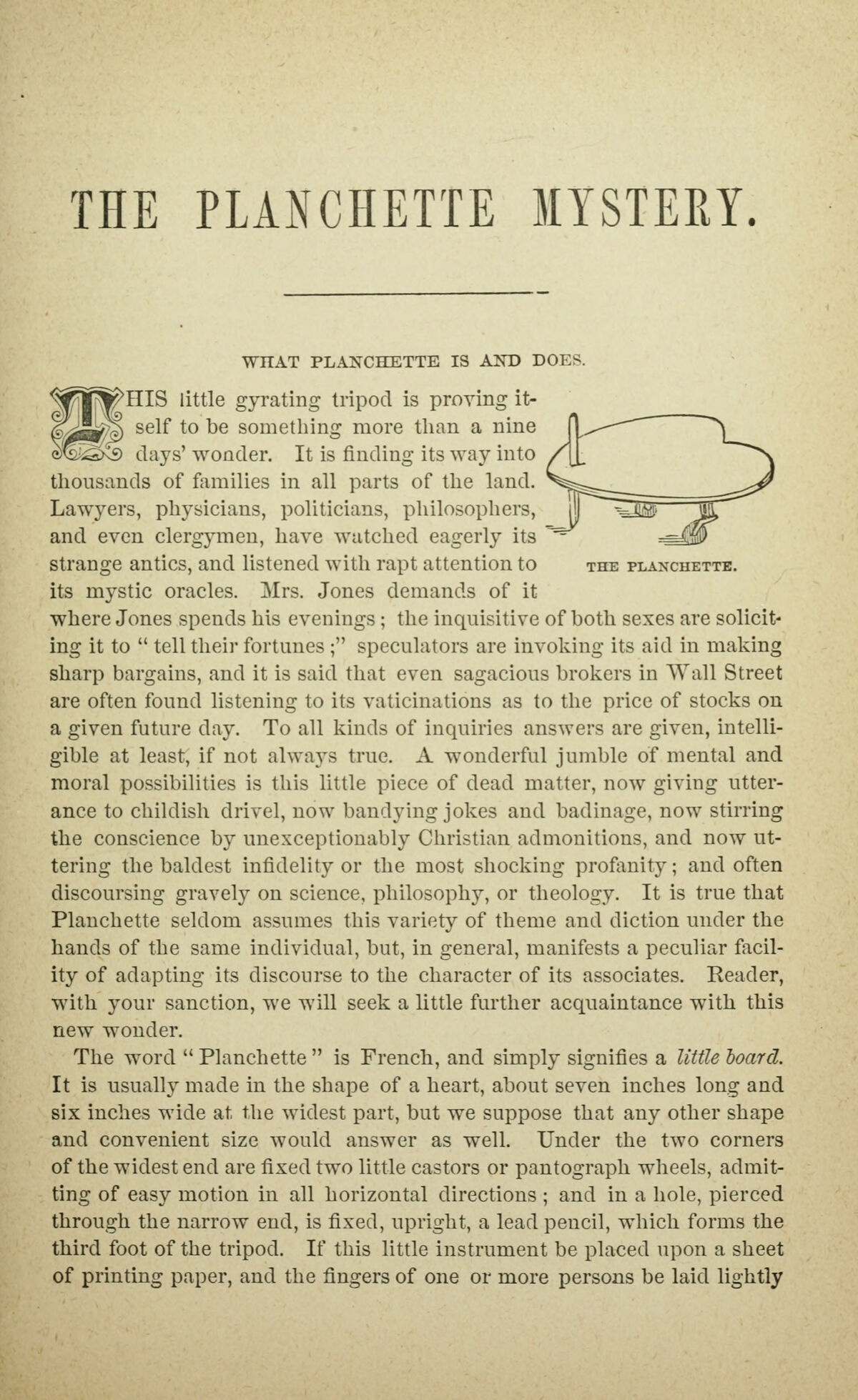
A pencil-bearing planchette illustrated in the 1886 compilation The Salem Witchcraft; The Planchette Mystery; and Modern Spiritualism. The device gives one historical form to writing interpreted as a message. It differs from writing with a pen directly in the hand and from marks said to appear without contact. This is context for the practice, not an illustration of the apparatus used by the Diary’s recorder or Ward.
Brandeis University Libraries, Medical Heritage Library, via Wellcome Collection. 1886. Public Domain Mark. · Image source ↗ · Public Domain
Accounts from the Library
Direct writing in Witchcraft Magic & Alchemy
Grillot de Givry moves from reports of table rappings, in which groups of knocks could stand for letters, to Baron de Güldenstubbe’s claim that marks appeared directly on paper. The baron dated his first result to August 1856. The figure De Givry reproduces brings anonymous tracings together with examples attributed to Augustus and Julius Caesar. The specimens show what the baron offered as evidence for a claim about how the writing appeared and who made it. [30]
De Givry tests the attribution to Louise de La Vallière by setting a signature from a convent letter beside the one reported at the Val-de-Grâce in December 1856. Both bear the name she took as a Carmelite, Louise de la Miséricorde. Their lettering and fluency look different on the page. The comparison asks whether the second hand resembles the first. The name alone would give a reader much less to go on. [31]
Güldenstubbe’s claim concerns how marks reached the paper. De Givry’s comparison then asks a separate question about whose name or hand the marks represent. A reader can inspect the published specimens for resemblance and still need testimony about what happened before and during the sitting. [30][31]
In Gone West, J. S. M. Ward records a communicator’s difficulty in making a message legible through automatic writing. Dresser and Rafferty likewise identify living hands and describe the conditions of receiving a message. Güldenstubbe’s direct-writing claim, as De Givry presents it, removes the human writer from the claimed production of the marks. De Givry can still compare the specimens with other documents, even though the proposed mode of writing has changed. [10][11][20][21][30][31]
Life Here and Hereafter: Charlotte E. Dresser and Fred Rafferty
In Life Here and Hereafter, received chiefly by Charlotte E. Dresser and edited by Fred Rafferty, the introduction takes the circle from table-tipping and the ouija board to automatic writing. Dresser develops the pencil method first. Rafferty says he can later receive writing while Dresser places a hand on one of his hands. [17][18][19][20][21]
The introduction allows that automatic writing is often produced without trance and acknowledges that subconscious activity can originate or alter a message. Later passages describe the circle checking the written result and stopping when the words go astray. The account therefore includes composition, reception and correction, rather than presenting every movement as an exact transcript from outside the writer. [20][22][23][24][25]
An episode of interrupted writing supplies a more unusual explanation. Mary says that resisting another alleged influence can use all the force available, leaving none for her own message. The book interprets some silence as protection. This is a claim within the communicating circle’s account, not an independently established explanation for an inability to write. [26][27][28][29]
See references (13)
- Life Here and Hereafter, Reader page 2
- Life Here and Hereafter, Reader page 3
- Life Here and Hereafter, Reader page 4
- Life Here and Hereafter, Reader page 10
- Life Here and Hereafter, Reader page 11
- Life Here and Hereafter, Reader page 86
- Life Here and Hereafter, Reader page 96
- Life Here and Hereafter, Reader page 97
- Life Here and Hereafter, Reader page 136
- Life Here and Hereafter, Reader page 154
- Life Here and Hereafter, Reader page 155
- Life Here and Hereafter, Reader page 156
- Life Here and Hereafter, Reader page 157
The Angels’ Diary
The Angels’ Diary gives several people a role in its production. The title page names Effie M. Shirey and Charles Samson as authors in the celestial sphere. Their mother, J. A. Seeds Samson Lender, receives the dedication and supplies an acknowledgment. She credits Elizabeth Maud Weatherhead, through whose hand she says the communications came. The book presents celestial authorship through a living person's act of recording. [3][4][1]
Inside the narrative, writing becomes visible in another way. Newly arrived in her home, the traveller sees her own thoughts appear on paper said to be formed from spiritual flowers. She is astonished that thinking can produce a book. The scene gives the reader an origin story for a diary written after its narrator’s death. [5]
The later chapter on celestial literature develops the same idea. Writers who worked on earth continue in the next world. Words appear on open pages through thought, and the sheets carry different tints. The flowers from which the paper is made are said to retain their life. A spiritual book is imagined as an enduring object with a material history of its own. [6][7]
The chapter even describes a new work attributed to T. H. Burgoyne, The Light of Eternity, which corrects errors in his earthly writing. Within the diary’s story, authorship survives together with the ability to reconsider an earlier conclusion. This is the communicated book’s account of a celestial title. [6][7]
In the discussion of New Thought, visible writing appears beside pictures formed through thought and raps produced without contact. The author proposes an ability to write in the atmosphere or upon a surface without moving an arm or hand. This belongs to a theory of thought acting on matter. The opening acknowledgment describes a hand recording messages, while this later passage proposes a further way in which a sign might appear. [8][2]
The examples ask three distinct questions: whether a living hand makes the marks, whether a sign appears independently, and whether the writing is reported on earth or within the narrated spirit world. [1][5][7][2]
Gone West by J. S. M. Ward
In Gone West, J. S. M. Ward first receives visions and then reports a proposal to try automatic writing. H. J. L., one of Ward’s reported spirit contributors, says another spirit will help him learn the method. The first recorded note is brief and comments on the difficulty of making the writing readable. The book treats the channel as something the proposed communicator has to master. [9][10][11]
Ward distinguishes his own states during the writing. He describes the early letters as taking place in semi-trance and says that subsequent ones were received in complete trance. Questions are sometimes written down beforehand. The printed arrangement preserves a sequence of question, response and observation. [12]
When the Officer is first introduced, an editorial note reports a change in the writing’s style, speed and the medium’s demeanour. H. J. L. later says that this new communicator exhausts Ward and should be allowed contact only with care. The book interprets changes in the written production as part of a change in speaker. [13][14]
Ward’s introduction argues that trance and information unknown to him support an external origin for the messages. That is the conclusion he draws from the circumstances he reports. The recorded letters give readers particular observations to examine, including interruptions, changes of hand and comments about how the communication is being made. [9][11][13]
Read beside the acknowledgment in The Angels’ Diary, Ward’s account makes the process of recording more prominent. Both books identify living people through whose hands words are said to arrive. Ward additionally prints questions and observations about his state. Each volume gives a reader a different amount of information about the making of its text. [9][10][11][1]
W. A.’s later account gives writing another use. He reports causing a living business partner to produce a letter disclosing a plan to take money, thereby protecting someone W. A. had disliked. The book judges this intervention through its proposed purpose. Placed beside the early letters written through Ward, the episode shows how widely its contributors apply the idea of a spirit acting through another person’s hand. [15]
See references (8)
- The Angels’ Diary, Reader page 4
- Gone West, Introduction, Reader page 7
- Gone West, printed p. 4, Reader page 17
- Gone West, printed p. 5, Reader page 18
- Gone West, printed p. 6, Reader page 19
- Gone West, printed p. 7, Reader page 20
- Gone West, printed p. 8, Reader page 21
- Gone West, printed p. 172, Reader page 185
Authorship and the moving hand
The Angels’ Diary names celestial authors and also credits a living recorder. Ward’s first note draws attention to the difficulty of making the lettering readable. De Givry’s direct-writing account makes a different claim: marks appeared with no writer’s hand on the paper. [3][4][1][5][7][2][9][10][11]
Ward describes a move from semi-trance to complete trance. Dresser and Rafferty include waking writing and active correction. Each tells the reader something about the recorder’s state and what the group did when the words needed checking. [10][11][12][20][21][27][28]
See references (14)
- The Angels’ Diary, Reader page 4
- The Angels’ Diary, Reader page 200
- The Angels’ Diary, Reader page 2
- The Angels’ Diary, Reader page 3
- The Angels’ Diary, Reader page 30
- The Angels’ Diary, Reader page 180
- Gone West, Introduction, Reader page 7
- Gone West, printed p. 4, Reader page 17
- Gone West, printed p. 5, Reader page 18
- Gone West, printed p. 6, Reader page 19
- Life Here and Hereafter, Reader page 10
- Life Here and Hereafter, Reader page 11
- Life Here and Hereafter, Reader page 155
- Life Here and Hereafter, Reader page 156
Read further in the library
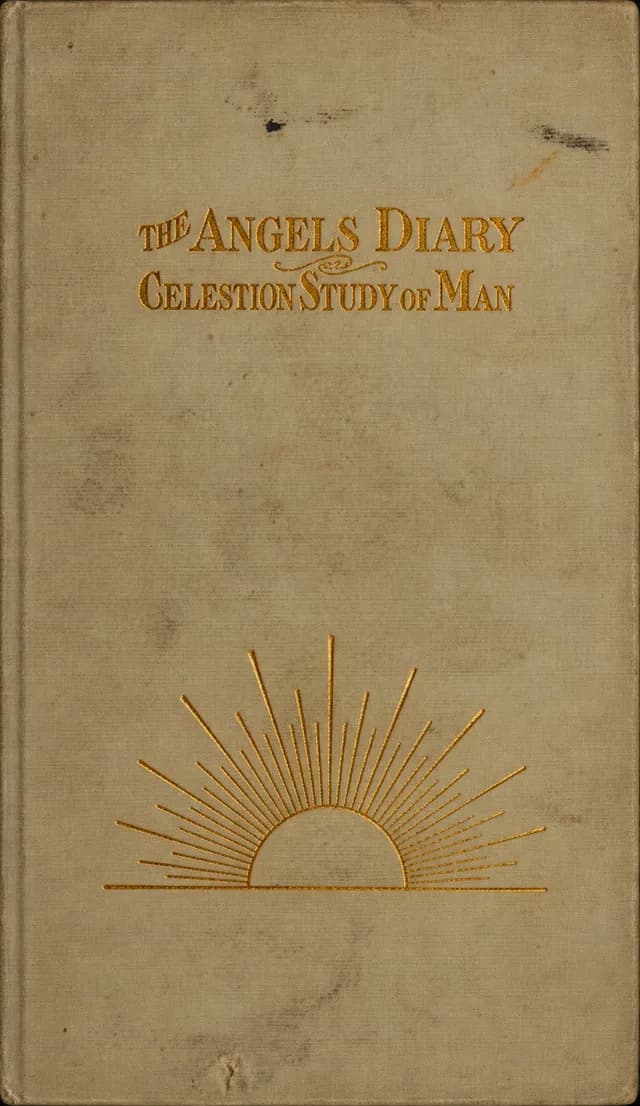
The Angels’ Diary and Celestion Study of Man
Reading note
A hand on the opening page, letters in the air. Read the original passage in the 1903 edition.
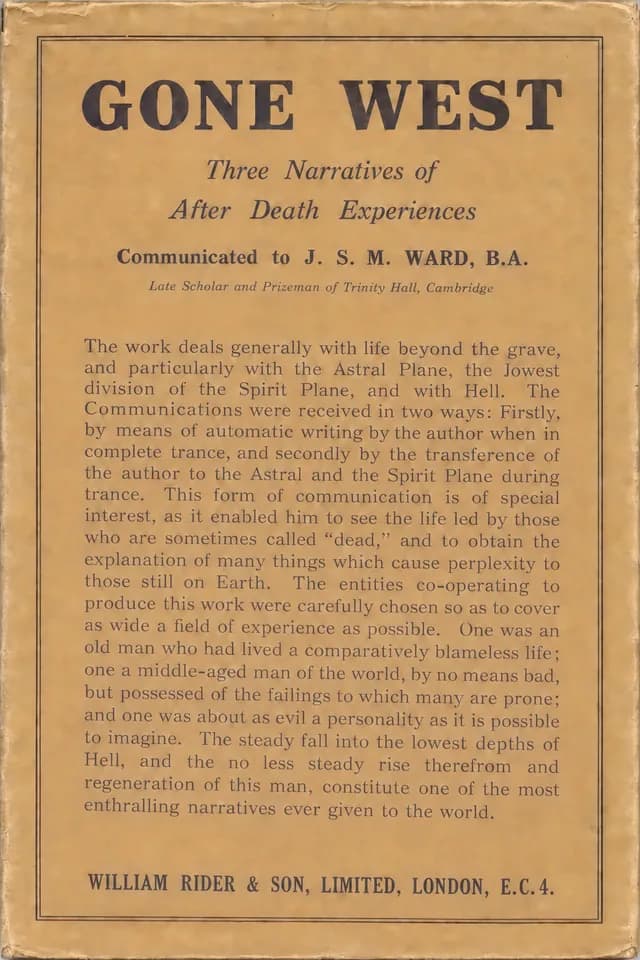
Gone West
Reading note
Ward’s communicated accounts supply the separately cited comparison in this entry.

Life Here and Hereafter
Reading note
The separately titled account draws on exact passages in the consulted Library edition.
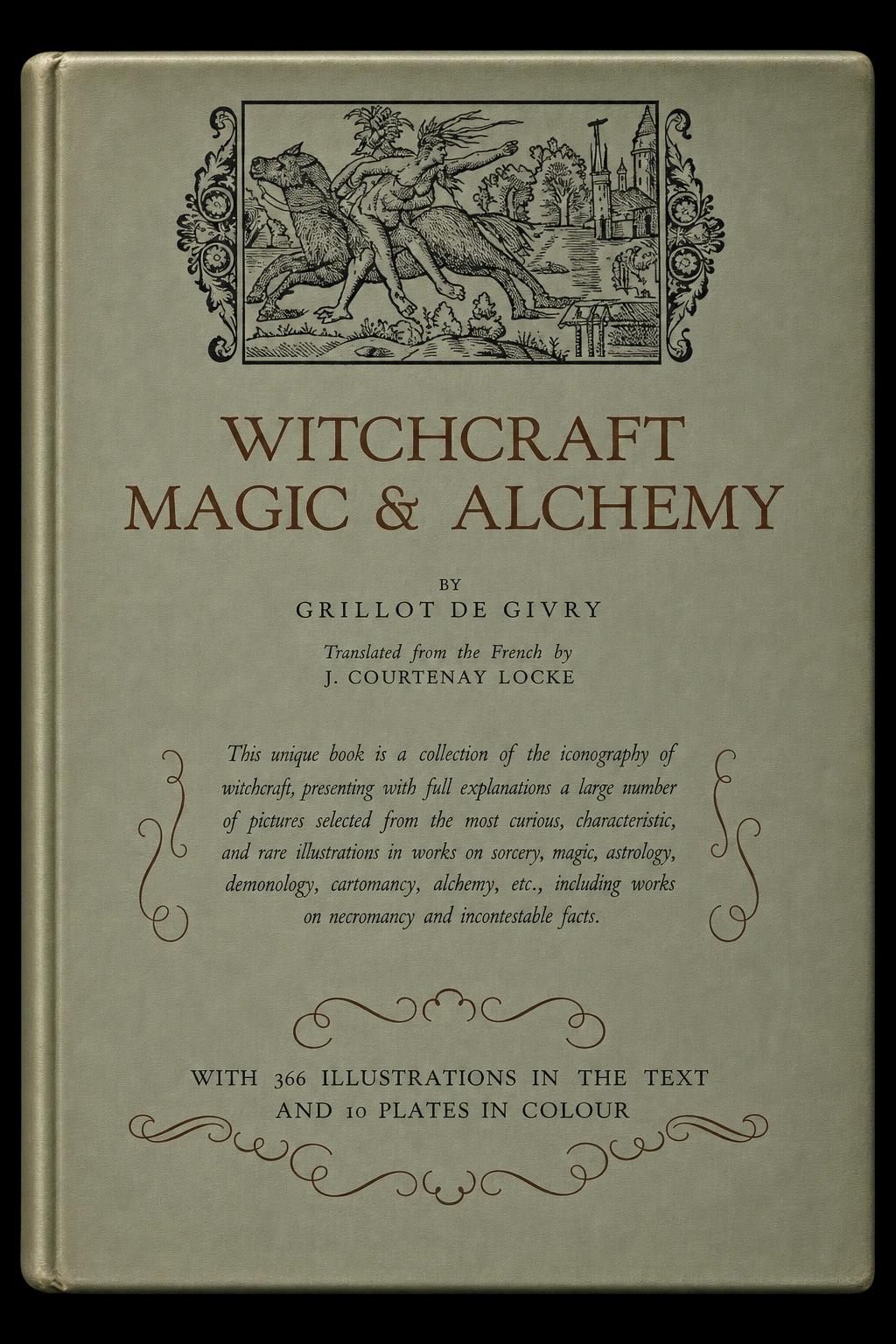
Witchcraft Magic and Alchemy
Reading note
The separately titled account draws on exact passages in the consulted Library edition.
Sources
See references (31)
- The Angels’ Diary, Reader page 4The Angels’ Diary (1903), attributed to Effie M. Shirey and Charles SamsonRead this page in The Angels’ Diary and Celestion Study of Man ↗Return to text ↑
- The Angels’ Diary, Reader page 200The Angels’ Diary (1903), attributed to Effie M. Shirey and Charles SamsonRead this page in The Angels’ Diary and Celestion Study of Man ↗Return to text ↑
- The Angels’ Diary, Reader page 2Effie M. Shirey and Charles Samson, The Angels’ Diary and Celestion Study of Man (1903), communicated through Elizabeth Maud Weatherhead according to the acknowledgment.Read this page in The Angels’ Diary and Celestion Study of Man ↗Return to text ↑
- The Angels’ Diary, Reader page 3Effie M. Shirey and Charles Samson, The Angels’ Diary and Celestion Study of Man (1903), communicated through Elizabeth Maud Weatherhead according to the acknowledgment.Read this page in The Angels’ Diary and Celestion Study of Man ↗Return to text ↑
- The Angels’ Diary, Reader page 30Effie M. Shirey and Charles Samson, The Angels’ Diary and Celestion Study of Man (1903), communicated through Elizabeth Maud Weatherhead according to the acknowledgment.Read this page in The Angels’ Diary and Celestion Study of Man ↗Return to text ↑
- The Angels’ Diary, Reader page 179Effie M. Shirey and Charles Samson, The Angels’ Diary and Celestion Study of Man (1903), communicated through Elizabeth Maud Weatherhead according to the acknowledgment.Read this page in The Angels’ Diary and Celestion Study of Man ↗Return to text ↑
- The Angels’ Diary, Reader page 180Effie M. Shirey and Charles Samson, The Angels’ Diary and Celestion Study of Man (1903), communicated through Elizabeth Maud Weatherhead according to the acknowledgment.Read this page in The Angels’ Diary and Celestion Study of Man ↗Return to text ↑
- The Angels’ Diary, Reader page 199Effie M. Shirey and Charles Samson, The Angels’ Diary and Celestion Study of Man (1903), communicated through Elizabeth Maud Weatherhead according to the acknowledgment.Read this page in The Angels’ Diary and Celestion Study of Man ↗Return to text ↑
- Gone West, Introduction, Reader page 7J. S. M. Ward, Gone West, 1920 third impression as reproduced in the 2009 Geoff Cutler digital transcription.Read this page in Gone West ↗Return to text ↑
- Gone West, printed p. 4, Reader page 17J. S. M. Ward, Gone West, 1920 third impression as reproduced in the 2009 Geoff Cutler digital transcription.Read this page in Gone West ↗Return to text ↑
- Gone West, printed p. 5, Reader page 18J. S. M. Ward, Gone West, 1920 third impression as reproduced in the 2009 Geoff Cutler digital transcription.Read this page in Gone West ↗Return to text ↑
- Gone West, printed p. 6, Reader page 19J. S. M. Ward, Gone West, 1920 third impression as reproduced in the 2009 Geoff Cutler digital transcription.Read this page in Gone West ↗Return to text ↑
- Gone West, printed p. 7, Reader page 20J. S. M. Ward, Gone West, 1920 third impression as reproduced in the 2009 Geoff Cutler digital transcription.Read this page in Gone West ↗Return to text ↑
- Gone West, printed p. 8, Reader page 21J. S. M. Ward, Gone West, 1920 third impression as reproduced in the 2009 Geoff Cutler digital transcription.Read this page in Gone West ↗Return to text ↑
- Gone West, printed p. 172, Reader page 185J. S. M. Ward, Gone West, 1920 third impression in the 2009 Geoff Cutler digital transcription.Read this page in Gone West ↗Return to text ↑
- The Planchette Mystery: opening illustrated page, 1886 compilation, digital canvas 69 ↗Brandeis University Libraries, Medical Heritage Library, via Wellcome Collection. 1886. Public Domain Mark.
- Life Here and Hereafter, Reader page 2Charlotte E. Dresser and Fred Rafferty, Life Here and Hereafter, edited by Fred Rafferty. Modern transcription reproducing the Author’s Edition, San Jose, California, 1927. Exact selected Library edition IMJ-0447-E001; original PageIDs and current Reader positions verified. Communications and their claimed spiritual origins remain attributed to this source.Read this page in Life Here and Hereafter ↗Return to text ↑
- Life Here and Hereafter, Reader page 3Charlotte E. Dresser and Fred Rafferty, Life Here and Hereafter, edited by Fred Rafferty. Modern transcription reproducing the Author’s Edition, San Jose, California, 1927. Exact selected Library edition IMJ-0447-E001; original PageIDs and current Reader positions verified. Communications and their claimed spiritual origins remain attributed to this source.Read this page in Life Here and Hereafter ↗Return to text ↑
- Life Here and Hereafter, Reader page 4Charlotte E. Dresser and Fred Rafferty, Life Here and Hereafter, edited by Fred Rafferty. Modern transcription reproducing the Author’s Edition, San Jose, California, 1927. Exact selected Library edition IMJ-0447-E001; original PageIDs and current Reader positions verified. Communications and their claimed spiritual origins remain attributed to this source.Read this page in Life Here and Hereafter ↗Return to text ↑
- Life Here and Hereafter, Reader page 10Charlotte E. Dresser and Fred Rafferty, Life Here and Hereafter, edited by Fred Rafferty. Modern transcription reproducing the Author’s Edition, San Jose, California, 1927. Exact selected Library edition IMJ-0447-E001; original PageIDs and current Reader positions verified. Communications and their claimed spiritual origins remain attributed to this source.Read this page in Life Here and Hereafter ↗Return to text ↑
- Life Here and Hereafter, Reader page 11Charlotte E. Dresser and Fred Rafferty, Life Here and Hereafter, edited by Fred Rafferty. Modern transcription reproducing the Author’s Edition, San Jose, California, 1927. Exact selected Library edition IMJ-0447-E001; original PageIDs and current Reader positions verified. Communications and their claimed spiritual origins remain attributed to this source.Read this page in Life Here and Hereafter ↗Return to text ↑
- Life Here and Hereafter, Reader page 86Charlotte E. Dresser and Fred Rafferty, Life Here and Hereafter, edited by Fred Rafferty. Modern transcription reproducing the Author’s Edition, San Jose, California, 1927. Exact selected Library edition IMJ-0447-E001; original PageIDs and current Reader positions verified. Communications and their claimed spiritual origins remain attributed to this source.Read this page in Life Here and Hereafter ↗Return to text ↑
- Life Here and Hereafter, Reader page 96Charlotte E. Dresser and Fred Rafferty, Life Here and Hereafter, edited by Fred Rafferty. Modern transcription reproducing the Author’s Edition, San Jose, California, 1927. Exact selected Library edition IMJ-0447-E001; original PageIDs and current Reader positions verified. Communications and their claimed spiritual origins remain attributed to this source.Read this page in Life Here and Hereafter ↗Return to text ↑
- Life Here and Hereafter, Reader page 97Charlotte E. Dresser and Fred Rafferty, Life Here and Hereafter, edited by Fred Rafferty. Modern transcription reproducing the Author’s Edition, San Jose, California, 1927. Exact selected Library edition IMJ-0447-E001; original PageIDs and current Reader positions verified. Communications and their claimed spiritual origins remain attributed to this source.Read this page in Life Here and Hereafter ↗Return to text ↑
- Life Here and Hereafter, Reader page 136Charlotte E. Dresser and Fred Rafferty, Life Here and Hereafter, edited by Fred Rafferty. Modern transcription reproducing the Author’s Edition, San Jose, California, 1927. Exact selected Library edition IMJ-0447-E001; original PageIDs and current Reader positions verified. Communications and their claimed spiritual origins remain attributed to this source.Read this page in Life Here and Hereafter ↗Return to text ↑
- Life Here and Hereafter, Reader page 154Charlotte E. Dresser and Fred Rafferty, Life Here and Hereafter, edited by Fred Rafferty. Modern transcription reproducing the Author’s Edition, San Jose, California, 1927. Exact selected Library edition IMJ-0447-E001; original PageIDs and current Reader positions verified. Communications and their claimed spiritual origins remain attributed to this source.Read this page in Life Here and Hereafter ↗Return to text ↑
- Life Here and Hereafter, Reader page 155Charlotte E. Dresser and Fred Rafferty, Life Here and Hereafter, edited by Fred Rafferty. Modern transcription reproducing the Author’s Edition, San Jose, California, 1927. Exact selected Library edition IMJ-0447-E001; original PageIDs and current Reader positions verified. Communications and their claimed spiritual origins remain attributed to this source.Read this page in Life Here and Hereafter ↗Return to text ↑
- Life Here and Hereafter, Reader page 156Charlotte E. Dresser and Fred Rafferty, Life Here and Hereafter, edited by Fred Rafferty. Modern transcription reproducing the Author’s Edition, San Jose, California, 1927. Exact selected Library edition IMJ-0447-E001; original PageIDs and current Reader positions verified. Communications and their claimed spiritual origins remain attributed to this source.Read this page in Life Here and Hereafter ↗Return to text ↑
- Life Here and Hereafter, Reader page 157Charlotte E. Dresser and Fred Rafferty, Life Here and Hereafter, edited by Fred Rafferty. Modern transcription reproducing the Author’s Edition, San Jose, California, 1927. Exact selected Library edition IMJ-0447-E001; original PageIDs and current Reader positions verified. Communications and their claimed spiritual origins remain attributed to this source.Read this page in Life Here and Hereafter ↗Return to text ↑
- Witchcraft Magic & Alchemy, printed p. 173, Reader page 165Grillot de Givry, Witchcraft Magic & Alchemy, translated by J. Courtenay Locke. Boston and New York, Houghton Mifflin Company, 1931.Read this page in Witchcraft Magic and Alchemy ↗Return to text ↑
- Witchcraft Magic & Alchemy, printed p. 176, Reader page 168Grillot de Givry, Witchcraft Magic & Alchemy, translated by J. Courtenay Locke. Boston and New York, Houghton Mifflin Company, 1931.Read this page in Witchcraft Magic and Alchemy ↗Return to text ↑