The Moon-dance in The Goat-Foot God
In The Goat-Foot God, Mona tries a dance she associates with a sea goddess. A few steps and a low hum leave Jelkes wondering what he has just witnessed.
In this article
A rite performed for a witness
The Moon-dance is a scene in Dion Fortune’s The Goat-Foot God. Mona imagines a rite in which priestesses of a sea goddess draw down the moon. When she tries the dance in a pasture, Hugh joins her and Jelkes watches. [1][2][3][4][5]
Mona’s performance in The Goat-Foot God
Dion Fortune first gives Mona two kinds of imagined dancing. In one she follows Dionysus over the mountains and sometimes lets herself dance alone on the turf. The dance she associates with the sea goddess and the moon is distinct. She remembers knowing it without ever daring to try it. [1][2]
After she and Hugh find that their daydreams meet, Mona leads him into the moonlit pasture. She hums low and marks out the action with her hands and a few steps. Jelkes thinks he can read the movements as an attempt to draw magnetism. He takes the scene for playacting at first, then becomes unsure of how much his own imagination is supplying. [3][4][5][6]
Night dances in A Midsummer Night’s Dream
William Shakespeare makes moonlight the setting of Titania’s revels and gives her fairies a round dance and song. At the end of the play, Oberon and Titania lead them through a house at night. The dancing and singing become a blessing for the household. [7]
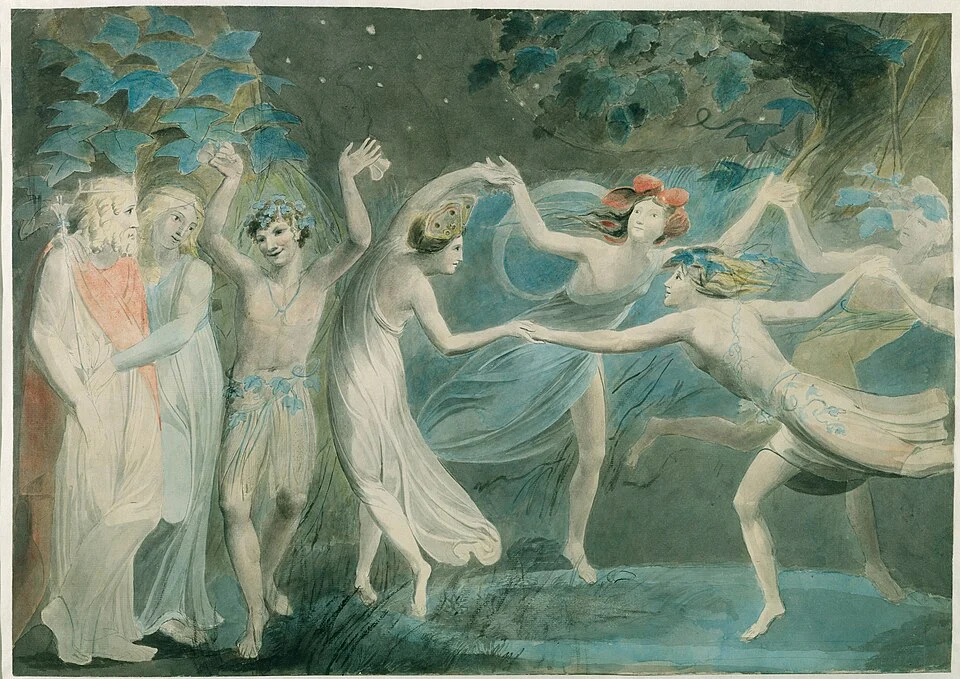
William Blake’s image responds to the fairy blessing at the end of A Midsummer Night’s Dream. The group dance offers a contrast with Mona’s small gestures before two witnesses.
William Blake, Oberon, Titania and Puck with Fairies Dancing, ca. 1786, Tate, N02686. Digital reproduction via Wikimedia Commons. · Image source ↗ · Public Domain
What the dances do
Shakespeare gives the fairies a round dance and song before they go through the house to bless it. Fortune gives Mona a hum and a few small movements in a field. We see the scene through Jelkes’s uncertainty about what those gestures have done. [7][3][4][5]
In the library
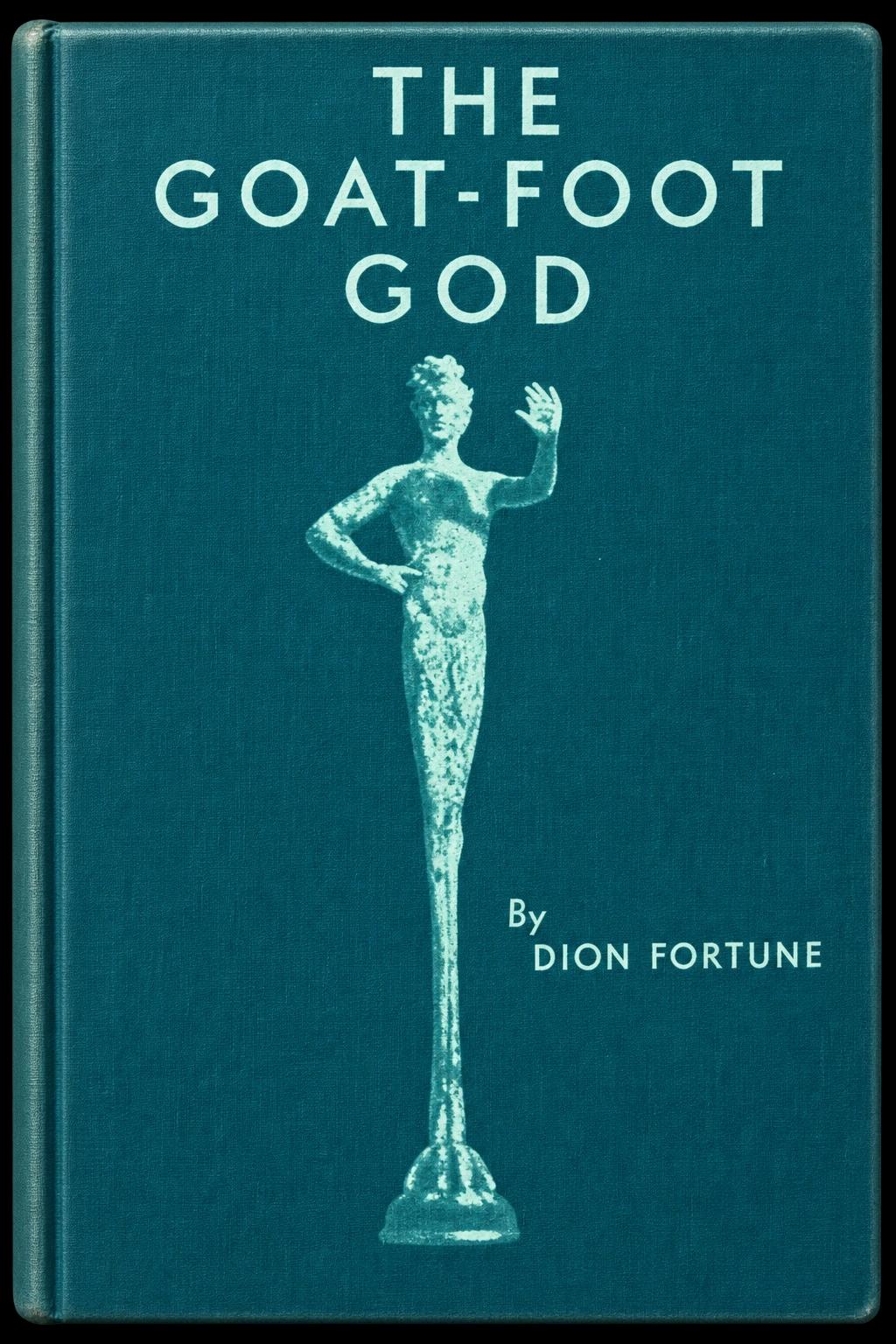
The Goat-Foot God
Reading note
Read Mona’s memory of the dance beside the pasture scene, where Jelkes tries to make sense of what he sees.
Sources
See references (8)
- The Goat-Foot God, Reader page 247Dion Fortune, The Goat-Foot God. Undated digital Library edition IMJ-0643-E001. Numbered references use the Library Reader sequence.Read this page in The Goat-Foot God ↗
- The Goat-Foot God, Reader page 248Dion Fortune, The Goat-Foot God. Undated digital Library edition IMJ-0643-E001. Numbered references use the Library Reader sequence.Read this page in The Goat-Foot God ↗
- The Goat-Foot God, Reader page 314Dion Fortune, The Goat-Foot God. Undated digital Library edition IMJ-0643-E001. Numbered references use the Library Reader sequence.Read this page in The Goat-Foot God ↗
- The Goat-Foot God, Reader page 315Dion Fortune, The Goat-Foot God. Undated digital Library edition IMJ-0643-E001. Numbered references use the Library Reader sequence.Read this page in The Goat-Foot God ↗
- The Goat-Foot God, Reader page 316Dion Fortune, The Goat-Foot God. Undated digital Library edition IMJ-0643-E001. Numbered references use the Library Reader sequence.Read this page in The Goat-Foot God ↗
- The Goat-Foot God, Reader page 317Dion Fortune, The Goat-Foot God. Undated digital Library edition IMJ-0643-E001. Numbered references use the Library Reader sequence.Read this page in The Goat-Foot God ↗
- William Shakespeare, A Midsummer Night’s Dream, acts 2 and 5 ↗William Shakespeare, A Midsummer Night’s Dream, 2.1.145–146, 2.2.1–2 and 5.1.408–429, Folger Shakespeare Library.
- Oberon, Titania and Puck with Fairies Dancing ↗William Blake, Oberon, Titania and Puck with Fairies Dancing, ca. 1786, Tate, N02686. Digital reproduction via Wikimedia Commons.