Gone West
In Gone West, J. S. M. Ward presents three accounts of life after death. Their speakers describe a college for spirits, a drinking den and a cave of sleepers.
In this article
How Ward says he received the accounts
Trance vision. Ward says the visits recurred on Mondays, the day of the week on which H. J. L. died. Sometimes it took him two days to write up an encounter. Until then, he says, the details remained unusually clear. Once on paper, the experience began to feel like an ordinary memory. [1]
Continuity of testimony. Ward says each visit picked up where the last left off. He wrote those conversations from memory. In automatic writing, he says he had to come out of trance and read what his hand had written to learn what the message contained. [1]
The astral plane. Ward assigns the astral world two narrators, the Officer and W. A. Their dispositions matter. The same plane can give rise to different testimony depending on who enters it. [2]
Realm of Half-Belief. H. J. L. reports on a region whose name makes uncertainty into a place. Ward explains an unevenness in the map: wartime printing costs forced him to shorten the book. The astral plane, hell and the realm of half-belief receive extended accounts. Readers meet the two higher realms chiefly through his introductory summary. [2]
See references (2)
Faith and its boundaries
Belief lacking in works. Communities retain religious divisions familiar from earth. Ward imagines that confidence in belonging to the right group can make a pleasant settlement difficult to leave. [2]
Belief shown in works. Love of other people supplies the practical measure of faith. Ward describes immediate admission to this realm as rare, even among strong believers. [4]
Wall of Fire. Ward places a limit on his map. An angel offers an assurance about the survival of personal identity but declines to describe life beyond the wall. [5]
Reincarnation. Ward entertains the possibility that some who cross the wall return to earth. He leaves open a different future for others. His uncertainty matters when using the book as a source on rebirth. [5]
See references (3)
Learning and desire
The spirit college. The college first comes into view from higher ground. Its towers and roofs give a familiar institutional shape to the idea that H. J. L. can continue learning after death. [6]
The dreamer’s double. Ward describes seeing his physical body in the bedroom while experiencing another body as substantial. The scene makes the difference between embodied sleep and conscious travel a matter of viewpoint. [7]
Astral appetite. Asked where he wants to go, the Officer wants a drink. An apparently generous offer lets a familiar appetite choose his destination before he understands the place. [8]
The bottomless pit. The Officer experiences the lowest depth as absolute solitude. The horror comes from having no answering voice, a striking contrast with the crowds elsewhere in his journey. [9]
See references (4)
How a soul changes direction
Prayer before belief. The Officer thinks the damned cannot pray. Looking back, he calls his first wish for a better life a prayer, though he had no name for it at the time. [10]
Messenger of light. An approaching helper hurts the Officer’s eyes. The messenger explains the burning as the cost of change, giving the Officer a reason both to desire and to recoil from the light. [11]
Rescue in Corinth. Progress leads the Officer back into a region he has already endured. Returning for someone else tests whether his wish to escape has grown into a willingness to help. [12]
Houses of refuge. The people awaiting the traveller direct their prayers towards him. Ward gives their faith a visible effect: a light bright enough to mark the path before the house itself comes into view. [13]
See references (4)
Companions and resistance
Personified vice. The guide distinguishes former human companions, personified vices and devils. A hostile figure in Ward’s hell can belong to any of several kinds of being. [13]
The sleepers. The Officer encounters people whose conviction that death ends consciousness has become a prolonged sleep. This is Ward’s religious reading of unbelief, expressed as a scene in which even a willing visitor cannot wake the sleepers. [14]
Service after death. W. A. wants an object for his otherwise drifting existence. The guide sets a task whose particulars W. A. must discover for himself: find another person to help. [15]
Guardian angel. As W. A. begins to help, his guardian appears nearer and the opposing spirit farther away. A change in conduct becomes visible as a change in the distance between companions. [15]
See references (3)
In the library
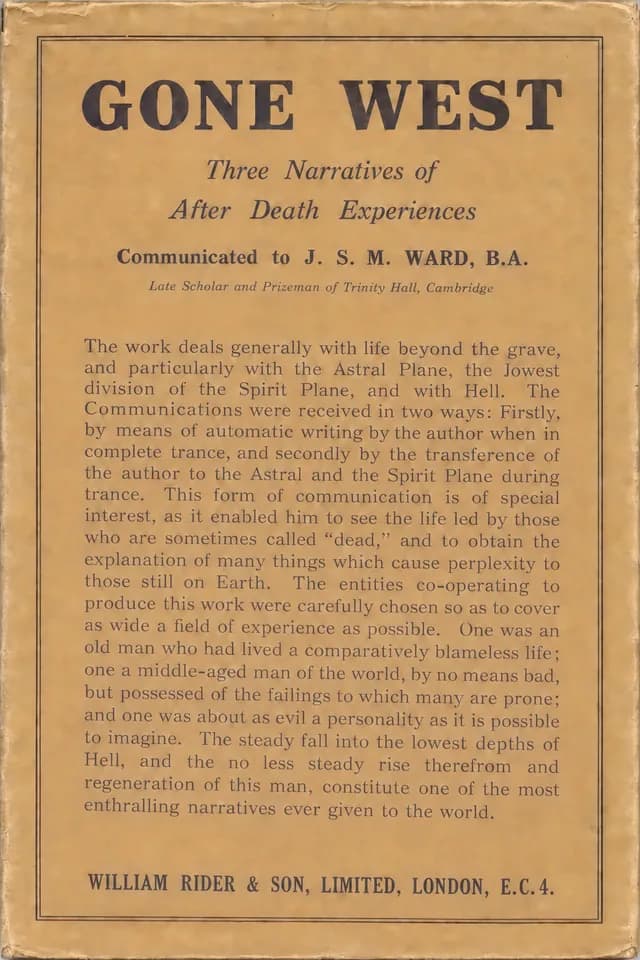
Gone West
Reading note
Read Ward’s introduction before following the Officer from the drinking den to his return to Corinth.
A Subaltern in Spirit Land: A Sequel to Gone West
Read the Compendium companionReading note
Follow the Officer into Ward’s wartime sequel. Rex describes joining his rescue work, and the Officer later gives his own account of the armistice.
Sources
See references (15)
- Trance visionJ. S. M. WardRead this page in Gone West ↗
- The astral planeJ. S. M. WardRead this page in Gone West ↗
- Diagram of the Spirit Plane, printed page 19J. S. M. WardRead this page in Gone West ↗
- Belief shown in worksJ. S. M. WardRead this page in Gone West ↗
- Wall of FireJ. S. M. WardRead this page in Gone West ↗
- The spirit collegeJ. S. M. WardRead this page in Gone West ↗
- The dreamer’s doubleJ. S. M. WardRead this page in Gone West ↗
- Astral appetiteJ. S. M. WardRead this page in Gone West ↗
- The bottomless pitJ. S. M. WardRead this page in Gone West ↗
- Prayer before beliefJ. S. M. WardRead this page in Gone West ↗
- Messenger of lightJ. S. M. WardRead this page in Gone West ↗
- Rescue in CorinthJ. S. M. WardRead this page in Gone West ↗
- Houses of refugeJ. S. M. WardRead this page in Gone West ↗
- The sleepersJ. S. M. WardRead this page in Gone West ↗
- Service after deathJ. S. M. WardRead this page in Gone West ↗