Six attributes for spiritual training
Read Rudolf Steiner’s six attributes for spiritual training and how he connects them with the twelve-petalled lotus near the heart.
In this article
Understanding the concept
Rudolf Steiner’s six attributes are control of thought, control of action, perseverance, tolerance, faith or receptive openness, and equanimity. He sets them out as habits of daily life and links them to the development of the twelve-petalled lotus near the heart. [3][4][5][6][7][8]
See references (6)
- Knowledge of the Higher Worlds and Its Attainment, Reader page 124
- Knowledge of the Higher Worlds and Its Attainment, Reader page 125
- Knowledge of the Higher Worlds and Its Attainment, Reader page 126
- Knowledge of the Higher Worlds and Its Attainment, Reader page 127
- Knowledge of the Higher Worlds and Its Attainment, Reader page 128
- Knowledge of the Higher Worlds and Its Attainment, Reader page 143
Steiner’s six attributes
Knowledge of the Higher Worlds by Rudolf Steiner
Rudolf Steiner begins with control of thought and action. Thoughts are to follow one another in a coherent sequence, and successive actions are to serve a purpose. His third attribute is perseverance. The student continues through obstacles once a goal has been judged right. [3][4]
Tolerance includes trying to understand a person or circumstance from another standpoint. The fifth attribute involves letting new information test a settled opinion and trusting the possibility of success despite repeated failure. Finally, equanimity is steadiness through success and joy as well as danger and sorrow. [5][6]
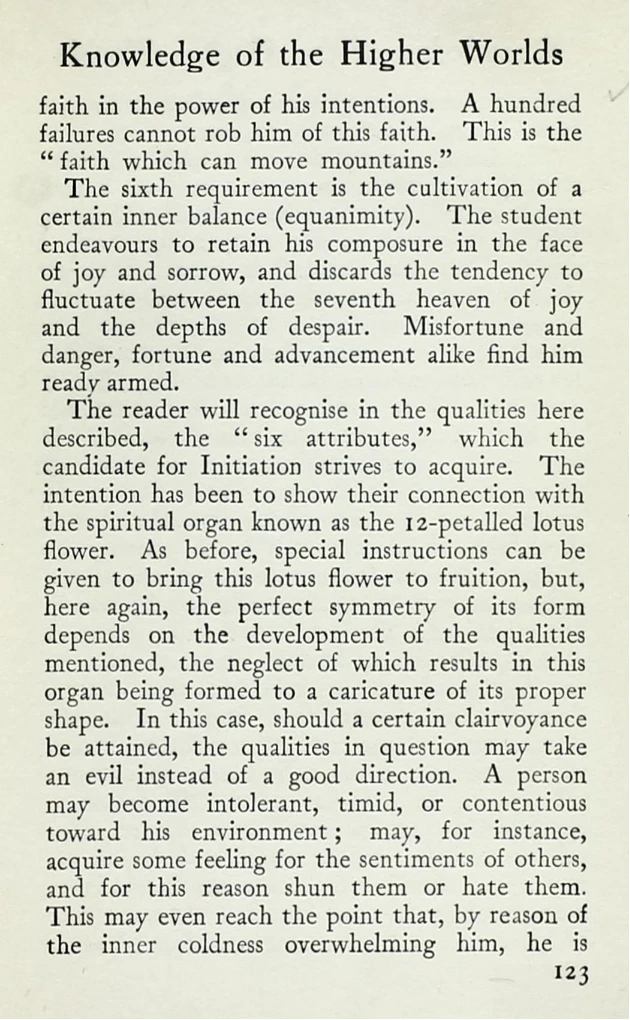
Steiner concludes the list with equanimity and relates the attributes to the heart lotus. Knowledge of the Higher Worlds, printed p. 123, Library reader p. 127.
Rudolf Steiner, G. Metaxa translation, edited by Harry Collison. Historical public-domain source facsimile from the exact checksum-verified Library edition. Repository date 1932; the inspected title page is undated. · Image source ↗ · Public Domain
The twelve-petalled lotus
Steiner says that six petals of the heart lotus are consciously formed by practice and then work with six he attributes to earlier development. He distinguishes the formation of the organ through conduct from the later instruction meant to awaken it. [9][6][7]
He returns to the six in his account of probation. They appear alongside discrimination, sound valuation and a longing for freedom. Daily actions retain their value within the discipline. [8][10]
See references (5)
- Knowledge of the Higher Worlds and Its Attainment, Reader page 127
- Knowledge of the Higher Worlds and Its Attainment, Reader page 128
- Knowledge of the Higher Worlds and Its Attainment, Reader page 143
- Knowledge of the Higher Worlds and Its Attainment, Reader page 123
- Knowledge of the Higher Worlds and Its Attainment, Reader page 145
Composure in Karma-Yoga
Karma-Yoga by Swami Vivekananda
Swami Vivekananda pictures someone walking through a crowded city while keeping the calm of a person alone in a cave. He treats that steadiness as a quality of the worker in the middle of ordinary action. [1][2]
See references (2)
Composure and the heart lotus
For Vivekananda, the relevant question is how a person can work intensely and remain calm. Steiner has a broader list of habits and joins them to his theory of how a spiritual organ forms. [1][2][4][6]
In Knowledge of the Higher Worlds, the six attributes belong to the chapter’s account of the twelve-petalled heart lotus. The same chapter gives eight activities of the soul a separate role in the formation of the sixteen-petalled lotus at the throat. [11][12][9][6][8]
See references (8)
- Karma-Yoga, Reader page 14
- Karma-Yoga, Reader page 15
- Knowledge of the Higher Worlds and Its Attainment, Reader page 125
- Knowledge of the Higher Worlds and Its Attainment, Reader page 127
- Knowledge of the Higher Worlds and Its Attainment, Reader page 143
- Knowledge of the Higher Worlds and Its Attainment, Reader page 123
- Knowledge of the Higher Worlds and Its Attainment, Reader page 115
- Knowledge of the Higher Worlds and Its Attainment, Reader page 122
Read further in the library

Karma Yoga
Reading note
Separately attributed primary Library account, cited on exact verified Reader leaves.

Knowledge of the Higher Worlds and Its Attainment
Reading note
The separately titled account draws on exact passages in the consulted Library edition.
Sources
See references (12)
- Karma-Yoga, Reader page 14Swami Vivekananda, Karma-Yoga, in Karma-Yoga & Bhakti-Yoga, English second printing, Ramakrishna-Vivekananda Center of New York, Inc., 1939. Exact Library edition IMJ-0097-E002. Only the Karma-Yoga part is used in this crawl; the old Work slug mentioning Hindi does not identify this edition’s language.Read this page in Karma Yoga ↗Return to text ↑
- Karma-Yoga, Reader page 15Swami Vivekananda, Karma-Yoga, in Karma-Yoga & Bhakti-Yoga, English second printing, Ramakrishna-Vivekananda Center of New York, Inc., 1939. Exact Library edition IMJ-0097-E002. Only the Karma-Yoga part is used in this crawl; the old Work slug mentioning Hindi does not identify this edition’s language.Read this page in Karma Yoga ↗Return to text ↑
- Knowledge of the Higher Worlds and Its Attainment, Reader page 124Rudolf Steiner, Knowledge of the Higher Worlds and Its Attainment, authorized English translation by G. Metaxa, edited by Harry Collison, Anthroposophic Press, New York City. Exact Library edition IMJ-0513-E001. No publication year is visible on the inspected title page; the repository assigns 1932. Claims of supersensible perception remain attributed to Steiner.Read this page in Knowledge of the Higher Worlds and Its Attainment ↗Return to text ↑
- Knowledge of the Higher Worlds and Its Attainment, Reader page 125Rudolf Steiner, Knowledge of the Higher Worlds and Its Attainment, authorized English translation by G. Metaxa, edited by Harry Collison, Anthroposophic Press, New York City. Exact Library edition IMJ-0513-E001. No publication year is visible on the inspected title page; the repository assigns 1932. Claims of supersensible perception remain attributed to Steiner.Read this page in Knowledge of the Higher Worlds and Its Attainment ↗Return to text ↑
- Knowledge of the Higher Worlds and Its Attainment, Reader page 126Rudolf Steiner, Knowledge of the Higher Worlds and Its Attainment, authorized English translation by G. Metaxa, edited by Harry Collison, Anthroposophic Press, New York City. Exact Library edition IMJ-0513-E001. No publication year is visible on the inspected title page; the repository assigns 1932. Claims of supersensible perception remain attributed to Steiner.Read this page in Knowledge of the Higher Worlds and Its Attainment ↗Return to text ↑
- Knowledge of the Higher Worlds and Its Attainment, Reader page 127Rudolf Steiner, Knowledge of the Higher Worlds and Its Attainment, authorized English translation by G. Metaxa, edited by Harry Collison, Anthroposophic Press, New York City. Exact Library edition IMJ-0513-E001. No publication year is visible on the inspected title page; the repository assigns 1932. Claims of supersensible perception remain attributed to Steiner.Read this page in Knowledge of the Higher Worlds and Its Attainment ↗Return to text ↑
- Knowledge of the Higher Worlds and Its Attainment, Reader page 128Rudolf Steiner, Knowledge of the Higher Worlds and Its Attainment, authorized English translation by G. Metaxa, edited by Harry Collison, Anthroposophic Press, New York City. Exact Library edition IMJ-0513-E001. No publication year is visible on the inspected title page; the repository assigns 1932. Claims of supersensible perception remain attributed to Steiner.Read this page in Knowledge of the Higher Worlds and Its Attainment ↗Return to text ↑
- Knowledge of the Higher Worlds and Its Attainment, Reader page 143Rudolf Steiner, Knowledge of the Higher Worlds and Its Attainment, authorized English translation by G. Metaxa, edited by Harry Collison, Anthroposophic Press, New York City. Exact Library edition IMJ-0513-E001. No publication year is visible on the inspected title page; the repository assigns 1932. Claims of supersensible perception remain attributed to Steiner.Read this page in Knowledge of the Higher Worlds and Its Attainment ↗Return to text ↑
- Knowledge of the Higher Worlds and Its Attainment, Reader page 123Rudolf Steiner, Knowledge of the Higher Worlds and Its Attainment, authorized English translation by G. Metaxa, edited by Harry Collison, Anthroposophic Press, New York City. Exact Library edition IMJ-0513-E001. No publication year is visible on the inspected title page; the repository assigns 1932. Claims of supersensible perception remain attributed to Steiner.Read this page in Knowledge of the Higher Worlds and Its Attainment ↗Return to text ↑
- Knowledge of the Higher Worlds and Its Attainment, Reader page 145Rudolf Steiner, Knowledge of the Higher Worlds and Its Attainment, authorized English translation by G. Metaxa, edited by Harry Collison, Anthroposophic Press, New York City. Exact Library edition IMJ-0513-E001. No publication year is visible on the inspected title page; the repository assigns 1932. Claims of supersensible perception remain attributed to Steiner.Read this page in Knowledge of the Higher Worlds and Its Attainment ↗Return to text ↑
- Knowledge of the Higher Worlds and Its Attainment, Reader page 115Rudolf Steiner, Knowledge of the Higher Worlds and Its Attainment, authorized English translation by G. Metaxa, edited by Harry Collison, Anthroposophic Press, New York City. Exact Library edition IMJ-0513-E001. No publication year is visible on the inspected title page; the repository assigns 1932. Claims of supersensible perception remain attributed to Steiner.Read this page in Knowledge of the Higher Worlds and Its Attainment ↗Return to text ↑
- Knowledge of the Higher Worlds and Its Attainment, Reader page 122Rudolf Steiner, Knowledge of the Higher Worlds and Its Attainment, authorized English translation by G. Metaxa, edited by Harry Collison, Anthroposophic Press, New York City. Exact Library edition IMJ-0513-E001. No publication year is visible on the inspected title page; the repository assigns 1932. Claims of supersensible perception remain attributed to Steiner.Read this page in Knowledge of the Higher Worlds and Its Attainment ↗Return to text ↑