Sitātapatrā: The Buddhist Goddess of the White Parasol
Sitātapatrā is a Buddhist protector whose white parasol represents shelter from danger. In Tibetan Buddhist texts her name designates both a goddess and the protective formula associated with her.
In this article
What does the white parasol mean?
Sitātapatrā is a Buddhist goddess whose name means white parasol. A parasol shelters the person beneath it. In her images it becomes an emblem of protection. She can appear with one face and two hands or with a wide array of heads and arms. [2][3][4]
In Alice Getty’s The Gods of Northern Buddhism
Alice Getty describes a two-armed goddess with one palm raised in reassurance and a parasol held in the other hand. In some eight-armed forms, her two main hands hold parasols. The object remains an identifying detail as the number of faces and hands changes. [2]
Getty also records a form of Avalokiteśvara with eleven heads and twelve arms under a White Umbrella title. She describes Sitātapatrā Aparājitā separately. Where the umbrella points to either figure, the other implements and the company they keep help identify the image. [1][2]
The goddess in the Tibetan Kangyur
In the Kangyur text known as The Invincible Sitātapatrā, the goddess is born from the Buddha’s uṣṇīṣa, the raised feature at the crown of his head. The invocation calls on her with a thousand arms and heads and asks for protection from dangers including fire and poison. Getty also describes quieter, two-armed forms of the same goddess. [3][2]
The white parasol in Tibetan painting
The white parasol and Dharma wheel are visible in the central hands of this Tibetan painting. The Asian Art Museum identifies Śākyamuni above and three forms of Mahākāla below. The central parasol remains visible even amid the mass of arms. [4][1]
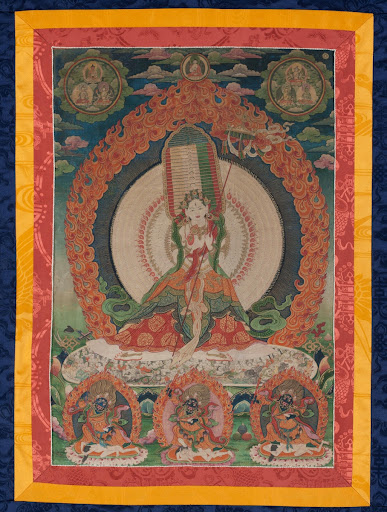
In this Tibetan painting, the parasol and wheel identify Sitātapatrā amid the mass of outstretched arms. Tibet, c. 1800–1900.
Asian Art Museum, The Avery Brundage Collection, B76D10. Public domain. · Image source ↗ · Public Domain
In the library
The Gods of Northern Buddhism
Reading note
Read Alice Getty’s illustrated discussion of Sitātapatrā.
Sources
See references (4)
- The Gods of Northern Buddhism, printed p. 70, Reader page 121Alice Getty, The Gods of Northern Buddhism, 1928 revised second edition, Munshiram Manoharlal reprint. Lumitheca Library edition IMJ-0597-E001.Read this page in The Gods of Northern Buddhism ↗
- The Gods of Northern Buddhism, printed p. 136, Reader page 184Alice Getty, The Gods of Northern Buddhism, 1928 revised second edition, Munshiram Manoharlal reprint. Lumitheca Library edition IMJ-0597-E001.Read this page in The Gods of Northern Buddhism ↗
- The Invincible Sitātapatrā (1), Toh 592, §§1.8–1.10 and 1.16–1.17 ↗The Invincible Sitātapatrā (1), Toh 592, §§1.8–1.10 and 1.16–1.17. Source credit: Samye Translations and 84000: Translating the Words of the Buddha.
- The Buddhist deity Ushnishasitatapatra ↗Asian Art Museum, The Avery Brundage Collection, B76D10. Public domain.