Seven Rays in Theosophy
What are the Seven Rays in Theosophy? Explore Ernest Wood’s account of human tendencies and Leadbeater’s use of rays, candles and altar gems.
In this article
What are the Seven Rays?
The Seven Rays are a Theosophical scheme in which spiritual life is said to express itself in seven ways. Authors apply the scheme to qualities such as will, love and knowledge, to differences of human character and to the arrangement of worship. [1][2][3][4][5][6][7]
See references (7)
- The Seven Rays, preface, Part II and printed pp. 99–100
- The Science of the Sacraments, Reader page 94
- The Science of the Sacraments, Reader page 95
- The Science of the Sacraments, Reader page 96
- The Science of the Sacraments, printed p. 404, Reader page 417
- The Science of the Sacraments, printed p. 405, Reader page 418
- The Science of the Sacraments, printed p. 406, Reader page 419
The Seven Rays by Ernest Wood
Ernest Wood uses the rays to ask which tendency leads within a person’s character. A person whose guiding tendency is love could have a stronger will than someone he places on the first ray. For Wood the question is which of the person’s own powers gives the others direction. [1]
The Science of the Sacraments by Charles W. Leadbeater
Charles W. Leadbeater connects the altar cross and six candles with the seven Rays and associates the second Ray with Christ. During the censing, he asks the worshipper to consider qualities such as strength, wisdom, knowledge and devotion and to put them at the service of others. [8][2][3][4][9]
Leadbeater gives the Rays a material counterpart in the altar. His table assigns the first Ray a diamond, the second a sapphire and each of the others its own stone, with substitutes. He believes the stones can carry distinct influences, and relates them to the candlesticks and crosses in the church. [5][6][7][10][11]
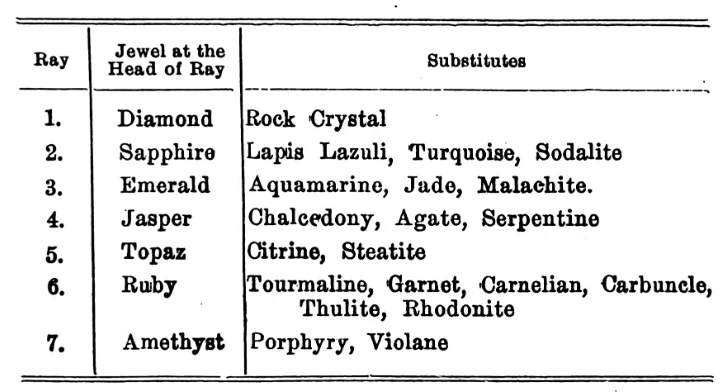
Printed page 407. Leadbeater lists stones for each Ray and gives substitutes where the first choice is unavailable.
The Science of the Sacraments by Charles W. Leadbeater, The St. Alban Press, 1920. Library facsimile. · Image source ↗ · Public Domain
See references (10)
- The Science of the Sacraments, Reader page 94
- The Science of the Sacraments, Reader page 95
- The Science of the Sacraments, Reader page 96
- The Science of the Sacraments, printed p. 404, Reader page 417
- The Science of the Sacraments, printed p. 405, Reader page 418
- The Science of the Sacraments, printed p. 406, Reader page 419
- The Science of the Sacraments, Reader page 93
- The Science of the Sacraments, Reader page 97
- The Science of the Sacraments, printed p. 407, Reader page 420
- The Science of the Sacraments, printed p. 408, Reader page 421
A tendency in a person and a place in a church
Wood uses the rays to explain what gives a personality its direction. Leadbeater gives them positions and materials in a church, so candles and gemstones make the scheme visible during worship. [1][2][3][4][7][10]
See references (6)
- The Seven Rays, preface, Part II and printed pp. 99–100
- The Science of the Sacraments, Reader page 94
- The Science of the Sacraments, Reader page 95
- The Science of the Sacraments, Reader page 96
- The Science of the Sacraments, printed p. 406, Reader page 419
- The Science of the Sacraments, printed p. 407, Reader page 420
In the library
The Science of the Sacraments
Reading note
The separately titled account draws on exact passages in the consulted Library edition.
Sources
See references (11)
- The Seven Rays, preface, Part II and printed pp. 99–100 ↗Ernest Wood, The Seven Rays, The Theosophical Publishing House, 1925.
- The Science of the Sacraments, Reader page 94Charles W. Leadbeater, The Science of the Sacraments, The St. Alban Press, 1920. Exact Library edition IMJ-0615-E001.Read this page in The Science of the Sacraments ↗
- The Science of the Sacraments, Reader page 95Charles W. Leadbeater, The Science of the Sacraments, The St. Alban Press, 1920. Exact Library edition IMJ-0615-E001.Read this page in The Science of the Sacraments ↗
- The Science of the Sacraments, Reader page 96Charles W. Leadbeater, The Science of the Sacraments, The St. Alban Press, 1920. Exact Library edition IMJ-0615-E001.Read this page in The Science of the Sacraments ↗
- The Science of the Sacraments, printed p. 404, Reader page 417Charles W. Leadbeater, The Science of the Sacraments, The St. Alban Press, 1920. Exact Library edition IMJ-0615-E001.Read this page in The Science of the Sacraments ↗
- The Science of the Sacraments, printed p. 405, Reader page 418Charles W. Leadbeater, The Science of the Sacraments, The St. Alban Press, 1920. Exact Library edition IMJ-0615-E001.Read this page in The Science of the Sacraments ↗
- The Science of the Sacraments, printed p. 406, Reader page 419Charles W. Leadbeater, The Science of the Sacraments, The St. Alban Press, 1920. Exact Library edition IMJ-0615-E001.Read this page in The Science of the Sacraments ↗
- The Science of the Sacraments, Reader page 93Charles W. Leadbeater, The Science of the Sacraments, The St. Alban Press, 1920. Exact Library edition IMJ-0615-E001.Read this page in The Science of the Sacraments ↗
- The Science of the Sacraments, Reader page 97Charles W. Leadbeater, The Science of the Sacraments, The St. Alban Press, 1920. Exact Library edition IMJ-0615-E001.Read this page in The Science of the Sacraments ↗
- The Science of the Sacraments, printed p. 407, Reader page 420Charles W. Leadbeater, The Science of the Sacraments, The St. Alban Press, 1920. Exact Library edition IMJ-0615-E001.Read this page in The Science of the Sacraments ↗
- The Science of the Sacraments, printed p. 408, Reader page 421Charles W. Leadbeater, The Science of the Sacraments, The St. Alban Press, 1920. Exact Library edition IMJ-0615-E001.Read this page in The Science of the Sacraments ↗