Scepticism about an afterlife
Does an offering feed the dead? Read Javali’s argument against an afterlife and Rama’s reply about evidence, truth and duty in the Ramayana.
In this article
Can the living still owe anything to the dead?
Scepticism about an afterlife asks whether people continue to exist after death and what might count as evidence. In the Ramayana the question arises when Javali wants Rama to leave exile and return to Ayodhya. He asks whether the dead can receive food, and whether a dead king’s command should still decide who rules. [4][1][5]
Javali’s speech in the Ayodhya Kanda
In Canto CVIII of Ralph T. H. Griffith’s translation, Javali tests an offering by analogy. If food eaten in one place can feed someone elsewhere, he reasons, a meal offered at home should nourish a living traveller on the road. He urges Rama to choose the throne he can take in this life. [1]
Rama’s reply and Javali’s explanation
In Canto CIX, Rama defends truth and his obligation to complete the exile. Javali then says he adopted the argument to persuade Rama and withdraws it. The recantation changes what the reader can infer about Javali’s own beliefs. [2]
Indian Myth and Legend by Donald A. Mackenzie
In Indian Myth and Legend, Donald A. Mackenzie’s Javali compares family and possessions to stops on a journey. He argues that the dead cannot eat and asks how an offering would reach them even if they had taken another body. [4]
Mackenzie’s Rama asks what justifies restraint if pleasure is all that matters. He also distinguishes direct sight from inference. A husband can be out of sight without his wife being a widow. [5]
Rama stays in exile. Bharata takes the sandals Rama has worn and uses them as the sign of the authority in whose name he will rule. [5]
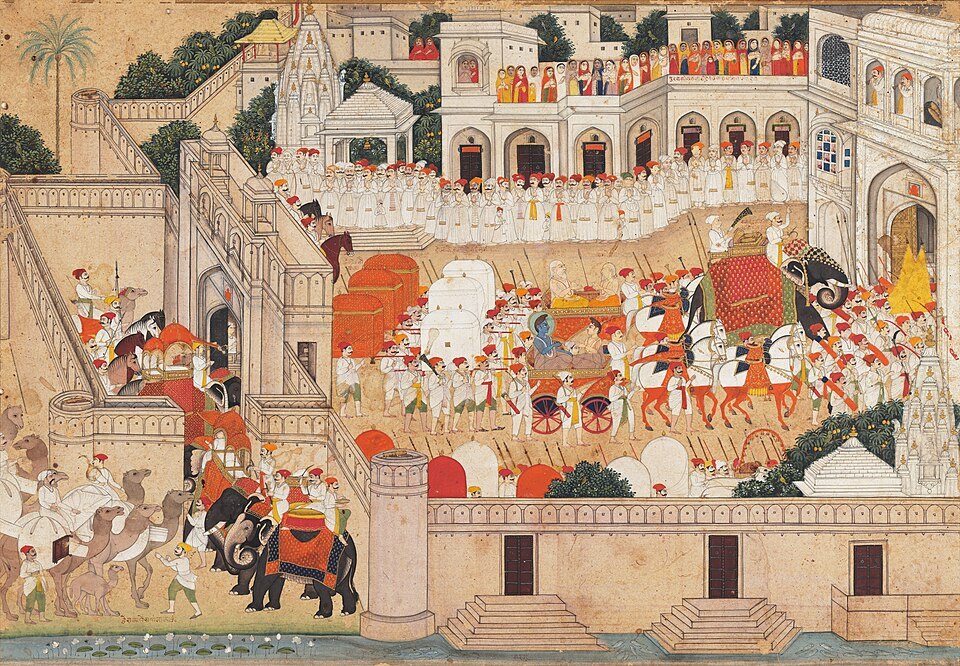
Bharata returns with Rama’s sandals in this eighteenth-century painting. The sandals represent the authority Rama retains while in exile.
Guman, National Museum, New Delhi, 61.1453. Wikimedia Commons, public domain reproduction. JPEG derivative. · Image source ↗ · Public Domain
Where the two retellings end the argument
Griffith gives Javali one more speech to explain why he made the argument. Mackenzie brings the debate back to Bharata and the sandals. Both versions ask what evidence can support a belief and what is left of an obligation after the person it was owed to has died. [4][5][1][2]
Read further in the library
Indian Myth and Legend
Reading note
The separately titled account draws on exact passages in the consulted Library edition.
Sources
See references (5)
- Ramayana, Ayodhya Kanda, Canto CVIII, translated by Ralph T. H. Griffith ↗Complete canto, Jáváli’s Speech. The comparison of food with provisions for a traveller belongs to the epic’s argument.Return to text ↑
- Ramayana, Ayodhya Kanda, Canto CIX, translated by Ralph T. H. Griffith ↗The Praises of Truth, especially Rama’s appeal to truth and duty and Javali’s closing explanation of his speech.Return to text ↑
- Bharata returning to Ayodhya with Rama’s sandals, mid-18th century ↗Guman, National Museum, New Delhi, 61.1453. Wikimedia Commons, public domain reproduction. JPEG derivative.
- Indian Myth and Legend, Reader page 489Donald A. Mackenzie, Indian Myth and Legend, Gresham Publishing Company Limited, London, undated consulted impression. Library edition IMJ-0649-E001. Persistent PageIDs and current Reader positions verified against the supplied PDF and cached Reader manifest. Embedded translations are Mackenzie’s presentation unless a separately consulted primary text is named.Read this page in Indian Myth and Legend ↗Return to text ↑
- Indian Myth and Legend, Reader page 490Donald A. Mackenzie, Indian Myth and Legend, Gresham Publishing Company Limited, London, undated consulted impression. Library edition IMJ-0649-E001. Persistent PageIDs and current Reader positions verified against the supplied PDF and cached Reader manifest. Embedded translations are Mackenzie’s presentation unless a separately consulted primary text is named.Read this page in Indian Myth and Legend ↗Return to text ↑