Mount Meru in Hindu Cosmology and Theosophy
What is Mount Meru? Explore the sacred mountain in the Viṣṇu Purāṇa and how H. K. Challoner reimagines its summit as a place of spiritual union.
In this article
A mountain at the centre of the world
Mount Meru is a sacred mountain at the centre of the world in several South Asian cosmologies. In the Viṣṇu Purāṇa it anchors the surrounding regions and rivers. H. K. Challoner’s Theosophical poem uses the climb toward Meru to picture a movement toward divine knowledge. [2][3][4][5]
The Viṣṇu Purāṇa, translated by McComas Taylor
In the Viṣṇu Purāṇa, Parāśara places golden Meru at the centre of Jambūdvīpa. Brahmā’s city crowns the mountain and the cities of the world guardians surround it. The Gaṅgā descends from heaven and divides into four streams. Meru and the surrounding regions resemble the centre and petals of a lotus. [2]
Meru in a Buddhist mandala
A Yuan-dynasty Buddhist tapestry gives Meru the form of an inverted pyramid topped by a lotus. Four landscapes stand around the mountain at the cardinal points. The tapestry combines this cosmological arrangement with Chinese images of the sun and moon. [1]
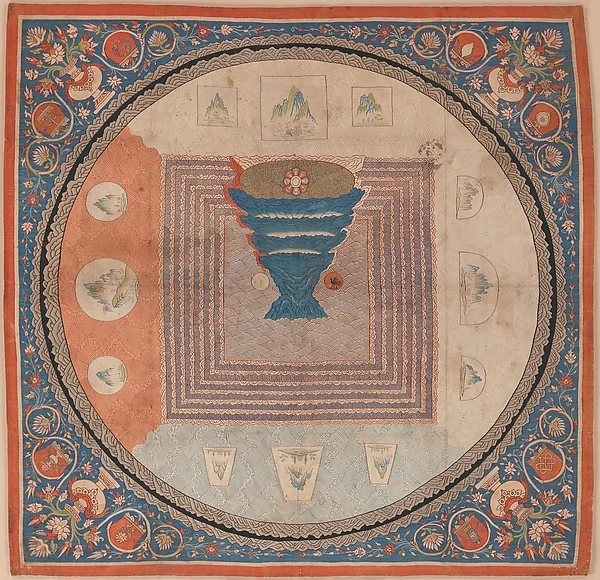
In this fourteenth-century Chinese Buddhist tapestry, the inverted pyramid at the centre is Mount Meru. A lotus crowns it, and four landscapes around it mark the cardinal directions.
Cosmological Mandala with Mount Meru. The Metropolitan Museum of Art. Purchase, Fletcher Fund and Joseph E. Hotung and Michael and Danielle Rosenberg Gifts, 1989. · Image source ↗ · CC0
Watchers of the Seven Spheres by H. K. Challoner
In The Guardian of the Heights, a poem in H. K. Challoner’s Watchers of the Seven Spheres, the mountain appears as an unfolding lotus. Climbing it involves relinquishing passions and desires. The mountain goat gives the poem an image of courage on steep and uncertain ground. [3][4][6][5]
The poem names Meru near the close, as the climber approaches the heart of the lotus and union with divine thought. The closing climb brings the opening image of the lotus back into view. [3][5]
The lotus as map and destination
The Purāṇa uses the lotus to show the relations among parts of a world. Challoner gives the lotus an inward centre toward which the climber moves. [3][4][5][2]
In the library
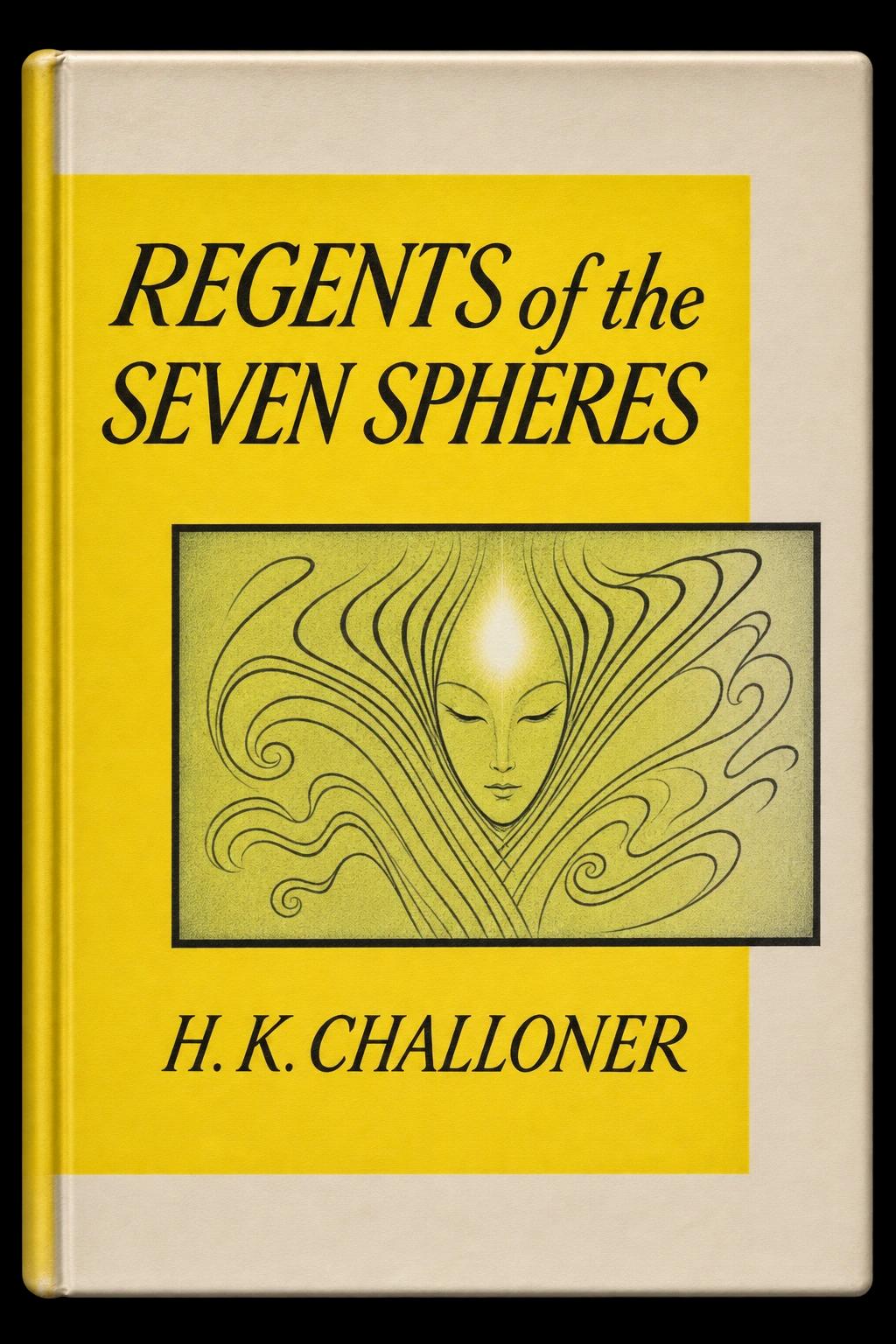
Watchers of the Seven Spheres
Reading note
The separately titled account draws on exact passages in the consulted Library edition.
Sources
See references (6)
- Cosmological Mandala with Mount Meru ↗Cosmological Mandala with Mount Meru. The Metropolitan Museum of Art. Purchase, Fletcher Fund and Joseph E. Hotung and Michael and Danielle Rosenberg Gifts, 1989.
- The Viṣṇu Purāṇa, 2.2.7–17, 30–39 ↗The Viṣṇu Purāṇa, translated by McComas Taylor, ANU Press, book 2, chapter 2, verses 7–17 and 30–39.
- Watchers of the Seven Spheres, Reader page 74H. K. Challoner, Watchers of the Seven Spheres, London, George Routledge & Sons, 1933. Lumitheca Library edition IMJ-0604-E001.Read this page in Watchers of the Seven Spheres ↗
- Watchers of the Seven Spheres, printed p. 77, Reader page 76H. K. Challoner, Watchers of the Seven Spheres, London, George Routledge & Sons, 1933. Lumitheca Library edition IMJ-0604-E001.Read this page in Watchers of the Seven Spheres ↗
- Watchers of the Seven Spheres, printed p. 80, Reader page 79H. K. Challoner, Watchers of the Seven Spheres, London, George Routledge & Sons, 1933. Lumitheca Library edition IMJ-0604-E001.Read this page in Watchers of the Seven Spheres ↗
- Watchers of the Seven Spheres, printed p. 79, Reader page 78H. K. Challoner, Watchers of the Seven Spheres, London, George Routledge & Sons, 1933. Lumitheca Library edition IMJ-0604-E001.Read this page in Watchers of the Seven Spheres ↗