Ritual Identification with a Deity
What does assuming a godform mean? Compare Crowley’s dramatic enactment of Pan and Diana with mental invocation in Magick in Theory and Practice.
In this article
What does it mean to assume a godform?
Ritual identification with a deity means taking on a divine figure’s form or role during a rite. In Western ceremonial magic this can mean imagining the figure inwardly or acting out a part in a sacred story. Aleister Crowley uses both approaches to describe a change in the participant’s awareness. [4][5][1][2]
Magick in Theory and Practice by Aleister Crowley
In chapter XV of Magick in Theory and Practice, Aleister Crowley describes an approach to invocation in which a person shapes what he calls the astral body into a deity’s likeness. He lists assuming the form and using a mantra as distinct ways to engage the mind. [1]
Moonchild by Aleister Crowley
In Aleister Crowley’s Moonchild, Cyril appears in goatskins as Pan in an enactment of the story of Pan and Diana. The narrator says the action is meant to help the participants identify with the figures in thought. Costume and movement have a purpose within the rite. [6][7][8][4][5]
Iliel later sees Artemis approach as a huntress. In the earlier scene Iliel takes part in a story about gods. Here she experiences the goddess as a figure coming towards her. [4][5][9]
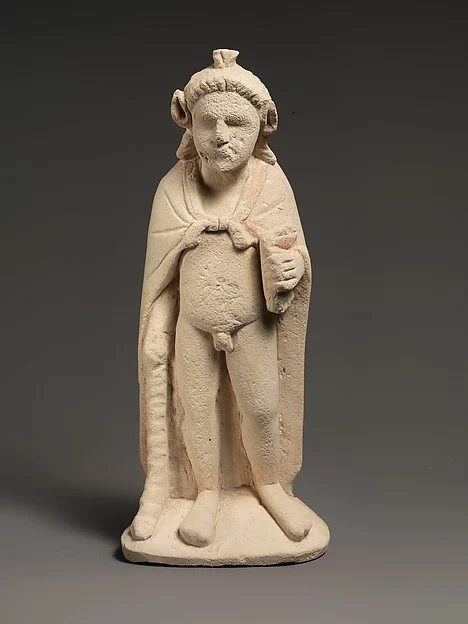
The Met identifies this Cypriot limestone figure as Pan or Opaon Melanthios. It provides historical context for a horned figure that Crowley makes a role in his own dramatic scene.
The Metropolitan Museum of Art. The Cesnola Collection, Purchased by subscription, 1874–76. 74.51.2735. · Image source ↗ · CC0
Taking a role and seeing a figure
Crowley’s manual describes inward assumption of a form. The novel gives readers a dramatic example, then shows another possibility in Iliel’s vision. Both scenes involve a deity, but only the enacted rite explicitly aims at identification. [1][4][5][9]
In the library
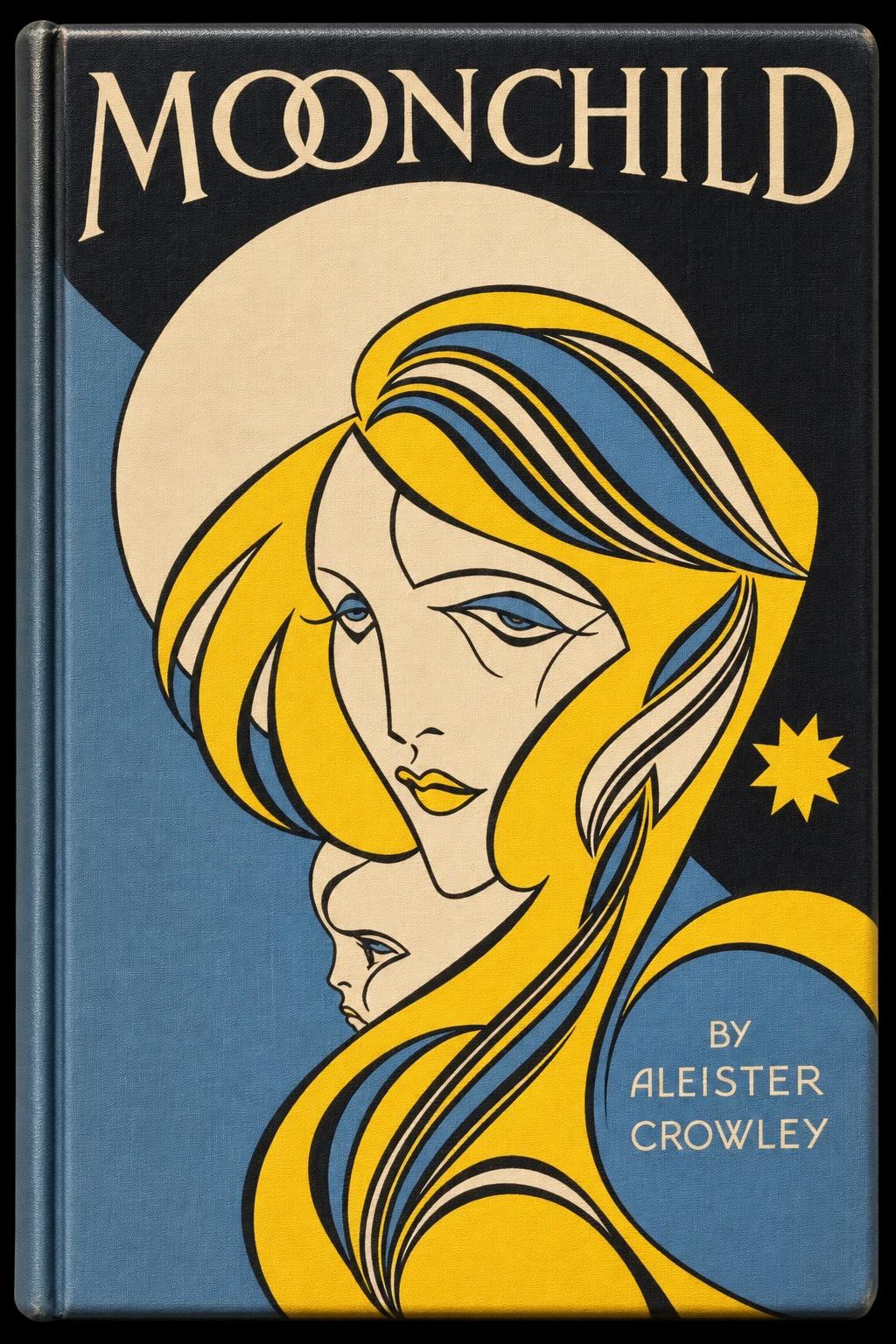
Moonchild
Reading note
The separately titled account draws on exact passages in the consulted Library edition.
Sources
See references (9)
- Magick in Theory and Practice, chapter XV, §II, printed p. 131 ↗Aleister Crowley, Magick in Theory and Practice, Book 4, part III, Paris edition.
- Liber Resh vel Helios, The Equinox I.6, printed pp. 31–32, §§0–7 ↗Aleister Crowley, The Equinox, vol. I, no. 6, London, 1911. The title leaf precedes the text.
- Limestone statuette of Pan or Opaon Melanthios ↗The Metropolitan Museum of Art. The Cesnola Collection, Purchased by subscription, 1874–76. 74.51.2735.
- Moonchild, Reader page 177Aleister Crowley, Moonchild (Liber LXXXI, The Butterfly Net), Library digital transcription IMJ-0629-E001.Read this page in Moonchild ↗
- Moonchild, Reader page 178Aleister Crowley, Moonchild (Liber LXXXI, The Butterfly Net), Library digital transcription IMJ-0629-E001.Read this page in Moonchild ↗
- Moonchild, Reader page 174Aleister Crowley, Moonchild (Liber LXXXI, The Butterfly Net), Library digital transcription IMJ-0629-E001.Read this page in Moonchild ↗
- Moonchild, Reader page 175Aleister Crowley, Moonchild (Liber LXXXI, The Butterfly Net), Library digital transcription IMJ-0629-E001.Read this page in Moonchild ↗
- Moonchild, Reader page 176Aleister Crowley, Moonchild (Liber LXXXI, The Butterfly Net), Library digital transcription IMJ-0629-E001.Read this page in Moonchild ↗
- Moonchild, Reader page 274Aleister Crowley, Moonchild (Liber LXXXI, The Butterfly Net), Library digital transcription IMJ-0629-E001.Read this page in Moonchild ↗