Radiant Lokeśvara: The Khmer Bodhisattva Covered in Buddhas
Radiant Lokeśvara is a Khmer form of Avalokiteśvara whose body bears rows of small sacred figures. Surviving stone and bronze images vary in the placement of these figures and in the details that identify them.
In this article
Why is this form called radiant?
Radiant Lokeśvara is a Khmer form of Avalokiteśvara, the bodhisattva of compassion. Across the surface of the figure are rows of tiny seated figures. On a sculpture that has lost its head and hands, those rows can still identify the type. [2][3][5]
In Alice Getty’s The Gods of Northern Buddhism
Alice Getty describes a stone example from Phnom Dei. She can make out a vajra and bell held by a small figure on the back and proposes Vajrasattva as a possibility. The implements narrow the identification without settling it. [2][3]
Getty separately describes a Padmapāṇi bronze acquired at Darjeeling. Twelve figures emerge from particular points, including the ears, hands and feet. The precise locations matter in that example. In the Khmer torso below, repeated bands are the first detail to catch the eye. [1][2][3]
A body containing worlds in The Basket’s Display
In The Basket’s Display, Avalokiteśvara’s body contains worlds within its pores. Bodhisattvas live in one, and Buddhas teach the six perfections in another. The text offers a parallel for a body that contains many sacred figures. Getty’s individual identifications depend on what can be seen in the stone. [4][2][3]
Reading the Honolulu torso
Two views of the Honolulu torso show how the rows follow the body’s contours. Larger seated figures stand out against the bands of smaller ones. The back and front are both worth looking at because the carver used the full surface. [5][2]
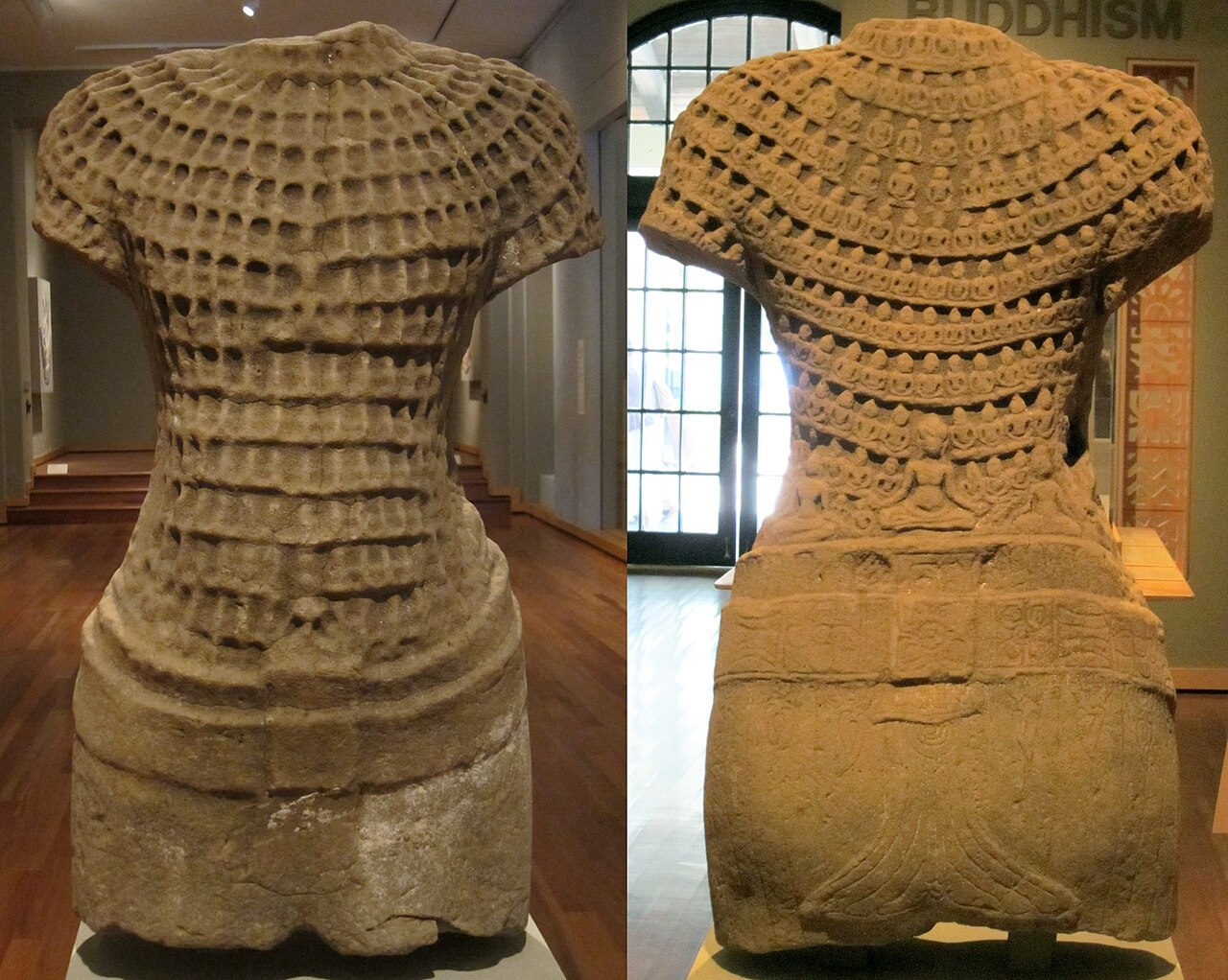
Two views of a Cambodian torso of Radiating Lokeśvara, dated to the 12th–13th century. Much of the figure is lost, but the bands of small images still define the type.
Honolulu Museum of Art, accession 4483.1. Photograph by Hiart, Wikimedia Commons, CC0. · Image source ↗ · CC0
In the library
The Gods of Northern Buddhism
Reading note
Read Alice Getty’s illustrated discussion of Radiant Lokeśvara.
Sources
See references (5)
- The Gods of Northern Buddhism, printed p. 63, Reader page 114Alice Getty, The Gods of Northern Buddhism, 1928 revised second edition, Munshiram Manoharlal reprint. Lumitheca Library edition IMJ-0597-E001.Read this page in The Gods of Northern Buddhism ↗
- The Gods of Northern Buddhism, printed p. 73, Reader page 124Alice Getty, The Gods of Northern Buddhism, 1928 revised second edition, Munshiram Manoharlal reprint. Lumitheca Library edition IMJ-0597-E001.Read this page in The Gods of Northern Buddhism ↗
- The Gods of Northern Buddhism, printed p. 74, Reader page 125Alice Getty, The Gods of Northern Buddhism, 1928 revised second edition, Munshiram Manoharlal reprint. Lumitheca Library edition IMJ-0597-E001.Read this page in The Gods of Northern Buddhism ↗
- The Basket’s Display (Kāraṇḍavyūha), Toh 116, §§2.83–2.86 ↗The Basket’s Display (Kāraṇḍavyūha), Toh 116, §§2.83–2.86. Source credit: Peter Alan Roberts and team, for 84000.
- Torso of Radiating Lokeshvara ↗Honolulu Museum of Art, accession 4483.1. Photograph by Hiart, Wikimedia Commons, CC0.