Pure thought
Pure thought is thinking experienced as an activity in its own right. Read Steiner’s argument and compare Vivekananda’s account of discovering knowledge.
In this article
Understanding the concept
Pure thought is thinking experienced as an activity of its own, apart from the sensations, feelings and impulses that usually accompany it. Rudolf Steiner argues that a person can learn to notice this activity directly. He makes that claim the starting point of his account of spiritual knowledge. [3][4][5]
Thinking and knowledge in Steiner
Knowledge of the Higher Worlds by Rudolf Steiner
Rudolf Steiner’s appendix asks whether every thought is taken from sensation or the inward experiences that depend on the body. He proposes that thinking can be experienced as sustaining itself. He treats that experience as spiritual in its own right. At first, he says, the person is aware only of the activity of thinking itself. [4][5][6][7]
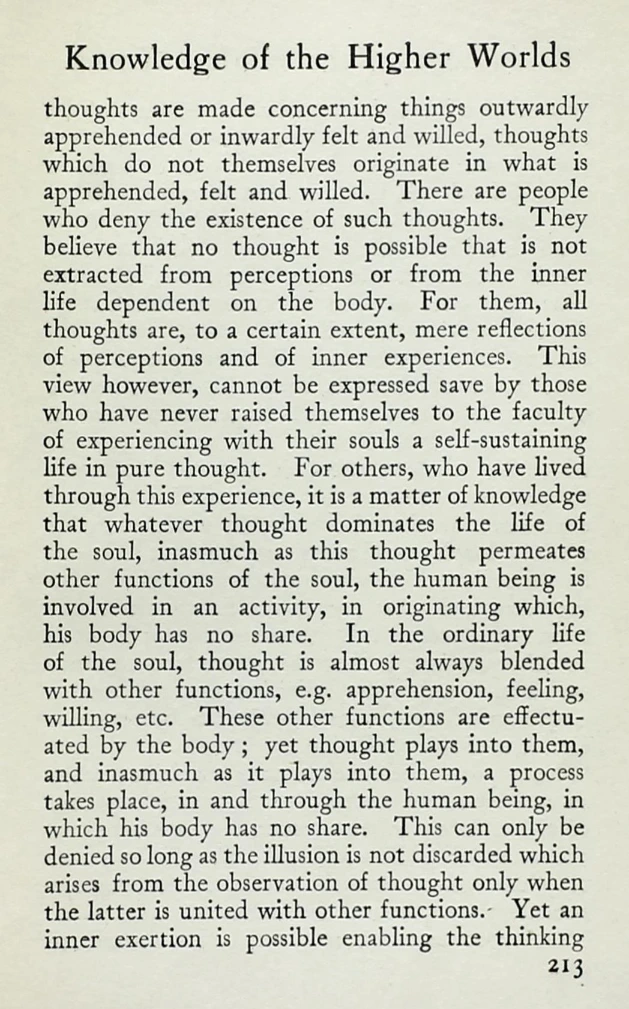
The appendix asks whether thinking can be experienced as an activity in its own right. Knowledge of the Higher Worlds, printed p. 213, Library reader p. 217.
Rudolf Steiner, G. Metaxa translation, edited by Harry Collison. Historical public-domain source facsimile from the exact checksum-verified Library edition. Repository date 1932; the inspected title page is undated. · Image source ↗ · Public Domain
Clarity and concentration
Steiner takes conscious clarity as the criterion for the next step. In his view, spiritual cognition extends the activity and alertness of pure thinking. He calls the visionary and mediumistic states he is discussing more passive and dependent on the body. That is part of his argument for a particular kind of spiritual cognition. [3][8][6][7]
Earlier in the book, the etheric-body chapter gives concentrated thinking a place in practical training. It describes thought held intentionally at one point, independent of sense impressions, and relates it to a proposed centre in the head. The appendix explains why Steiner gives this activity a part in knowing. [9][4][6]
See references (6)
- Knowledge of the Higher Worlds and Its Attainment, Reader page 216
- Knowledge of the Higher Worlds and Its Attainment, Reader page 217
- Knowledge of the Higher Worlds and Its Attainment, Reader page 220
- Knowledge of the Higher Worlds and Its Attainment, Reader page 221
- Knowledge of the Higher Worlds and Its Attainment, Reader page 219
- Knowledge of the Higher Worlds and Its Attainment, Reader page 140
Knowledge within
Karma-Yoga by Swami Vivekananda
Swami Vivekananda says learning uncovers knowledge that was within a person. In his Newton example, the falling apple gives the thinker an occasion to arrange ideas in a new relation and recognize a law. Vivekananda applies the example to both secular and spiritual knowledge. [1][2]
See references (2)
The activity of thinking and the knowledge it yields
Vivekananda’s question is where a discovery comes from, with the apple supplying an occasion for Newton’s thinking. Steiner asks what a person can learn about the activity of thinking by experiencing it directly. The first account uses a discovery to explain what it means to learn. The second asks what it is like to become aware of the thinking itself. [1][2][4][5][6]
Read further in the library

Karma Yoga
Reading note
Separately attributed primary Library account, cited on exact verified Reader leaves.
Knowledge of the Higher Worlds and Its Attainment
Reading note
The separately titled account draws on exact passages in the consulted Library edition.
Sources
See references (9)
- Karma-Yoga, Reader page 6Swami Vivekananda, Karma-Yoga, in Karma-Yoga & Bhakti-Yoga, English second printing, Ramakrishna-Vivekananda Center of New York, Inc., 1939. Exact Library edition IMJ-0097-E002. Only the Karma-Yoga part is used in this crawl; the old Work slug mentioning Hindi does not identify this edition’s language.Read this page in Karma Yoga ↗Return to text ↑
- Karma-Yoga, Reader page 7Swami Vivekananda, Karma-Yoga, in Karma-Yoga & Bhakti-Yoga, English second printing, Ramakrishna-Vivekananda Center of New York, Inc., 1939. Exact Library edition IMJ-0097-E002. Only the Karma-Yoga part is used in this crawl; the old Work slug mentioning Hindi does not identify this edition’s language.Read this page in Karma Yoga ↗Return to text ↑
- Knowledge of the Higher Worlds and Its Attainment, Reader page 216Rudolf Steiner, Knowledge of the Higher Worlds and Its Attainment, authorized English translation by G. Metaxa, edited by Harry Collison, Anthroposophic Press, New York City. Exact Library edition IMJ-0513-E001. No publication year is visible on the inspected title page; the repository assigns 1932. Claims of supersensible perception remain attributed to Steiner.Read this page in Knowledge of the Higher Worlds and Its Attainment ↗Return to text ↑
- Knowledge of the Higher Worlds and Its Attainment, Reader page 217Rudolf Steiner, Knowledge of the Higher Worlds and Its Attainment, authorized English translation by G. Metaxa, edited by Harry Collison, Anthroposophic Press, New York City. Exact Library edition IMJ-0513-E001. No publication year is visible on the inspected title page; the repository assigns 1932. Claims of supersensible perception remain attributed to Steiner.Read this page in Knowledge of the Higher Worlds and Its Attainment ↗Return to text ↑
- Knowledge of the Higher Worlds and Its Attainment, Reader page 218Rudolf Steiner, Knowledge of the Higher Worlds and Its Attainment, authorized English translation by G. Metaxa, edited by Harry Collison, Anthroposophic Press, New York City. Exact Library edition IMJ-0513-E001. No publication year is visible on the inspected title page; the repository assigns 1932. Claims of supersensible perception remain attributed to Steiner.Read this page in Knowledge of the Higher Worlds and Its Attainment ↗Return to text ↑
- Knowledge of the Higher Worlds and Its Attainment, Reader page 220Rudolf Steiner, Knowledge of the Higher Worlds and Its Attainment, authorized English translation by G. Metaxa, edited by Harry Collison, Anthroposophic Press, New York City. Exact Library edition IMJ-0513-E001. No publication year is visible on the inspected title page; the repository assigns 1932. Claims of supersensible perception remain attributed to Steiner.Read this page in Knowledge of the Higher Worlds and Its Attainment ↗Return to text ↑
- Knowledge of the Higher Worlds and Its Attainment, Reader page 221Rudolf Steiner, Knowledge of the Higher Worlds and Its Attainment, authorized English translation by G. Metaxa, edited by Harry Collison, Anthroposophic Press, New York City. Exact Library edition IMJ-0513-E001. No publication year is visible on the inspected title page; the repository assigns 1932. Claims of supersensible perception remain attributed to Steiner.Read this page in Knowledge of the Higher Worlds and Its Attainment ↗Return to text ↑
- Knowledge of the Higher Worlds and Its Attainment, Reader page 219Rudolf Steiner, Knowledge of the Higher Worlds and Its Attainment, authorized English translation by G. Metaxa, edited by Harry Collison, Anthroposophic Press, New York City. Exact Library edition IMJ-0513-E001. No publication year is visible on the inspected title page; the repository assigns 1932. Claims of supersensible perception remain attributed to Steiner.Read this page in Knowledge of the Higher Worlds and Its Attainment ↗Return to text ↑
- Knowledge of the Higher Worlds and Its Attainment, Reader page 140Rudolf Steiner, Knowledge of the Higher Worlds and Its Attainment, authorized English translation by G. Metaxa, edited by Harry Collison, Anthroposophic Press, New York City. Exact Library edition IMJ-0513-E001. No publication year is visible on the inspected title page; the repository assigns 1932. Claims of supersensible perception remain attributed to Steiner.Read this page in Knowledge of the Higher Worlds and Its Attainment ↗Return to text ↑