Pravritti and nivritti
Pravritti and nivritti mean engagement and withdrawal. The Bhagavad Gita asks when to act, while Vivekananda asks what an action serves.
In this article
Understanding the concept
Pravritti and nivritti are Sanskrit terms for turning toward activity and turning away from it. In Hindu thought the pair can help distinguish when to act and when to refrain, or describe a change in what a person seeks through action. [1][2]
When to act in the Bhagavad Gita
In Bhagavad Gita 18.30, Krishna describes a clear, sattvic intellect as one that understands both pravritti and nivritti. Swami Mukundananda glosses the pair as activity and renunciation of action. The verse puts this discernment beside knowing what should be done, what to fear and what binds or liberates a person. [1]
Karma-Yoga by Swami Vivekananda
Swami Vivekananda uses pravritti for the movement of gathering wealth, power or reputation around “I and mine.” Nivritti begins when that movement breaks. He calls both movements kinds of work. A person may remain active while giving up the habit of making every action serve private gain. [2][3]
Vivekananda takes nivritti as far as complete self-abnegation. He argues that the worker, philosopher and devotee can reach that point by different routes. His account also makes room for someone who works for others without belief in God. [3][4]
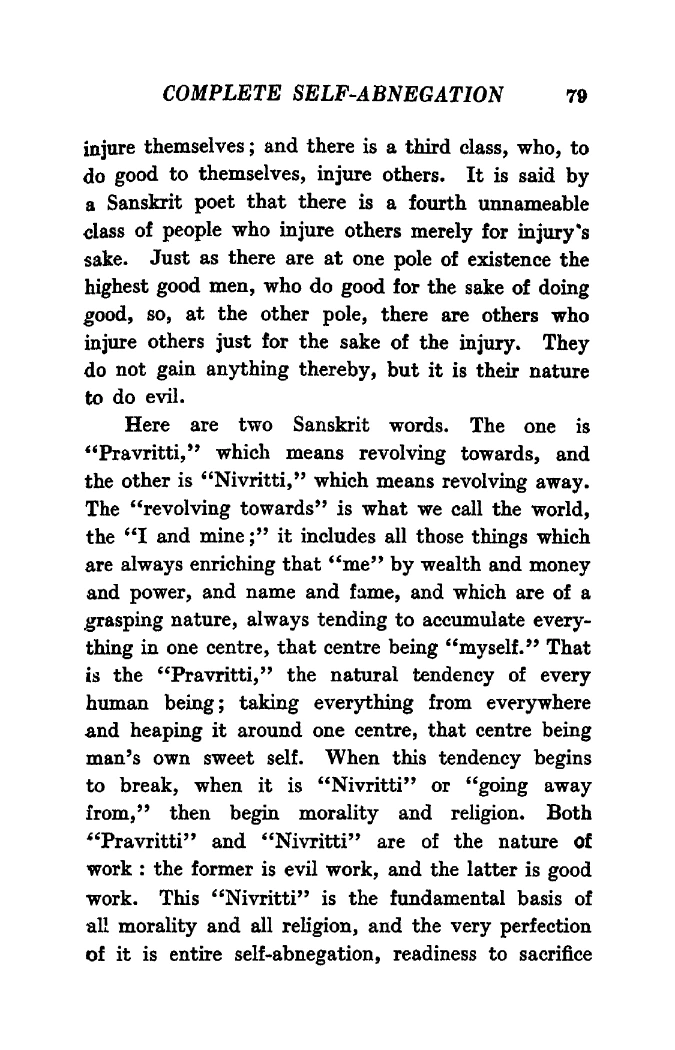
Vivekananda describes pravritti as drawing things to oneself and nivritti as turning away from that habit. Karma-Yoga (1939), printed p. 79, Library reader p. 81.
Swami Vivekananda, Karma-Yoga, English second printing in the 1939 combined volume. Historical public-domain text, exact checksum-verified Library scan. · Image source ↗ · Public Domain
What an action serves
The Gita asks whether a person can discern the occasion for action or restraint. Vivekananda asks in whose interest the action is done. Giving time or wealth away, for instance, can express nivritti in his sense precisely because it reverses the movement of gathering things to oneself. [1][2][3]
Read further in the library
Karma Yoga
Reading note
The separately titled account draws on exact passages in the consulted Library edition.
Sources
See references (4)
- Bhagavad Gita 18.30, translated by Swami Mukundananda ↗Bhagavad Gita 18.30, Sanskrit and word meanings, with Swami Mukundananda’s English translation. The site glosses pravritti as activities and nivritti as renunciation from action.Return to text ↑
- Karma-Yoga, printed p. 79, Reader page 81Swami Vivekananda, Karma-Yoga, in Karma-Yoga & Bhakti-Yoga, English second printing, Ramakrishna-Vivekananda Center of New York, Inc., 1939. Exact Library edition IMJ-0097-E002. Only the Karma-Yoga part is used in this crawl; the old Work slug mentioning Hindi does not identify this edition’s language.Read this page in Karma Yoga ↗Return to text ↑
- Karma-Yoga, Reader page 82Swami Vivekananda, Karma-Yoga, in Karma-Yoga & Bhakti-Yoga, English second printing, Ramakrishna-Vivekananda Center of New York, Inc., 1939. Exact Library edition IMJ-0097-E002. Only the Karma-Yoga part is used in this crawl; the old Work slug mentioning Hindi does not identify this edition’s language.Read this page in Karma Yoga ↗Return to text ↑
- Karma-Yoga, Reader page 83Swami Vivekananda, Karma-Yoga, in Karma-Yoga & Bhakti-Yoga, English second printing, Ramakrishna-Vivekananda Center of New York, Inc., 1939. Exact Library edition IMJ-0097-E002. Only the Karma-Yoga part is used in this crawl; the old Work slug mentioning Hindi does not identify this edition’s language.Read this page in Karma Yoga ↗Return to text ↑