Planetary Hours: The Traditional System and Abra-Melin’s Objection
How do planetary hours work, and why does Abra-Melin question them? Compare the sunrise-to-sunset calculation, Abraham’s argument, and Mathers’s reply.
In this article
How daylight and darkness make hours of different lengths
Planetary hours assign stretches of the day and night to the seven classical planets, counting the Sun and Moon among them. A common method divides daylight into twelve parts and darkness into another twelve. With ten hours of daylight, each daytime part lasts fifty minutes and each nighttime part seventy. [2][3][1]
The Book of the Sacred Magic of Abra-Melin the Mage, translated by S. L. MacGregor Mathers
In the Book of Abramelin, as translated by S. L. MacGregor Mathers, Abraham points out that a planet can be absent from the visible sky when a timetable gives it power. He proposes that a planet is strongest on the local meridian and limits that influence to natural effects. [4][5][2][3][6]
Mathers describes Abraham’s objections as worth attention. He also says he found the usual hour assignments effective to an extent. The translator and narrator give the table different weight within the same edition. [7][5][6]
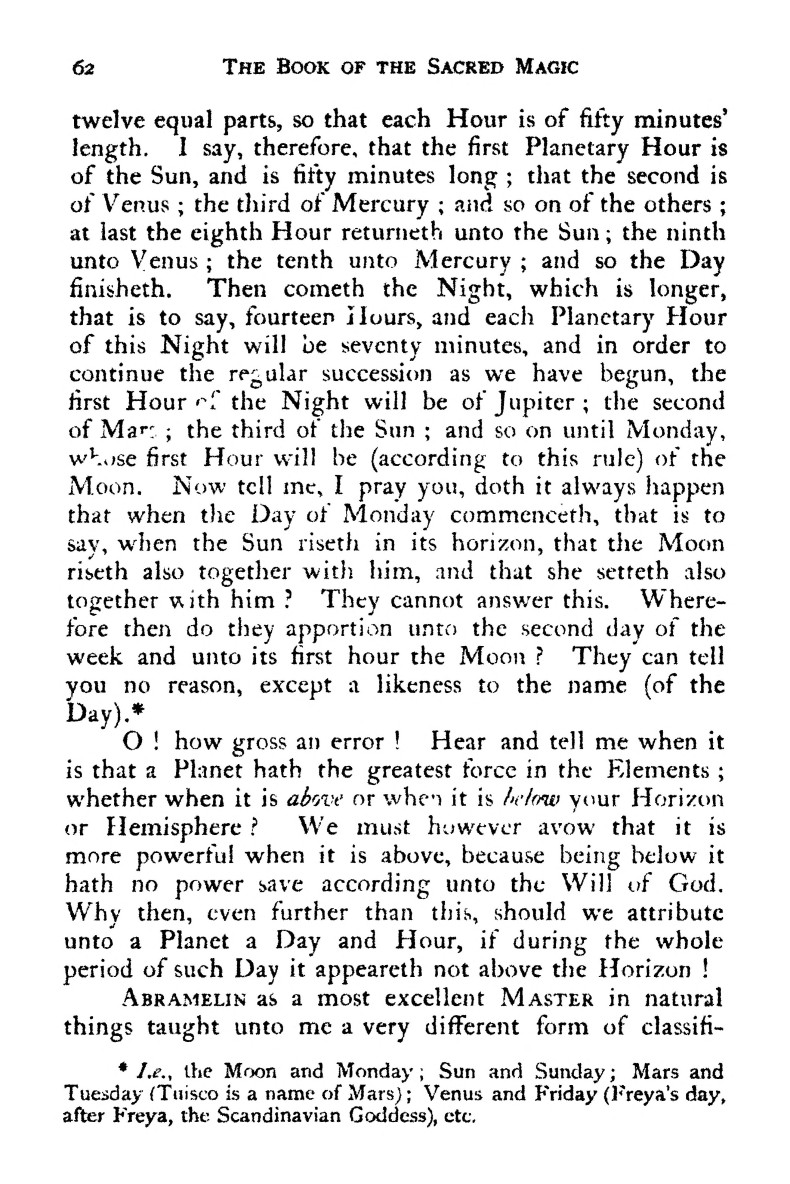
On printed page 62, Abraham gives an example with unequal daylight and nighttime hours and asks whether the assigned planet is above the horizon.
S. L. MacGregor Mathers, The Book of the Sacred Magic of Abra-Melin the Mage (1898), printed p. 62. Salar Jung Museum via Internet Archive. · Image source ↗ · Public Domain
See references (6)
- The Book of the Sacred Magic of Abra-Melin the Mage, printed p. 61, Reader page 99
- The Book of the Sacred Magic of Abra-Melin the Mage, printed p. 62, Reader page 100
- The Book of the Sacred Magic of Abra-Melin the Mage, printed p. 57, Reader page 95
- The Book of the Sacred Magic of Abra-Melin the Mage, printed p. 60, Reader page 98
- The Book of the Sacred Magic of Abra-Melin the Mage, printed p. 63, Reader page 101
- The Book of the Sacred Magic of Abra-Melin the Mage, Reader page 37
Three Books of Occult Philosophy by Heinrich Cornelius Agrippa
In Three Books of Occult Philosophy, Heinrich Cornelius Agrippa describes the usual division into twelve hours of light and twelve of darkness, beginning the day with its ruling planet. He also records a calculation that depends on which segments of the ecliptic are rising. [1]
A timetable and the planet’s position
Agrippa describes more than one way of setting an hour. Abraham asks whether the planet’s actual position in the sky is a better guide. His larger question is how much authority any such computation should have over spiritual practice. [5][2][3][6][1]
See references (5)
- Three Books of Occult Philosophy, Book II, chapter 34
- The Book of the Sacred Magic of Abra-Melin the Mage, printed p. 61, Reader page 99
- The Book of the Sacred Magic of Abra-Melin the Mage, printed p. 62, Reader page 100
- The Book of the Sacred Magic of Abra-Melin the Mage, printed p. 60, Reader page 98
- The Book of the Sacred Magic of Abra-Melin the Mage, printed p. 63, Reader page 101
In the library
The Book of the Sacred Magic of Abra-Melin the Mage
Reading note
The separately titled account draws on exact passages in the consulted Library edition.
Sources
See references (7)
- Three Books of Occult Philosophy, Book II, chapter 34 ↗Heinrich Cornelius Agrippa, Three Books of Occult Philosophy, Book II, chapter XXXIV, English translation of 1651, transcribed by Joseph H. Peterson.
- The Book of the Sacred Magic of Abra-Melin the Mage, printed p. 61, Reader page 99The Book of the Sacred Magic of Abra-Melin the Mage, translated by S. L. MacGregor Mathers. London, John M. Watkins, 1898. Lumitheca Library edition IMJ-0601-E001.Read this page in The Book of the Sacred Magic of Abra-Melin the Mage ↗
- The Book of the Sacred Magic of Abra-Melin the Mage, printed p. 62, Reader page 100The Book of the Sacred Magic of Abra-Melin the Mage, translated by S. L. MacGregor Mathers. London, John M. Watkins, 1898. Lumitheca Library edition IMJ-0601-E001.Read this page in The Book of the Sacred Magic of Abra-Melin the Mage ↗
- The Book of the Sacred Magic of Abra-Melin the Mage, printed p. 57, Reader page 95The Book of the Sacred Magic of Abra-Melin the Mage, translated by S. L. MacGregor Mathers. London, John M. Watkins, 1898. Lumitheca Library edition IMJ-0601-E001.Read this page in The Book of the Sacred Magic of Abra-Melin the Mage ↗
- The Book of the Sacred Magic of Abra-Melin the Mage, printed p. 60, Reader page 98The Book of the Sacred Magic of Abra-Melin the Mage, translated by S. L. MacGregor Mathers. London, John M. Watkins, 1898. Lumitheca Library edition IMJ-0601-E001.Read this page in The Book of the Sacred Magic of Abra-Melin the Mage ↗
- The Book of the Sacred Magic of Abra-Melin the Mage, printed p. 63, Reader page 101The Book of the Sacred Magic of Abra-Melin the Mage, translated by S. L. MacGregor Mathers. London, John M. Watkins, 1898. Lumitheca Library edition IMJ-0601-E001.Read this page in The Book of the Sacred Magic of Abra-Melin the Mage ↗
- The Book of the Sacred Magic of Abra-Melin the Mage, Reader page 37The Book of the Sacred Magic of Abra-Melin the Mage, translated by S. L. MacGregor Mathers. London, John M. Watkins, 1898. Lumitheca Library edition IMJ-0601-E001.Read this page in The Book of the Sacred Magic of Abra-Melin the Mage ↗